
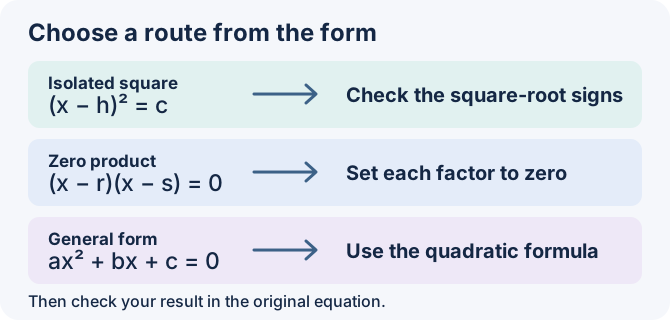
Compare isolated squares, zero products, completing the square, and the quadratic formula. Use the original equation to check a solution.
Start by deciding what you need to find
A quadratic can tell you where a curve crosses the horizontal axis, which input gives the lowest output, or whether two expressions ever agree. Those tasks do not all call for solving the same equation. If you need an x-intercept, set the output to zero and solve for x. If you need the minimum of an upward-opening curve already written as a squared expression plus a constant, the square can show that minimum directly. Write down the unknown before rearranging the expression so that the form you choose serves your actual question.
Once the task is an equation, look at the form on the page. An isolated square suggests looking at its two possible signs. A factored product equal to zero gives a direct route to its solutions. An expanded expression may factor cleanly, or it may need completing the square or the quadratic formula. Several methods can solve the same equation. The aim is to pick a short path whose conditions you can check.
Isolate an existing square and keep both signs
Consider 3(x − 1)² = 27. Divide both sides by 3 to isolate the square, so (x − 1)² = 9. The quantity x − 1 can be 3 or −3. Adding one to each branch gives 4 and −2. The negative branch is just as real as the positive branch because the square loses its sign. Substitute both values into the original expression to verify that multiplying the square by 3 returns 27.
The same strategy exposes special cases. If the isolated square equals zero, its inside must equal zero, so the two signs give one value. If the square equals a negative number, there are no real values that satisfy it. Before using the quadratic formula on an equation that already has a square, check whether these observations answer the question directly.
Use factors after the equation is ready
For (x + 5)(x − 1) = 0, a zero product requires a zero factor. Solve x + 5 = 0 or x − 1 = 0 to get −5 or 1. Substitution gives zero in the original product. Now change the equation so that the product equals twelve. Setting either factor to zero would give the wrong output. Move the twelve to the left after expanding, then decide whether the new quadratic factors or needs a different method.
Expanded equations that factor over the integers can often be checked quickly. For a monic quadratic x² + bx + c, look for two integers whose sum is b and whose product is c. Multiply the chosen factors to verify both the middle and the constant terms. A failed search does not prove that a real solution is absent. It tells you to use a method that does not depend on finding integer factors.
Use a general method when factors are awkward
For 2x² + 3x − 1 = 0, the coefficients are a = 2, b = 3, and c = −1. The expression under the square root in the quadratic formula is b² − 4ac. Here it is 9 + 8 = 17. Apply the formula as one quotient with the entire numerator over 2a. The solutions are (−3 + √17)/4 and (−3 − √17)/4. Keeping the minus sign on c and the whole denominator under both numerator terms prevents two common algebra errors.
If the equation is monic and the middle coefficient is even, completing the square can be shorter. For x² + 10x + 13 = 0, move 13 to the right, then add 25 to both sides. The equation becomes (x + 5)² = 12. Its real roots are −5 + 2√3 and −5 − 2√3. This method creates the isolated-square form you already know how to solve.
Check that your answer fits the original task
For y = (x − 2)² + 3, the smallest output is three at input two. The graph stays above the horizontal axis, so it has no real x-intercepts. A graph can help you predict the number of real roots before you calculate. Check the solution set by substituting into the original equation, especially after moving terms or using a signed branch. Then answer with the requested quantity. A coordinate pair, an input value, and the lowest output describe different features.
Apply the guide
Solve (w + 6)² = 16 over the real numbers. Which equation form makes the two solutions visible?Reveal explanation
The square is already isolated, so w + 6 is 4 or −4. Subtract 6 in each branch to get w = −2 or w = −10. Both values make the square equal 16.
Solve r² − 8r + 11 = 0 by completing the square. What value must you add to both sides?Reveal explanation
Move 11 to the right and add 16 to both sides. The result is (r − 4)² = 5. The real roots are 4 + √5 and 4 − √5.
Turn the idea into practice.
Apply the rule to a new case, then explain your choice.
Practice this skillSources & authorship
Official scope and mathematical methods are linked for reference. Examples and illustrations are original.
Original OpenExam teaching and fictional practice situations.
Independent educator review is pending. This guide is not an official exam paper or a video transcript.
College Board ACCUPLACER Math test contentOpenStax Intermediate Algebra 2e