
Learn how to compare unit prices, measure growth against its starting value, and identify when a fixed charge breaks proportional scaling.
Start with the question and its reference unit
A total can sound decisive even when it answers a different question from the one you need to solve. A larger package can cost more overall and still cost less for each item. A larger gain in people can be a smaller gain in percentage terms when the starting group is larger. Put the units into a short sentence before you calculate. Write “dollars for one meter” for a price comparison and “added members per starting member” for relative growth. The sentence tells you which quantity belongs in the denominator and what the result means.
Try reading a quotient in both directions. When you divide price by length, the answer tells you how much each unit of length costs. When you divide length by price, the answer tells you how much length a dollar buys. Both quotients may be useful. In a single comparison, use one consistent direction so you interpret larger and smaller values correctly.
Bring different amounts to a common unit
A theater uses two types of tape with equal width and quality. One roll offers 14 meters for $8.40 and the other offers 18 meters for $10.26. The first rate is $0.60 per meter and the second is $0.57 per meter. The 18-meter roll costs more at the register, but each meter costs three cents less. If the question asks which roll gives a lower price for one meter, compare those rates. If you need exactly fourteen meters and cannot buy partial rolls, the package totals and the amount of unused material also matter.
An equivalent way to compare rates is to project both rates onto the same hypothetical amount. At 100 meters, the rates correspond to $60 and $57. This projection is a mathematical comparison. It only represents an actual purchase when those prices extend to the quantity you plan to buy.
Anchor a percent change to its starting point
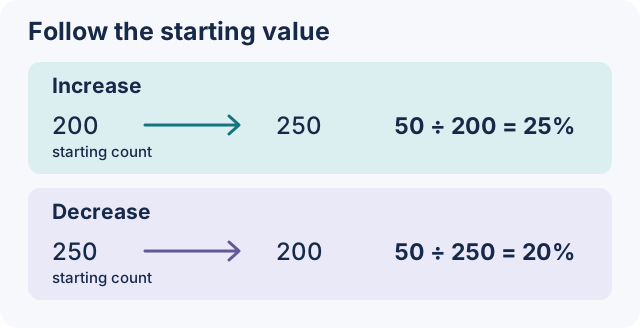
Consider a neighborhood workshop that grows from 200 to 250 members. It gains 50 members. Using 200 as the reference, 50/200 equals one quarter, so the increase is 25%. If it later falls from 250 back to 200, the decrease has the same size in members. This time 50/250 equals one fifth, so the decrease is 20%. The diagram shows why reversing the journey changes the denominator.
A second useful calculation is the ratio of the ending value to the starting value. For the first journey that ratio is 250/200 = 1.25. In percent form, the ending value is 125% of the starting value, and the increase is the extra 25%. You can check either method by applying the resulting multiplier to the stated starting count. A percent-change calculation using zero as its starting value is undefined because its denominator would be zero.
Distinguish equal percents from equal changes
Suppose two volunteer groups grow by 10%. A group of 40 gains 4 volunteers, while a group of 90 gains 9. Each gain reflects one tenth of its own starting size. If a question asks which gain was larger in volunteers, compare 4 and 9. If it asks which grew faster relative to its starting size, the percentage changes are equal.
The base also changes when you apply successive percents to a single quantity. Start with 80 tickets, increase the number by 10%, and then decrease the new number by 10%. The first step gives 88. The second keeps 90% of 88, which is 79.2 in an arithmetic model. For indivisible tickets, any rounding rule would need to be stated. The calculation shows that the two 10% changes use different bases, so they do not undo each other.
Check for a fixed fee before scaling
Imagine a printer that charges $9 once per order plus $0.40 for each poster. One order of ten posters costs $13. One order of twenty costs $17. Doubling the number of posters doubles the variable portion, from $4 to $8, while the setup fee remains $9. The total would reach $26 if you placed two separate ten-poster orders and paid the setup fee twice.
When you compare quotes, ask whether the price is proportional to the requested amount. A proportional price keeps the price per unit constant and gives zero cost when the quantity is zero. A fixed charge keeps the price per additional item constant while the average price per item changes. Mark the fixed and variable parts before you compare alternatives.
Review the reasoning you used
After a practice answer, state the reference quantity aloud. If your unit price is upside down, rewrite the quotient with its units and choose the direction required by the question. If you gave an absolute change when a percent was requested, divide the change by the starting value. If a rate comparison depends on a setup charge, work out the actual total for the requested amount. Use the two checks below to decide which comparison is appropriate before computing.
Apply the guide
A store charges $7.20 for 15 meters of cord and $10.80 for 24 meters of comparable cord. Which pack costs less per meter?Reveal explanation
The 15-meter pack costs $7.20 ÷ 15 = $0.48 per meter. The 24-meter pack costs $10.80 ÷ 24 = $0.45 per meter, so it has the lower unit price.
A group shrinks from 140 to 112 members and later returns to 140. Find the percent decrease and the percent increase.Reveal explanation
The decrease is 28/140 = 20%. The increase is 28/112 = 25%. Start each calculation with the size of the group at the beginning of that change.
Turn the idea into practice.
Apply the rule to a new case, then explain your choice.
Practice this skillSources & authorship
Official scope and mathematical methods are linked for reference. Examples and illustrations are original.
Original OpenExam teaching and fictional practice situations.
Independent educator review is pending. This guide is not an official exam paper or a video transcript.
College Board ACCUPLACER Math test contentOpenStax Prealgebra 2eOpenStax Elementary Algebra 2e