
A reliable method
Mark the perpendicular height. For composite shapes, identify pieces with nonoverlapping interiors and calculate each area before combining.
The common trap
A slanted side is not automatically a height. Similar lengths scale by k, but areas scale by k² and volumes by k³.
Make the connection
For a sector, first determine its fraction of the full circle. When the question requests the coefficient of π, keep π symbolic rather than approximating it.
Worked example: choose the requested quantity
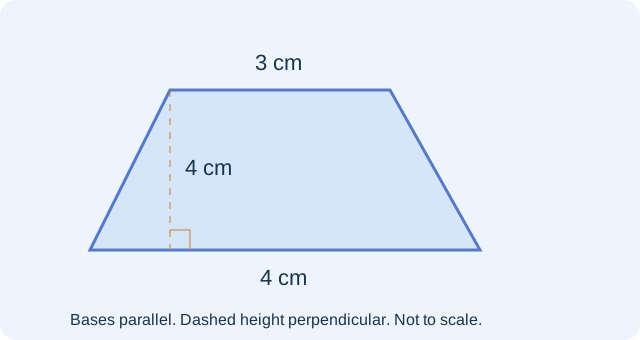
Use the dimensions in the trapezoid diagram. What is its area in square centimeters? Trapezoid has parallel bases 3 cm and 4 cm, perpendicular height 4 cm. Average the two parallel base lengths. Multiply this average by the perpendicular height. The requested value is 14.
Contrast and diagnose an error
A right prism has a triangular base of base length 3 cm and perpendicular height 6 cm. The prism is 4 cm long. What is its volume? The area of the triangular base is half its base times its height. Multiply that base area by the prism length. The requested value is 36. A tempting answer is 12: Use base × prism length, dropping both the perpendicular height and the triangular one-half factor.
Transfer practice and check
What is the sum, in degrees, of the interior angles of a convex 4-sided polygon? Try it before reading on. Check: 360. Draw diagonals from a single vertex to split the polygon into triangles. There are two fewer triangles than polygon sides, each contributing 180 degrees.
Use the dimensions in the trapezoid diagram. What is its area in square centimeters?
 Open full-size diagram ↗
- Average the two parallel base lengths.
- Multiply this average by the perpendicular height.
- The requested value is 14.
Compare the other answer choices
Use only the shorter base.
Use the mistaken area model base1 × base2 × height / 2, treating both parallel bases as multiplicative dimensions.
Omit the one-half in the trapezoid area formula.
Try it, then explain it.
Complete a short set without looking at the example. After each answer, explain which operation preserved the relationship and why the result makes sense.
Sources & authorship
Original Slope explanations and examples. References support the concepts; they are not the source of copied questions. Independent educator review is pending.
ACT Mathematics content