
The video introduces an accumulation function with a variable upper endpoint, assumes a continuous integrand, and connects its derivative to the original function. Its final example demonstrates applying the theorem without explicitly integrating. This companion uses independent examples to study units, signs and written justification.
Begin with two different questions
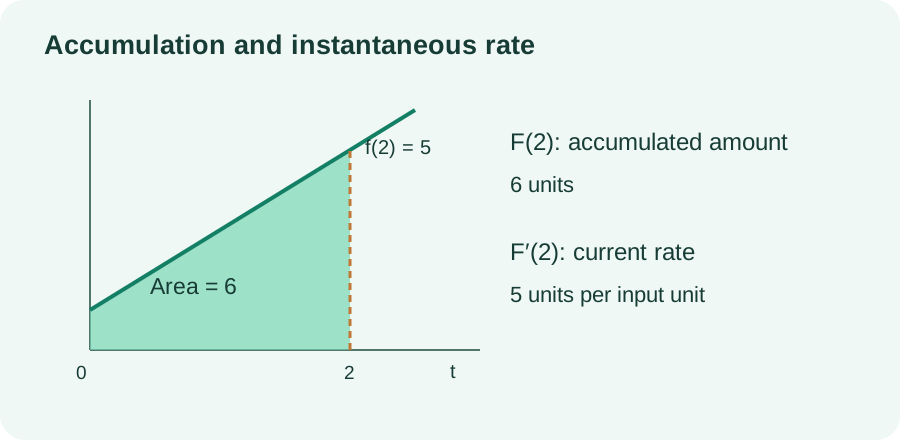
Imagine that a tank receives water at a rate f(t)=2t+1 liters per minute, starting at time zero. Asking how much water has entered by minute two is a different question from asking how quickly water is entering at minute two. The first concerns an accumulation over an interval. The second concerns a rate at one instant. Both are meaningful numbers, and confusing them can lead to an answer that looks reasonable while answering the wrong question.
In this original example, let F(x) mean the water added between time zero and time x. The notation F(x)=∫₀ˣ(2t+1)dt makes the roles visible: t is a temporary variable used inside the integral, while x controls where accumulation stops. The starting level of water is not part of F unless we add that initial amount separately. This distinction is useful in AP questions about reservoirs, populations, motion and accumulated cost.
Calculate the amount, then identify the rate
An antiderivative of 2t+1 is t²+t. Evaluate it at the two bounds to obtain F(x)=x²+x. Thus F(2)=6 liters. The rate at the endpoint is f(2)=5 liters per minute. The shaded trapezoid in the illustration represents the six liters, while its right-hand height represents five liters per minute. Units provide an immediate check: an area under a rate-versus-time graph has units of rate multiplied by time.
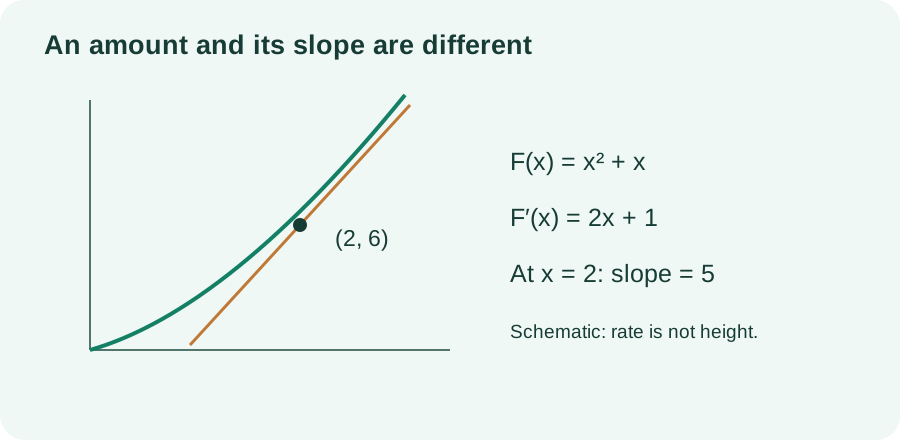
Differentiate the accumulated amount and the relationship becomes explicit: F′(x)=2x+1=f(x). This is the fundamental theorem at work for a continuous rate. You can obtain the derivative without first writing down the antiderivative. For this simple polynomial, doing both calculations gives a useful independent check, but more complicated integrands may make direct integration unnecessary or inconvenient.
Why a thin strip explains the theorem
Increase the stopping time from x to x+h. The added amount is the integral over that short interval. Dividing that addition by h gives its average rate. When the rate is continuous, values of f over a sufficiently short interval remain close to f(x). The average therefore approaches the endpoint rate as h approaches zero. This is a local argument about a narrow strip, rather than a claim that all areas are rectangles.
The continuity hypothesis deserves attention. Before applying the basic theorem, identify an interval on which the integrand is continuous and ensure the requested point lies within the relevant interior. A diagram with a jump may require a separate one-sided analysis. Writing “by the fundamental theorem” is stronger when it is accompanied by a correct statement of why the theorem applies.
Read signs as changes in an accumulated quantity
A positive integrand means the accumulated function is increasing; a negative integrand means it is decreasing. The accumulated function itself may still be positive when its derivative is negative. For example, an account can retain a positive balance while money is being withdrawn. Sign questions about the function and sign questions about its derivative must be kept separate.
If the input is time and the integrand is signed velocity, an integral gives displacement. Total distance instead accumulates speed, the absolute value of velocity. A negative contribution can cancel a positive contribution in displacement, while both contribute positively to distance. When a graph crosses the axis, split the interval before deciding whether the task asks for a signed integral or a geometric area.
Turn the relationship into an AP explanation
Use a three-part response: name the accumulated quantity, state the derivative relationship under its hypothesis, and interpret the value with units. In the tank example, “At minute two, the amount of water added is increasing at five liters per minute” explains what F′(2) means. Merely saying “the answer is five” leaves the quantity and units unstated.
Now change the constant starting time from zero to one. The amount accumulated by x changes because an initial portion is removed, but the instantaneous derivative remains 2x+1. Changing a fixed lower bound shifts the accumulation function by a constant. The tangent illustration shows why a vertical shift can change the height while leaving the slope unchanged. This observation does not apply unchanged when the lower bound itself depends on x.
Check your understanding before practising
For an independent check, define A(x)=∫₀ˣ(3t²+2)dt. At x=2, the accumulated amount is 12, whereas A′(2)=14. Explain the difference without treating either number as a mistake. Next decide whether A is increasing near two and justify the answer from the sign of its derivative. Finally, add an initial amount of seven and explain which result changes.
The answers are: A is increasing because its derivative is positive; adding seven changes the amount to nineteen but leaves the derivative fourteen. These checks are deliberately smaller than a formal AP free-response problem. Use the practice set for fluency, then write full solutions to official multi-part questions and compare them with official scoring guidance.
PAUSE & TRYFor A(x)=∫₀ˣ(3t²+2)dt, find A(2) and A′(2). What changes if the initial amount is seven?Reveal explanation
A(2)=12 and A′(2)=14. Adding an initial seven gives an amount of 19; the rate remains 14. Accumulated amount and instantaneous rate have different units.
Turn the idea into practice.
A fresh set will help you use the relationship with different numbers.
Practice this skillEvidence & editorial note
Actual English automatic captions were acquired and read. Mathematical notation can be imperfect in captions; the examples here are independently authored and checked. Figures are original diagrams, not video frames. No full audiovisual listening review or independent educator review has been completed. These calculus videos were acquired specifically for this pack, not reused from SAT.
Caption track SHA-256: 6b61c4d6203ddcff224961f8209571cc7b055ca2cde7792b6e782f8bb49664bc
Source segment references are retained in the catalog. Full captions remain in the local research archive.