
The video states continuity and differentiability conditions, illustrates average change as a secant slope, and explains the existence of an interior tangent with that slope. Its sketch allows several matching points. The counterexample, bounds and Rolle applications here are original extensions.
Separate an average from an instantaneous rate
A secant slope describes change over an interval. A tangent slope describes local change at one input. The Mean Value Theorem connects these different quantities under specific conditions: the function is continuous on a closed interval and differentiable on its interior. The conclusion is that at least one interior derivative equals the secant slope. It is an existence guarantee, not a claim that the two quantities are identical at every point.
The linked Khan Academy video introduces those interval conditions, explains the secant-and-tangent picture, and translates the picture into mathematical notation. Its sketch allows more than one tangent to match the secant. The examples in this companion use independently chosen functions and data to test the guarantee, its limitations and its use in bounding changes. They extend the source’s introductory explanation rather than reproduce its presentation.
Calculate a match and explain why it exists
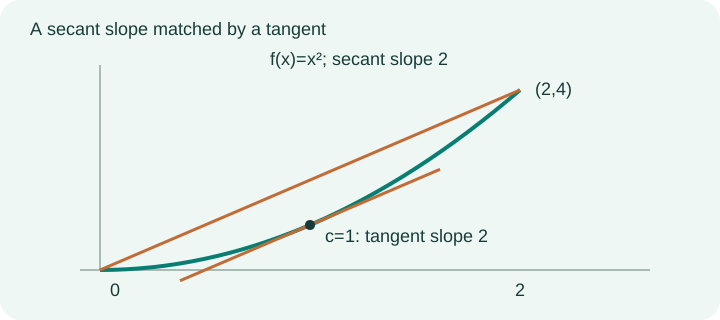
Take f(x)=x² on [0,2]. The secant slope is [f(2)−f(0)]/(2−0)=4/2=2. The derivative is f′(x)=2x, so solving f′(c)=2 gives c=1. This value lies in the required open interval. Because a polynomial is continuous and differentiable everywhere, the theorem’s conditions are satisfied before we solve the equation.
The diagram shows the chord between (0,0) and (2,4), together with the tangent at (1,1). Their slopes agree, but their vertical positions differ. A tangent need not coincide with the secant; matching direction is enough. The horizontal scale and vertical scale differ in the illustration, so rely on the labeled coordinates and equations for exact numerical slope calculations.
A corner explains why a hypothesis matters
Now consider g(x)=|x| on [−1,1]. The endpoint outputs are both one, so the secant slope is zero. The graph is continuous, but it is not differentiable at zero. Where the derivative exists, it equals −1 on the left and 1 on the right; there is no interior point with derivative zero. This is a concrete example of a missing hypothesis preventing the expected guarantee.
Do not reverse the logic. A failed hypothesis does not prove that a matching tangent is impossible for every such function; it means this theorem does not establish one. For a different function, a match could occur accidentally or follow from another argument. In a written explanation, distinguish “the theorem does not apply” from the stronger statement “no such point exists.” The latter needs additional evidence, as the explicit derivative calculation supplies for |x|.
Use derivative bounds without knowing the whole function
Suppose a differentiable temperature function has T(0)=10 and −2≤T′(t)≤3 for 0<t<4, with continuity on [0,4]. The Mean Value Theorem gives T(4)−T(0)=4T′(c) for some interior c. Therefore −8≤T(4)−10≤12, giving 2≤T(4)≤22. We have bounded the final temperature without finding an explicit formula for T.
The lower and upper bounds are attainable: the affine functions 10−2t and 10+3t satisfy the assumptions and reach the corresponding endpoints. This matters when a question asks for the smallest possible value rather than merely a safe lower estimate. The interval length multiplies the derivative bound, and the initial value must then be added. Omitting either step answers a different question about rate or change.
Rolle’s theorem counts gaps, not just roots
Rolle’s theorem adds equal endpoint values to the same continuity and differentiability conditions. The secant slope becomes zero, so an interior derivative must vanish. If a polynomial has four distinct real roots, order them as r₁<r₂<r₃<r₄. Each adjacent interval has equal zero endpoint outputs, and each supplies a derivative root in its interior.
Those three open intervals do not overlap, so the resulting derivative roots are distinct. The conclusion is at least three roots, not exactly three. A polynomial of higher degree may have more stationary points. This argument is useful because it builds a global conclusion from several local applications, while avoiding the false assertion that each root of the original function is automatically a root of its derivative.
Turn the guarantee into a careful response
Use a consistent sequence: identify the closed interval, verify continuity and interior differentiability, compute the average rate, and state the existence conclusion with an interior location. If the formula allows it, solve the derivative equation and check that its solutions lie inside the interval. If only bounds are supplied, explain the inequality that follows instead of inventing an explicit function.
For a final transfer, let H(1)=7, let 2≤H′(x)≤5 on (1,4), and assume the theorem’s interval conditions. The interval length is three, so 13≤H(4)≤22. A derivative bound controls accumulated change through the interval length; it does not directly bound the output by two and five. These practice explanations are original self-assessment guidance, and they do not constitute an official AP free-response scoring rubric.
PAUSE & TRYUnder the stated hypotheses, H(1)=7 and 2≤H′≤5 on (1,4). Bound H(4) and identify the role of interval length.Reveal explanation
Multiply derivative bounds by 4−1=3 to bound the change between 6 and 15. Add H(1)=7: 13≤H(4)≤22.
Turn the idea into practice.
A fresh set will help you use the relationship with different numbers.
Practice this skillEvidence & editorial note
Actual English automatic captions acquired and all segments read. Synopsis and time navigation are source-grounded; all worked examples, diagrams and exercises are independently authored. Caption notation may be imperfect; no uncertain source equation is reconstructed. Full audiovisual and independent educator review remain pending.
Caption track SHA-256: 2838b7d860860042261f958c748e3398f8e48f520c0ef14e2dda306c14209208
Source segment references are retained in the catalog. Full captions remain in the local research archive.