
Conditions before computation
A critical input is an interior point in the domain where f′ is zero or undefined. That definition does not guarantee an extremum. An inflection requires a change of concavity, not just a zero of f″. For absolute extrema on a closed interval, continuity gives existence and the comparison method includes both endpoints plus all interior critical inputs. A sign chart alone usually cannot tell you the value of a maximum unless function values or accumulated changes are also supplied.
Worked example with a method check
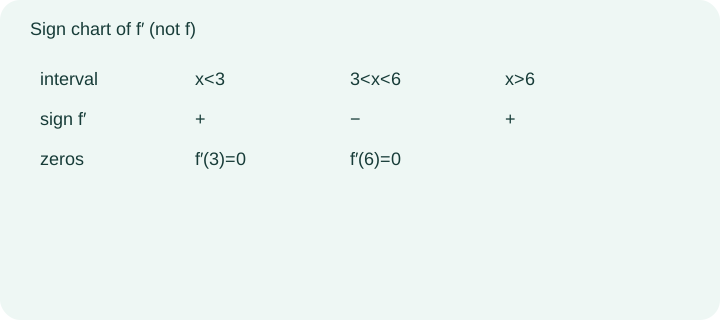
f is differentiable, and f′(3)=0; its derivative has exactly the zeros and signs shown. At which x-value does f have a local maximum? Figure data (exact labels in reading order): Sign chart of f′ (not f) | Sign chart of f′ (not f) | interval | x<3 | 3<x<6 | x>6 | sign f′ | + | − | + | zeros | f′(3)=0 | f′(6)=0. At x=3, f′ changes from positive to negative, so f changes from increasing to decreasing. At x=6, the reverse change gives a local minimum. The local maximum is at x=3; the chart does not provide its y-value.
Compare two methods
For f(x)=x³, f′(0)=0 but f is increasing on both sides, so zero is not a local extremum. Its second derivative does change sign at zero, so zero is an inflection input. For g(x)=x⁴, both g′ and g″ vanish at zero, but concavity stays upward: it is a minimum and not an inflection. A shared zero location does not make the classifications interchangeable.
Transfer: solve before reading
Assume f is continuous at x=2. Classify x=2 when its derivative is positive on (−∞,2) and negative on (2,∞). Can the maximum output be recovered from that chart? Then find the minimum of x³−12x on [0,6].
Transfer reasoning and answer
The sign change makes x=2 a local maximum, but the chart gives no vertical placement and hence no maximum output. For the cubic, candidates are x=0,2,6 with outputs 0,−16,144. The absolute minimum value is −16. Comparing outputs distinguishes a location from a value.
Practice the next representation
Work all four task families linked to this lesson. For the illustrated items, state which numerical labels and relationships you used. For a written extension, compare each line of your solution with its original self-assessment criteria; these criteria are practice feedback, not an official AP score.
f is differentiable, and f′(3)=0; its derivative has exactly the zeros and signs shown. At which x-value does f have a local maximum?
 Open full-size diagram ↗
- At x=3, f′ changes from positive to negative, so f changes from increasing to decreasing.
- At x=6, the reverse change gives a local minimum.
- The local maximum is at x=3; the chart does not provide its y-value.
Compare the other answer choices
Treat a zero derivative value as the x-coordinate of every extremum.
Add critical locations rather than classifying them.
Negate the x-coordinate because the derivative becomes negative.
Explain your thinking.
Optional written extension. Self-assessed only; it does not change your automatic practice result. These are teaching criteria, not official awarded marks.
(a) State the relationship or theorem that makes this calculation valid, including its relevant conditions. (b) Show the intermediate computation and give the requested result. (c) Explain why one plausible competing method would fail for this problem.
This draft stays on this page only. Use paper if you want to keep your working.
Try it, then explain it.
Complete a short set without looking at the example. After each answer, explain which operation preserved the relationship and why the result makes sense.
Sources & authorship
Original Slope explanations and examples. References support the concepts; they are not the source of copied questions. Independent educator review is pending.
AP Calculus AB and BC Course and Exam DescriptionCalculus Volume 1: Fundamental Theorem of Calculus