
The inspected captions explain inverse trigonometric functions, principal ranges and unit-circle reasoning. Original examples below apply the distinction between an inverse value and all solutions of an equation.
Two compositions ask different questions
Compare cos(arccos u) with arccos(cos θ). In the first, a valid cosine value u becomes a principal angle and then returns to the same cosine value. For−1≤u≤1, the result is u. In the second, an arbitrary angle becomes a cosine value and then a principal angle. The original angle is recovered only if it already lies in the inverse-cosine range. These statements look symmetric on paper, but they have different domains and different output quantities. Begin by identifying whether the outer operation must return a number between−1 and1 or an angle between0 andπ.
Use the upper semicircle
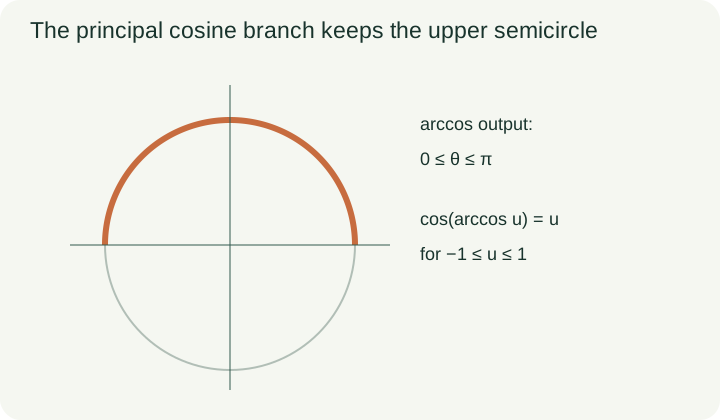
Cosine is the horizontal coordinate of a point on the unit circle. On the upper semicircle, from0 toπ radians, that coordinate decreases from1 to−1 without repeating. This gives inverse cosine a single output for every permitted input. For an original example, arccos(1/2)=π/3. A lower-semicircle angle5π/3 has the same cosine but lies outside the principal range. When the input is negative, the selected angle lies in quadrant II. For example, arccos(−√2/2)=3π/4. The negative cosine does not require a negative answer angle; the output interval decides its sign and location.
Follow an angle outside the range
Evaluate arccos(cos300°). The inner cosine is1/2 because300° is a reflection of60° across the horizontal axis. Inverse cosine then selects60°, which lies in[0°,180°]. Returning300° would violate the function definition. For another original example, arccos(cos450°)=90°: removing a full turn leaves90°, whose cosine is zero. These checks are easier when you preserve an exact unit-circle value until the final step. A decimal calculator result may confirm the magnitude, but it can hide which symmetry and range restriction made the answer necessary.
PAUSE & TRYEvaluate arccos(cos300°).Reveal explanation
60°; inverse cosine returns an angle between0°and180°.
Recover all solutions after inverse evaluation
To solve cos x=1/2 on0≤x<2π, first obtain the principal angleπ/3. The second solution is2π−π/3=5π/3. If the requested interval were[0,4π), each of those solutions would also occur one full turn later, giving four solutions altogether. Inverse cosine supplies a useful starting angle; it does not automatically enumerate the periodic solutions. For cos(2x)=1/2 on[0,2π), apply the interval to the inner angle2x before dividing the resulting values by two. The four x-values areπ/6,5π/6,7π/6 and11π/6. Substituting any one of them verifies the original cosine value.
Turn a composition into a domain test
Consider f(x)=cos(arccos(2x−1)). The inner inverse cosine exists only when−1≤2x−1≤1, which gives0≤x≤1. On that interval the composition simplifies to2x−1. Outside it, the real original expression is undefined even though the simplified linear formula can be evaluated. This is the same general caution encountered when canceling a denominator factor: an equivalent expression can have a larger natural domain than the original rule. Keep the original restriction attached to the simplified formula. For example, f(3/4)=1/2 is valid, while substituting x=2 into the simplified rule would not evaluate the original real function.
PAUSE & TRYWhat is the real domain of cos(arccos(2x−1))?Reveal explanation
0≤x≤1, inherited from−1≤2x−1≤1.
Explain a failure instead of memorizing a slogan
A student claims that inverse functions always cancel in either order. A useful response gives a precise counterexample and the corrected condition. Choose θ=5π/3: its cosine is1/2, and the principal inverse cosine of1/2 isπ/3, which differs from5π/3. The cosine is preserved, but the representative angle changes. The corrected statement is that arccos(cos θ)=θ for0≤θ≤π. A complete written explanation includes the principal range and a unit-circle reason, not just a warning to be careful. As a transfer check, evaluate arccos(cos225°). The result is135°, because both angles have cosine−√2/2 and135° lies in the selected interval.
Read the source with its limitations
The selected caption ranges introduce the reverse cosine question, state the principal range and compare the two composition orders. The captions include spoken self-corrections about the interval endpoint; the correct endpoint isπ, not2π. This companion resolves that mathematical statement explicitly and uses different original examples. Its figure is an original schematic of the principal branch. Selected captions were read in full, but full audiovisual and independent educator review are still pending. The source provides a complementary explanation; the domain conditions and transfer checks above are necessary parts of using it correctly.
Turn the idea into practice.
A fresh set will help you use the relationship with different numbers.
Practice this skillEvidence & editorial note
Selected actual caption text read; original examples and figures checked. Newly acquired caption source. Full audiovisual and educator review pending.
Original teaching companion with brief source synopsis; not a transcript reproduction.
Caption track SHA-256: 18a2f03eeddff1ce5e8301d091a0f934eee43eaa01034afc73776f3db1493932
Source segment references are retained in the catalog. Full captions remain in the local research archive.