
Learning goal and prerequisites
Translate polar geometry and compare radial changes over angle intervals. Before starting, review model selection.
Method and conditions
Use x=r cosθ and y=r sinθ with the signed radius. A negative radius reverses direction, so (−r,θ) can be written (r,θ+π). Average radial rate is Δr/Δθ, which is different from Cartesian slope.
Worked example: show the decisions
For r=8cosθ at θ=π/3, r=4, then x=4cos(π/3)=2 and y=2√3. The original coefficient eight is not the radius at every angle. Between 0 and π/2 the radius falls from 8 to 0, so its average rate is −16/π.
Contrast: why a plausible shortcut fails
The polar curve r=4 is a circle of radius four centered at the origin. The curve r=4cosθ instead satisfies x²+y²=4x, a circle centered at (2,0) with radius two. Similar notation describes different circles.
Transfer: try before revealing the answer
Represent (−5,π/6) with positive radius and compute its Cartesian x-coordinate.
Transfer solution and check
An equivalent representation is (5,7π/6). Both give x=−5√3/2. The positive-radius angle must be shifted by π, not merely negated.
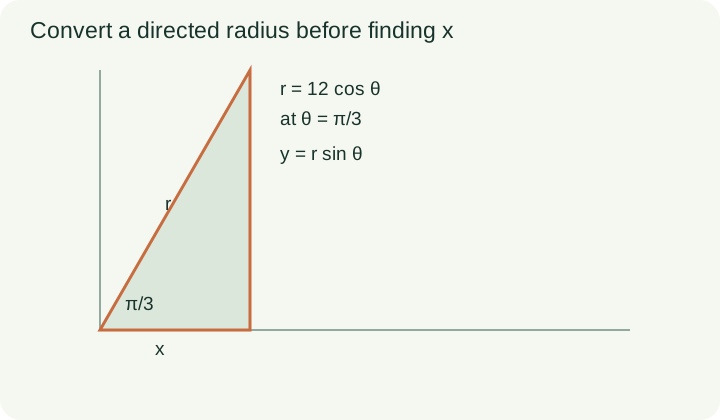
On the polar curve r=12cos(θ), what is the Cartesian x-coordinate at θ=π/3?
 Open full-size diagram ↗
- First find r at the angle; then multiply by cosine again to obtain x.
- Using these quantities: 12×(1/2)×(1/2) = 3.
- Check the original domain, requested quantity and units; do not substitute a related parameter.
Explain your thinking.
Optional written extension. Self-assessed only; it does not change your automatic practice result. These are teaching criteria, not official awarded marks.
At the indicated angle, (a) find r, (b) recover x and y, and (c) give an equivalent representation with negative radius.
This draft stays on this page only. Use paper if you want to keep your working.
Try it, then explain it.
Complete a short set without looking at the example. After each answer, explain which operation preserved the relationship and why the result makes sense.
Sources & authorship
Original Slope explanations and examples. References support the concepts; they are not the source of copied questions. Independent educator review is pending.
AP Precalculus Course at a Glance