
An independent comparison clinic for EC2 and explicitly scoped Lambda Event Functions. Use execution and host-control requirements, identify missing evidence, and keep cost and responsibility questions separate.
The direct answer depends on the requirement
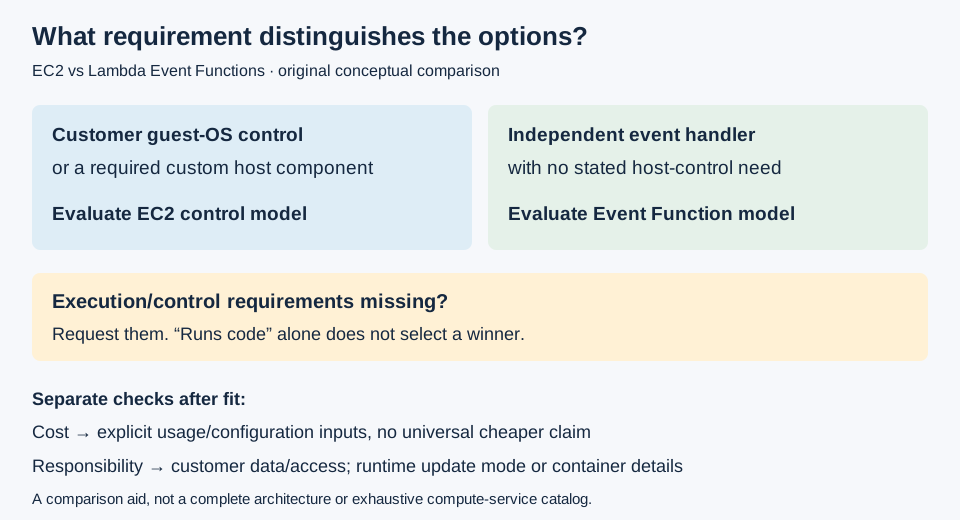
EC2 supplies configurable virtual servers with a customer-managed guest-OS model. Lambda Event Functions execute handlers in response to events or API calls while AWS manages underlying execution infrastructure. If the question explicitly requires customer guest-OS control, that is meaningful evidence for EC2 in this comparison. If it specifies an independent event handler and no host-management need, an Event Function can be a direct fit. “Which is better?” without those requirements is underspecified.
This guide deliberately compares EC2 with Lambda Event Functions, not every current Lambda primitive or every AWS compute service. No unnecessary duration, concurrency, quota, or discount figure is needed. The goal is to explain a defensible fit from retained evidence. It is not a deployment design, a benchmark, or a claim that either service wins every workload.
Build a comparison table in words
Use four rows. First, execution: what starts the work, and can the described work be expressed as the event-handler model? Second, control: does the application require customer guest-OS administration or a persistent custom host component? Third, operating duties: which infrastructure, application, data, and permission tasks remain? Fourth, cost evidence: what configuration, usage, and applicable pricing inputs are actually supplied? A blank row should remain unknown, rather than being filled with a remembered slogan.
The rows prevent a common error: answering a host-control requirement with a cost assertion, or answering a permission problem with a service-management label. A workload may fit one execution model while its cost remains unestimated. An abstracted runtime may reduce operating work while customer data-access decisions remain. Record these as separate conclusions, so that changing one condition does not silently change all the others.
Worked case: newly arrived language transcripts
Fictional case: a language archive validates newly arrived transcripts. The archive has deliberately written a compatible independent handler for each arrival, does not need guest-OS control for this component, and wants to avoid managing its execution servers. First identify the trigger and handler boundary. Next check that no host requirement contradicts the Event Function model. Within the stated comparison, Lambda Event Functions fit those conditions. That conclusion is grounded in execution and operating-control requirements, not a universal promise about speed or price.
Now test the boundary. The archive still decides which transcript collection the handler may access and which actions the code may perform. AWS infrastructure management does not validate that a transcript meets the archive’s own editorial rules. If the archive uses an AWS managed runtime, the update workflow depends on runtime-update mode. If it deploys a container image instead, image rebuild and redeployment remain customer work. A compute choice therefore does not complete the responsibility ledger.
Opposing case: a host-dependent audio application
A separate audio application in the same fictional organization requires a persistent licensed host extension and customer guest-OS control. Preserve that requirement even if the team likes the idea of not managing servers. EC2 supplies virtual-server capacity with configurable software and customer guest-OS administration; it is the direct control-model fit in this comparison. The transcript component’s event-driven rationale does not automatically transfer to the audio component just because both handle language media.
Check the counterfactual carefully. If the host extension requirement is removed, the original EC2 rationale weakens; more details about the execution model are needed. Removal does not by itself prove an Event Function is best, because missing requirements remain missing. Conversely, if the transcript validator acquires the same mandatory host extension, its earlier Event Function rationale must be reconsidered. A defensible comparison changes with the constraint, rather than protecting a product preference.
Cost is a separate model, not a tiebreaking slogan
EC2 purchasing choices include usage-based On-Demand, interruption-tolerant Spot scenarios, and differing usage/configuration commitment models. Selecting a purchasing category still needs workload conditions. Pricing Calculator models supplied configuration and usage assumptions; it does not read a hypothetical future invoice or guarantee the amount eventually payable. Include the entered components and recognize omitted costs, such as applicable storage-related factors. No real rates are supplied in these cases.
Thus “serverless is always cheaper” and “owned-looking virtual servers are always cheaper” both exceed the evidence. Use workload fit first, then a scoped cost comparison with applicable inputs. If a question supplies neither quantities nor current rates, write cost as unresolved rather than treating a service label as a price calculation. Workload sizing likewise follows the actual performance and capacity requirement; it is not an automatic savings result.
Two application checks
Check 1: a fictional editor says only “our application runs code” and asks for an EC2/Event Function choice. What should you request before selecting? Check basis: ask for the execution/trigger model and the need for customer guest-OS or persistent host control. Also identify any other stated operating constraints. Code execution alone applies too broadly to distinguish the options. An answer naming a winner without these facts is overconfident.
Check 2: a fictional transcript workflow originally required a custom host extension, but a revised component now uses an independent event handler and explicitly no longer needs host control. What changes? Check basis: the earlier host-control rationale for EC2 no longer settles the choice; the newly stated handler model supports evaluating Event Functions. Cost and customer permissions still need their own evidence. Use the constraint diagram, lessons aws-clf-skill-07 and aws-clf-skill-11, and formal tasks aws-clf-q-025–028 for further practice.
Apply the guide
Does “runs code” determine EC2 versus an Event Function?Reveal explanation
No. Request the execution model, guest-OS/host-control need, and other explicit constraints.
What follows when a mandatory custom-host requirement is removed and an independent handler model is stated?Reveal explanation
Re-evaluate the former EC2 rationale; the stated handler model supports evaluating Event Functions, without establishing cost or eliminating customer duties.
Turn the idea into practice.
Apply the rule to a new case, then explain your choice.
Practice this skillSources & authorship
Original teaching based on the linked official AWS documentation retained on 2026-11-01–02. Examples are fictional; no official exam questions or AWS diagrams are reproduced.
Original OpenExam prose and diagram; authored 2026-11-02.
Independent educator review is pending. This guide is not an official exam paper or a video transcript.
Shared Responsibility Model - Amazon Web Services (AWS)Security in AWS Lambda - AWS LambdaWhat is Amazon EC2? - Amazon Elastic Compute CloudWhat is AWS Lambda? - AWS LambdaAmazon EC2 billing and purchasing options - Amazon Elastic Compute CloudWhat is AWS Pricing Calculator? - AWS Pricing CalculatorUnderstanding the shared responsibility model for Lambda runtime management - AWS Lambda