
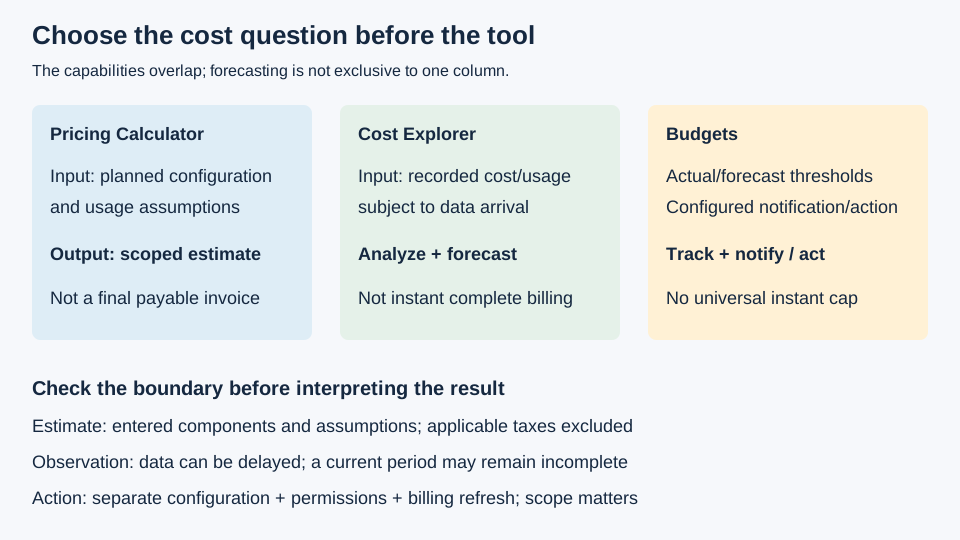
Choose a cost tool by its inputs and required output. A fictional project moves from planning to analysis and threshold tracking, with explicit calculation and enforcement boundaries.
Three questions, several overlapping capabilities
Use Pricing Calculator when you need a model from supplied configuration and usage assumptions. Use Cost Explorer when the question concerns recorded cost/usage analysis; it also supports forecasting. Use Budgets when you need actual or forecasted threshold tracking and notifications, with actions configured separately if appropriate. The distinction is not that only one tool can mention the future. It is which evidence and decision the user needs.
A planning estimate is not an invoice. A recorded-cost chart can be incomplete while upstream data arrives. A notification does not itself prevent every further charge. These limits belong next to the tool choice, because they change what the result can justify. A correct service name followed by an unsupported guarantee is still an incorrect explanation.
Worked project: a neighborhood recording program
Fictional case: a neighborhood program considers storing recordings and running a processing component. Before launch, the organizer knows assumed quantities but has no project cost history. She writes the assumptions and models entered components with Pricing Calculator. She labels the output an estimate and notes that applicable taxes are excluded. Unknown inputs remain visible rather than being silently replaced with current prices from memory.
After the project runs, an organizer notices increased spending. The question has changed from “what might this configuration cost?” to “what explains recorded use and cost?” Cost Explorer supports examining those recorded values and can also forecast. Data may arrive with delay, so a partial current period is not a final invoice. The organizer should state the time range and input completeness when describing a trend.
Finally, the program wants notification when actual or forecasted spending crosses a configured threshold. Budgets supports that tracking. The organizer must distinguish a notification from a separately configured action. Actions need appropriate permissions and operate with billing-data refresh; the sources do not establish a universal instantaneous spending cap. This guide intentionally omits an exact refresh frequency because retained official pages describe different cadences.
A transparent hypothetical subtotal
For arithmetic practice only, suppose a fictional project uses four processing units for eight hours at an invented $0.25 per unit-hour, plus 60 GB of storage at an invented $0.05 per GB for the stated period. These are not AWS prices. Compute is 4 × 8 × $0.25 = $8.00. Storage is 60 × $0.05 = $3.00. The supplied-component subtotal is $11.00. Units and the stated storage period explain why no additional day multiplier appears.
Now change the question: does $11.00 establish a final AWS payable amount? No. The arithmetic only includes the invented components. Other applicable quantities, pricing conditions, storage-related factors such as snapshot storage, and taxes have not been modeled. The honest output preserves both conclusions: the toy subtotal is correct under the supplied assumptions, and a real full-cost result remains unestablished. Correct arithmetic does not repair an incomplete model boundary.
A threshold needs a response plan
Imagine a volunteer sees a budget notification and concludes that every resource has already stopped. The message alone does not establish that. Ask whether an action was configured, whether it has the appropriate permissions, what it affects, and whether billing data has refreshed. A warning and an action are different outputs. Even configured actions should not be advertised as a universal instant limit on all possible charges.
The reverse mistake is saying Budgets can only ever send messages. It can apply configured actions, so that blanket description is also inaccurate. Teach the conditional capability: thresholds can generate notifications; actions are separately configured and constrained. Keep an unknown configuration unknown rather than assuming either complete enforcement or no action capability.
Categorization and purchasing fit do not replace the model
Activated applicable cost allocation tags can organize costs by project or other metadata categories. A label alone does not guarantee complete attribution, and categorizing a resource is not itself a grant of API permission. If a report lacks the expected category, check the allocation scope/activation assumptions instead of assuming the project had no cost. Metadata makes a cost question easier to ask; it does not supply missing usage or override security decisions.
Likewise, a purchasing label is not a complete estimate. Spot requires timing flexibility and interruption tolerance. A usage commitment and an instance-configuration commitment differ. Matching resource type and amount to actual workload requirements is a bounded sizing principle, not proof of a particular saving. The cost-tools diagram therefore shows questions and inputs, not a pipeline that mechanically approves every purchase.
Two independent application checks
Check 1: a fictional club has not launched a service but asks Cost Explorer to explain its nonexistent recorded project charges. What is mismatched? Check basis: the planning task needs explicit assumed inputs for an estimate; there is no project usage history to analyze. Cost Explorer’s forecasting capability does not turn absent project data into a completed Calculator scenario. State the missing input rather than inventing a historical trend.
Check 2: a fictional project’s forecast crosses a budget threshold, but nobody has specified any budget action. Can the team claim that all future spending is blocked? Check basis: no. A threshold/notification does not establish an action, its permissions, timing, or universal charge coverage. Record the configuration as unknown. Use lessons aws-clf-skill-11 and aws-clf-skill-12 and formal tasks aws-clf-q-041–048 to practice distinguishing the model, observation, and response without claiming official-score or real-savings predictions.
Apply the guide
What is missing when a pre-launch project asks for analysis of its recorded charges?Reveal explanation
Actual project cost/usage history is absent; use explicit assumed inputs for the planning estimate rather than inventing recorded data.
Does a crossed budget threshold prove all future charges are blocked?Reveal explanation
No. Action configuration, permissions, timing, and coverage are separate from the threshold/notification.
Turn the idea into practice.
Apply the rule to a new case, then explain your choice.
Practice this skillSources & authorship
Original teaching based on the linked official AWS documentation retained on 2026-11-01–02. Examples are fictional; no official exam questions or AWS diagrams are reproduced.
Original OpenExam prose and diagram; authored 2026-11-02.
Independent educator review is pending. This guide is not an official exam paper or a video transcript.
Security best practices in IAM - AWS Identity and Access ManagementWhat is Amazon EC2? - Amazon Elastic Compute CloudAmazon EC2 billing and purchasing options - Amazon Elastic Compute CloudWhat is AWS Pricing Calculator? - AWS Pricing CalculatorAnalyzing your costs and usage with AWS Cost Explorer - AWS Cost ManagementManaging your costs with AWS Budgets - AWS Cost ManagementOrganizing and tracking costs using AWS cost allocation tags - AWS BillingBest practices for AWS Budgets - AWS Cost Management