
An original guide connecting a systematic vehicle inspection with controlled movement and hazard anticipation.
A decision method that preserves the conditions
A commercial vehicle amplifies the cost of an untested assumption. A large mirror can still leave a blind area, a posted curve speed can still be too high for a tall load, and a truck can travel a substantial distance before the driver recognizes the need to brake. Treat preparation as a set of connected decisions rather than a collection of slogans.
Start with whether the vehicle is fit to move. Then choose a path and speed that preserve time to respond. The cases below ask what information is missing, what condition controls the maneuver, and what would happen if the tempting shortcut were followed. They are original learning scenarios, not official licensing questions or a substitute for practical training.
Use an inspection sequence and resolve defects
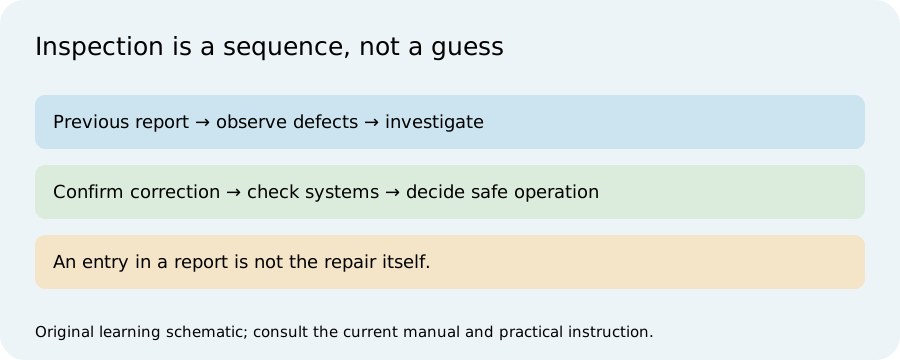
An inspection is a decision process rather than a recital. Work through a repeatable sequence, notice evidence of failure, and decide whether the vehicle is safe to operate. A written report records a problem but does not repair it. A component that passed yesterday may have changed during the last trip.
Use a consistent inspection sequence so important components are not omitted. An improvised walk-around can repeatedly overlook an unfamiliar area. Consider two cases: A driver changes the walk-around order every morning. An unfamiliar tractor makes the driver unsure which part was checked. In each case, the relevant action is use the systematic sequence and confirm every required area. The contrast is inspect only the parts visible from the cab window. This comparison tests which condition controls the choice, rather than whether an action is physically possible.
Use the inspection report to identify defects and confirm that safety-affecting problems are corrected before operation. A report communicates a defect; writing it down alone does not repair it. Consider two cases: An inspection report lists a steering defect from the previous shift. A driver discovers an unresolved brake problem before departure. In each case, the relevant action is confirm the safety defect is corrected before driving. The contrast is drive because recording the defect transfers all responsibility. This comparison tests which condition controls the choice, rather than whether an action is physically possible.
The guide requires at least 4/32-inch tread depth in major grooves on front tires and 2/32 inch on other tires. Different axle positions have different minimum tread requirements, and exposed fabric is unacceptable. Consider two cases: A front tire has only 3/32-inch tread in a major groove. A steering tire is worn below 4/32 inch. In each case, the relevant action is reject the front tire as failing the guide's requirement. The contrast is accept it because 2/32 inch is enough for every tire. This comparison tests which condition controls the choice, rather than whether an action is physically possible.
Describe the difference between noticing a defect, reporting it, and confirming correction. Then explain why the front-tire tread requirement cannot simply be replaced by the requirement for other axle positions. Keep the inspection decision tied to the actual defect.
PAUSE & TRYA vehicle's front tire shows cord through a damaged tread area. Which response best follows the general-knowledge guidance in the official commercial driver guide?Reveal explanation
Reject the front tire as failing the guide's requirement. Different axle positions have different minimum tread requirements, and exposed fabric is unacceptable.
Check the systems that make the trip safe
Look for clues that connect visible conditions to a safety function. Rust near a wheel fastener may indicate movement; fluid loss may threaten a critical system; dirty reflectors may hide the vehicle at night. Cargo weight, balance, and securement must each be addressed before departure.
Rust streaks around wheel nuts can indicate looseness and require checking tightness. Surface clues can reveal movement at the wheel fasteners before separation occurs. Consider two cases: Rust streaks extend from wheel nuts during a walk-around. A wheel was recently changed and the vehicle has traveled a short distance. In each case, the relevant action is check fastener condition and tightness before proceeding. The contrast is assume rust proves that the nuts cannot move. This comparison tests which condition controls the choice, rather than whether an action is physically possible.
Investigate fluid leaks during inspection rather than assuming every puddle is harmless. A leak may indicate loss from a system needed for braking, steering, cooling, or lubrication. Consider two cases: Fresh fluid appears beneath the truck after parking. A hose connection is visibly wet during the inspection. In each case, the relevant action is identify the leak and have a safety-affecting defect corrected. The contrast is ignore the puddle if the engine still starts. This comparison tests which condition controls the choice, rather than whether an action is physically possible.
Check required lamps and reflectors for function, condition, and visibility. The driver needs to see and to communicate position and intentions to other road users. Consider two cases: A turn signal does not illuminate during the inspection. Dirt covers the rear reflectors before a night trip. In each case, the relevant action is correct the lighting or visibility defect before the trip. The contrast is ignore the defect because the driver can see forward. This comparison tests which condition controls the choice, rather than whether an action is physically possible.
Before each trip, confirm the truck is not overloaded and the cargo is balanced and secured. Weight, distribution, and restraint create separate safety questions. Consider two cases: A loaded vehicle has not yet had its cargo restraint checked. A loader says the shipment is under the weight limit but has not checked balance. In each case, the relevant action is check load weight, balance, and securement before departure. The contrast is treat unused floor space as proof that loading is safe. This comparison tests which condition controls the choice, rather than whether an action is physically possible.
Choose a visible clue and name the system it could affect. Explain why a running engine or legal total weight does not settle every safety question. Describe what must be corrected before relying on the vehicle for the intended trip.
PAUSE & TRYA driver receives a loaded vehicle from another shift. Which response best follows the general-knowledge guidance in the official commercial driver guide?Reveal explanation
Check load weight, balance, and securement before departure. Weight, distribution, and restraint create separate safety questions.
Plan a visible, controlled backing maneuver
Avoid unnecessary reversing by planning the entry and exit before committing. When backing is required, establish the ground and overhead clearances, favor the more visible setup, and keep communication with any helper clear. A backup alarm alerts others but does not establish that the path is clear.
Avoid backing where a practical forward route exists because rear visibility is limited. Planning the path before entering a confined area can remove the blind maneuver. Consider two cases: A delivery site offers a safe pull-through route. A driver can choose a parking position that permits a forward departure. In each case, the relevant action is choose the practical forward route rather than unnecessary backing. The contrast is back first because mirrors make rear vision complete. This comparison tests which condition controls the choice, rather than whether an action is physically possible.
Before backing, inspect the area on foot when needed and check the intended path and clearances. The view from the cab can hide ground obstacles and overhead or side conflicts. Consider two cases: A backing path disappears behind a trailer. A driver cannot tell whether the loading area's ground is clear. In each case, the relevant action is stop and get out to check the area before backing. The contrast is continue until contact with an obstacle reveals its position. This comparison tests which condition controls the choice, rather than whether an action is physically possible.
When possible, back toward the driver's side for better visibility. Blind-side backing hides more of the path and makes correction harder. Consider two cases: A driver can choose either direction for a backing setup. A loading area allows a driver-side approach. In each case, the relevant action is set up toward the driver's side when possible. The contrast is choose the blind side solely to shorten the setup. This comparison tests which condition controls the choice, rather than whether an action is physically possible.
Stop if a backing helper disappears from view; agree on signals before movement. A helper cannot provide reliable guidance when the driver cannot see the signal. Consider two cases: The driver loses sight of the backing helper. A helper moves out of the mirror's field during a reverse maneuver. In each case, the relevant action is stop and re-establish visible, agreed communication. The contrast is continue slowly because the helper will shout if needed. This comparison tests which condition controls the choice, rather than whether an action is physically possible.
Compare a pull-through route with a backing route. For the unavoidable backing case, describe what to inspect on foot, which side gives the better view, and what should happen if the helper disappears from view. Do not treat low speed as a substitute for visibility.
PAUSE & TRYA driver and helper have not agreed what the signals mean. Which response best follows the general-knowledge guidance in the official commercial driver guide?Reveal explanation
Stop and re-establish visible, agreed communication. A helper cannot provide reliable guidance when the driver cannot see the signal.
Prepare power, gear, and curve entry
Select the gear and speed before the vehicle enters the demanding section. A steep descent may leave no good opportunity for a late downshift. A sharp curve may overturn a high load even at a speed shown on a sign. Smooth starting reduces unnecessary load on traction and vehicle connections.
Select the proper low gear before descending a steep grade. Changing too late can leave the vehicle without adequate engine braking while speed builds. Consider two cases: A loaded truck approaches the top of a steep downgrade. A driver plans to shift lower only after speed rises on the descent. In each case, the relevant action is select the proper low gear before descending. The contrast is wait until the truck is rolling too fast to choose a gear. This comparison tests which condition controls the choice, rather than whether an action is physically possible.
Reduce to a safe speed before entering a curve, especially with a high center of gravity. Heavy braking in a curve can cause a skid, and rollover can occur even at a posted curve speed. Consider two cases: A high-loaded truck approaches a sharp curve. The curve sign shows a speed that may be too high for a truck's load. In each case, the relevant action is slow to a safe speed before beginning the curve. The contrast is use the posted curve speed as a guarantee against rollover. This comparison tests which condition controls the choice, rather than whether an action is physically possible.
Accelerate smoothly to avoid rough vehicle movement and loss of control. Sudden power application can create traction problems or shift cargo. Consider two cases: A truck begins moving on a slippery surface. A loaded vehicle pulls away from a stop. In each case, the relevant action is apply power smoothly and progressively. The contrast is use maximum throttle immediately regardless of traction. This comparison tests which condition controls the choice, rather than whether an action is physically possible.
Explain why a braking plan and a gear plan are related but not interchangeable. Trace the effect of entering a curve too fast with a high center of gravity. Compare a smooth launch with a sudden power application on a slippery surface.
PAUSE & TRYA truck leaves a loading area with restrained cargo. Which response best follows the general-knowledge guidance in the official commercial driver guide?Reveal explanation
Apply power smoothly and progressively. Sudden power application can create traction problems or shift cargo.
Observe early and preserve a following cushion
The distance used before the brakes begin working is part of the stop. Looking ahead, using brief mirror checks, and preserving a time gap give the driver time to identify and respond. A truck-length rule for following distance addresses a different vehicle from a passenger car; increasing speed also changes the required cushion.
Look at least 12 to 15 seconds ahead while shifting attention between near and distant conditions. Early observation permits gradual speed or lane adjustments instead of last-second reactions. Consider two cases: A driver watches only the trailer immediately ahead. A distant traffic queue begins slowing. In each case, the relevant action is scan 12 to 15 seconds ahead and keep checking nearer hazards. The contrast is focus exclusively on the nearest rear bumper. This comparison tests which condition controls the choice, rather than whether an action is physically possible.
Check mirrors regularly and before a maneuver while still observing the road ahead. Regular checks build awareness of surrounding traffic, but prolonged mirror fixation creates a forward blind interval. Consider two cases: A driver has not checked following traffic for several minutes. A lane change will soon be needed. In each case, the relevant action is use brief, regular mirror checks and return attention forward. The contrast is stare continuously into one mirror until the next exit. This comparison tests which condition controls the choice, rather than whether an action is physically possible.
Below 40 mph, allow at least 1 second for each 10 feet of vehicle length; add 1 second above 40 mph. Vehicle length and speed change the time cushion needed behind another vehicle. Consider two cases: A commercial driver follows traffic below 40 mph. A long vehicle needs more following space than a shorter one. In each case, the relevant action is use the length-based time rule and add time above 40 mph. The contrast is use a single car length regardless of truck size or speed. This comparison tests which condition controls the choice, rather than whether an action is physically possible.
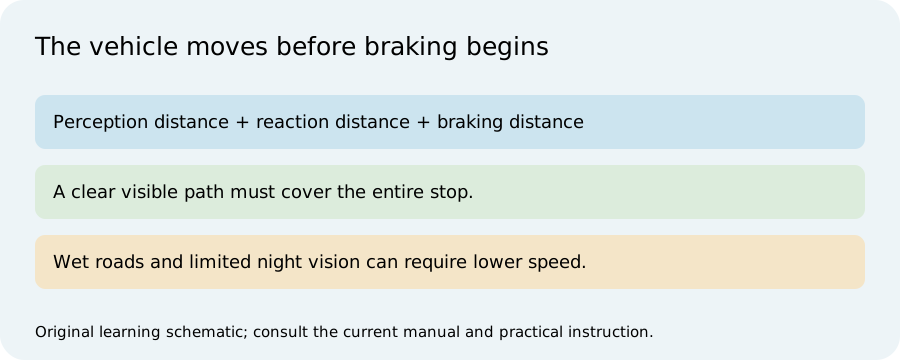
Total stopping distance includes perception, reaction, and braking distances. Brakes do not begin slowing the vehicle during the time spent noticing and responding. Consider two cases: A driver counts only the distance traveled after pressing the brake. A hazard appears before the driver recognizes it. In each case, the relevant action is include perception, reaction, and braking distances. The contrast is count braking distance alone because thinking uses no roadway. This comparison tests which condition controls the choice, rather than whether an action is physically possible.
Name perception, reaction, and braking distance separately. Use the guide's vehicle-length time rule without converting it into a fixed number of car lengths. Explain why looking farther ahead still requires checking nearby traffic and why a mirror glance should be brief.
PAUSE & TRYA stopping-distance estimate excludes observation and response time. Which response best follows the general-knowledge guidance in the official commercial driver guide?Reveal explanation
Include perception, reaction, and braking distances. Brakes do not begin slowing the vehicle during the time spent noticing and responding.
Match speed to visibility and surface grip
A driver must be able to stop in the visible space and keep tire demands within the grip available. Water changes that grip and can separate tire contact from pavement. The useful adjustment is early and smooth, not a hard brake or sharp steering input after the vehicle becomes unstable.
Select a speed that permits stopping within the visible distance ahead. A speed suitable for clear daylight may overrun the available view in darkness or fog. Consider two cases: A truck enters a dark road with a short illuminated view. Fog sharply limits the driver's forward view. In each case, the relevant action is slow until the visible space covers the required stopping distance. The contrast is keep speed and assume unseen roadway will be clear. This comparison tests which condition controls the choice, rather than whether an action is physically possible.
Reduce speed and increase space on wet roads rather than relying on dry-road stopping expectations. Water reduces traction, lengthening or complicating the stop. Consider two cases: Rain wets the roadway after a dry period. A driver reaches a slick bridge approach. In each case, the relevant action is slow down and leave a larger space cushion. The contrast is keep dry-road following distance because the tires are new. This comparison tests which condition controls the choice, rather than whether an action is physically possible.
If hydroplaning begins, release the accelerator and avoid braking or abrupt steering until control returns. Tires riding on water have reduced contact, so abrupt demands may not produce the expected control. Consider two cases: The truck's tires begin riding on standing water. The steering feels light while the vehicle crosses pooled water. In each case, the relevant action is ease off the accelerator and avoid abrupt control inputs. The contrast is brake sharply and steer rapidly to test the available grip. This comparison tests which condition controls the choice, rather than whether an action is physically possible.
Consider a wet road whose posted limit has not changed. Identify why the suitable driving speed may still be lower. Explain which action should be released when hydroplaning starts and why sudden steering or braking is a poor way to test grip.
PAUSE & TRYWater separates tire contact from the pavement. Which response best follows the general-knowledge guidance in the official commercial driver guide?Reveal explanation
Ease off the accelerator and avoid abrupt control inputs. Tires riding on water have reduced contact, so abrupt demands may not produce the expected control.
Anticipate fog, darkness, and crosswind
Visibility and side force can change abruptly. Fog can reflect high-beam light back to the driver, a move from shelter into wind can push a high-sided trailer, and dimming headlights reduces the illuminated stopping view. The right response is specific to the mechanism rather than a single rule to drive faster or use brighter lights.
Use low beams in fog and avoid speed that exceeds the available view. High beams reflect from moisture and can reduce useful visibility. Consider two cases: A commercial vehicle enters a fog bank. High beams reflect strongly back from fog. In each case, the relevant action is use low beams and reduce speed for visibility. The contrast is use high beams to cut through the moisture. This comparison tests which condition controls the choice, rather than whether an action is physically possible.
Expect stronger wind effects on high-sided vehicles, especially when leaving a sheltered area. A sudden side force can move a tall vehicle even when the road surface is dry. Consider two cases: A high-sided empty trailer leaves the shelter of a cutting. A truck emerges from behind a large building into crosswind. In each case, the relevant action is reduce risk by slowing and maintaining a firm, controlled steering grip. The contrast is assume a dry road prevents sideways movement. This comparison tests which condition controls the choice, rather than whether an action is physically possible.
At night, adjust speed so the vehicle can stop within the distance illuminated by the lights being used. Switching to low beams can reduce visible distance and therefore the suitable speed. Consider two cases: An approaching vehicle requires the truck driver to dim headlights. The illuminated view shrinks when high beams are dimmed. In each case, the relevant action is slow enough to stop within the illuminated view. The contrast is keep speed because changing beams does not change visibility. This comparison tests which condition controls the choice, rather than whether an action is physically possible.
For each condition, name what has changed: useful sight distance, lateral force, or illuminated roadway. Then identify the adjustment to speed, lights, or steering control. Preserve a view of the lane instead of staring into oncoming lights or the vehicle immediately ahead.
PAUSE & TRYAn unlit object may lie just beyond the visible road. Which response best follows the general-knowledge guidance in the official commercial driver guide?Reveal explanation
Slow enough to stop within the illuminated view. Switching to low beams can reduce visible distance and therefore the suitable speed.
Keep an escape option and stabilize emergencies
An emergency does not make an unchecked lane or weak shoulder safe. Identify a clear escape route before using it, avoid a gear change while on railway tracks, and stabilize a tire failure or skid before demanding abrupt control. On a downgrade, an available escape ramp may be the safe option that disappears if the driver hesitates.
Before changing lanes, check traffic and blind areas using the appropriate mirrors and observation. A signal announces a move but does not show whether the target space is occupied. Consider two cases: A small car may be beside the trailer. The driver has signaled but has not checked the adjacent lane. In each case, the relevant action is verify the target space rather than moving on the signal alone. The contrast is assume every nearby driver must yield once the signal is on. This comparison tests which condition controls the choice, rather than whether an action is physically possible.
Look for an escape path while managing a developing hazard, without steering into another conflict. Stopping may not be the only safe option, but an escape path must be checked before it is used. Consider two cases: A hazard develops ahead and the driver may need an escape path. A truck approaches an area where braking space may disappear. In each case, the relevant action is identify a clear escape path before committing to it. The contrast is steer into the next lane without checking because an emergency exists. This comparison tests which condition controls the choice, rather than whether an action is physically possible.
Choose a gear that carries the vehicle across railway tracks without shifting on them. A missed shift or loss of drive on the tracks creates an avoidable train conflict. Consider two cases: A driver is about to cross several railway tracks. A loaded truck needs to traverse a rough crossing. In each case, the relevant action is use the selected gear through the crossing without shifting. The contrast is shift to neutral on the tracks for a smoother ride. This comparison tests which condition controls the choice, rather than whether an action is physically possible.
For a tire failure, hold the steering wheel firmly, stay off the brake initially, and slow under control. Hard initial braking can magnify loss of control while the vehicle is already unstable. Consider two cases: A front tire fails at road speed. The steering wheel pulls suddenly after a loud tire failure. In each case, the relevant action is hold the wheel firmly and slow under control without initial hard braking. The contrast is brake as hard as possible before stabilizing the vehicle. This comparison tests which condition controls the choice, rather than whether an action is physically possible.
For a rear-wheel skid, look and steer toward the intended path, reducing the action that caused the skid. Overcorrection can make the vehicle skid the other way when traction returns. Consider two cases: A braking skid moves the vehicle's rear sideways. Rear wheels slide after excessive power on a slick surface. In each case, the relevant action is ease the cause and steer toward the intended path, avoiding overcorrection. The contrast is keep adding brake pressure regardless of wheel lock. This comparison tests which condition controls the choice, rather than whether an action is physically possible.
Use an available escape ramp promptly when a downgrade emergency makes it necessary. A designated ramp is intended to absorb speed when ordinary control is insufficient. Consider two cases: A truck loses effective braking on a downgrade with an escape ramp ahead. Speed is uncontrolled as a marked escape ramp approaches. In each case, the relevant action is use the escape ramp when needed rather than passing it in hope. The contrast is avoid every escape ramp to prevent possible vehicle damage. This comparison tests which condition controls the choice, rather than whether an action is physically possible.
State the conflict before naming the maneuver. Compare a controlled slowdown after a tire failure with immediate hard braking. For a possible escape route, identify who or what could occupy it. Explain why a ramp designed for emergencies should not be passed merely to avoid possible vehicle damage.
PAUSE & TRYOrdinary braking is insufficient on a steep descent and a marked escape ramp is available ahead. Which response best follows the general-knowledge guidance in the official commercial driver guide?Reveal explanation
Use the escape ramp when needed rather than passing it in hope. A designated ramp is intended to absorb speed when ordinary control is insufficient.
Turn the idea into practice.
Apply the rule to a new case, then explain your choice.
Practice this skillSources & authorship
Independent teaching guide based on the linked official references. It is not a video transcript or an official sample exam. Worked traffic situations and illustrations are original.
Original instructional synthesis and scenarios.
Independent educator review is pending. This guide is not an official exam paper or a video transcript.
wa-cdl