
The selected source segment derives a square-root inverse, exchanges domain and range, and retains the correct graph branch.
Start with the pairing you are reversing
An inverse sends a function output back to the input that produced it. If a function takes six to four, its inverse takes four to six. This is different from taking the reciprocal of the output. In the selected part of the linked lesson, The Organic Chemistry Tutor develops a square-root example and exchanges its domain and range with those of its inverse. This companion uses different examples to make those restrictions explicit. The reviewed caption scope is approximately 3:54 through 9:22. The full video and its other worked problems have not received complete audiovisual review.
Build a square-root function with a clear domain
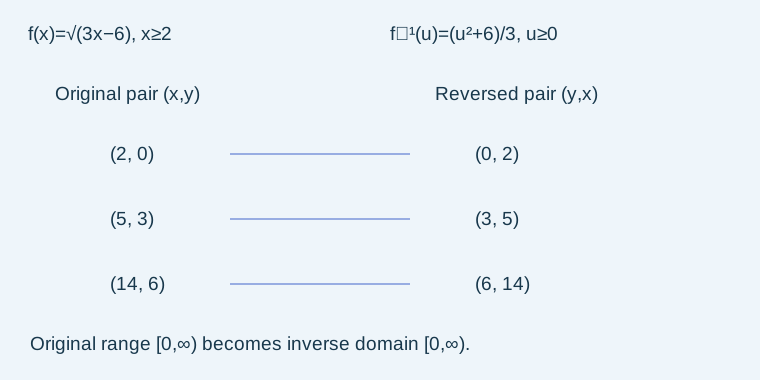
Let f(x)=√(3x−6). For real outputs, the radicand must be nonnegative: 3x−6≥0, so x≥2. A principal square root never gives a negative value, and every nonnegative output can occur, so the range is [0,∞). Several pairs make this concrete: f(2)=0, f(5)=3, and f(14)=6. Each pair is a statement about a permitted input and its output. The accompanying diagram places each original pair beside its reversed pair rather than drawing an unrestricted parabola and hoping the domain will be remembered.
Solve algebraically and carry the condition
Write y=√(3x−6), then exchange the roles of the variables to get x=√(3y−6). Because the right side is a principal square root, x must be nonnegative. Squaring gives x²=3y−6, and solving for y gives f⁻¹(x)=(x²+6)/3 for x≥0. The formula alone would accept negative inputs, but those extra inputs are not part of this inverse. The inverse domain is the original range [0,∞), and its range is the original domain [2,∞). A domain restriction is part of the function’s definition, not a footnote to discard after simplification.
Check both directions on their proper domains
At input three, the inverse gives (9+6)/3=5, and applying f to five gives √9=3. That checks one reversed pairing. For a general nonnegative input u, f(f⁻¹(u))=√(u²)=u because u≥0. Without that restriction, the square root would yield |u| instead of u. In the other direction, f⁻¹(f(x))=((3x−6)+6)/3=x for x≥2. These two identities verify the inverse on the stated domains. A single numerical check can expose an error, but the algebraic identities explain why every allowed input works.
Why an unrestricted quadratic fails
Consider q(x)=(x−2)²+1 on all real inputs. Both x=1 and x=3 give the output two. Reversing that relation would send one input, two, to two different outputs, so it would not be a function. Restrict q to x≥2 and the ambiguity disappears. Its inverse is q⁻¹(y)=2+√(y−1), with y≥1. The plus branch is required because the original input is at least two. Choosing the minus branch would instead reverse the left-hand restriction x≤2. The two branches describe different inverse functions associated with different original domains.
A rational extension shows another restriction
As an original extension beyond the selected caption range, take r(x)=(x+4)/(x−2). The original domain excludes two. To find the input producing output y, solve y(x−2)=x+4, hence x(y−1)=2y+4. This gives r⁻¹(y)=(2y+4)/(y−1), where y≠1. That excluded inverse input has meaning: the original function never outputs one, since x+4=x−2 would require four to equal negative two. At output two, the inverse gives eight; substituting eight into the original gives 12/6=2. The inverse is not the reciprocal (x−2)/(x+4).
Read the diagram as evidence, not decoration
The pairing diagram shows (2,0), (5,3) and (14,6) for the square-root example and (0,2), (3,5) and (6,14) for its inverse. The first coordinate of each original pair becomes the second coordinate of the inverse pair. This is the coordinate meaning of reflection across y=x, even when no graph is drawn. It also explains the exchanged bounds: the original outputs begin at zero, so the inverse inputs begin at zero. Three sample pairs do not establish the entire inverse by themselves; they support the domain-aware algebra already shown.
Transfer the method to a fresh function
Try h(x)=√(2x+4). Its original domain is x≥−2 and its range is y≥0. Reversing and solving gives h⁻¹(x)=(x²−4)/2 with x≥0. At x=4, the inverse returns six, and h(6)=√16=4. When writing a solution, state the original domain and range first, derive the reversed formula, and then attach the inverse domain. Finally verify a composition with the restriction still visible. This order prevents the common mistake of obtaining a correct-looking expression that defines too many inputs and therefore fails to be the requested inverse.
PAUSE & TRYFor f(x)=(x−3)² restricted to x≥3, what is f⁻¹(16)?Reveal explanation
7. The original-domain restriction selects 3+√16; −1 lies on the excluded branch.
Turn the idea into practice.
A fresh set will help you use the relationship with different numbers.
Practice this skillEvidence & editorial note
New public English captions acquired. Read scope 234–562 seconds only; remaining source portions and full audiovisual presentation unreviewed. Examples, diagrams and explicitly labeled extensions are original.
Original instructional companion; not a transcript reproduction.
Caption track SHA-256: 200bea67f0209d06fa2e165e605b2d7fc8218a33e0db4a6aa7d2bdbe566e3cb9
Source segment references are retained in the catalog. Full captions remain in the local research archive.