
The reviewed opening explains exact logarithm evaluation through exponentiation, including reciprocal arguments, zero and domain restrictions. Our companion adds original examples and explicit conditions that prevent overgeneralizing informal shortcuts. Later parts of the long video are outside this article’s review scope.
A logarithm names the missing exponent
Suppose a quantity is multiplied by five repeatedly, starting from one. After one step it is five, after two it is twenty-five, after three it is one hundred twenty-five, and after four it is six hundred twenty-five. The equation 5⁴ = 625 describes the outcome from the number of steps. The equivalent statement log₅(625) = 4 asks how many multiplication steps produce that outcome.
The opening portion of the linked tutorial develops this exponent interpretation, then explores zero, reciprocal arguments and domain restrictions. This original companion is deliberately limited to that opening material. The full video is much longer and also advertises graphing and equation topics that are not summarized here. The retained captions from zero through 630 seconds were read; full audiovisual review remains pending.
Keep base, argument and answer in different roles
In log₅(625), five is the base, six hundred twenty-five is the argument and four is the answer. Dividing the argument by its base gives one hundred twenty-five, but that only reverses one multiplication step. It does not count how many steps were used. The safest check translates the claimed answer back into exponential form: if the answer were three, 5³ would need to equal 625, which it does not.
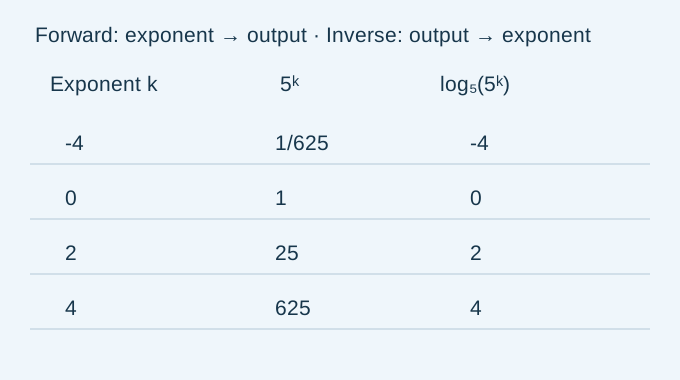
A short table connects exponents with outputs. Read from the exponent column to the output column to evaluate a power; reverse from the output to the exponent to recover a logarithm. These are inverse questions about the same relationship. You do not need a calculator for every exact power. Repeated multiplication can establish the value, while the inverse relationship checks that the final output answers the actual question.
Zero and negative exponents explain small arguments
Because any permitted logarithm base raised to zero equals one, log₅(1) = 0. A negative exponent takes a reciprocal: 5⁻⁴ = 1/625, so log₅(1/625) = −4. The negative sign belongs to the exponent, not to the argument. The argument one over six hundred twenty-five is still positive, so the logarithm is well-defined over the reals.
Do not turn that observation into the false rule that every fraction has a negative logarithm. Here the base exceeds one. With base one-fifth, the same argument one over six hundred twenty-five has logarithm positive four because (1/5)⁴ = 1/625. Precisely, for 0 < a < 1 and b > 1, log_b(a) is negative; with 0 < b < 1, the same proper-fraction argument gives a positive logarithm. The condition on the base matters. This clarification narrows an informal shortcut in the source explanation so that it is mathematically valid.
Real logarithms have a strict domain
For a real logarithm log_b(a), the base must be positive and different from one, and the argument must be strictly positive. Zero is excluded, not merely inconvenient. No real exponent on a positive base produces zero or a negative result. Base one is also unsuitable because every exponent gives one, preventing a unique inverse that could recover the exponent.
These restrictions apply to expressions before solving. For log₂(x − 3), the input must satisfy x > 3 because the complete argument is x − 3. The condition x > 0 alone is too weak. For instance, x = 2 is positive but makes the argument negative. Checking the variable’s sign is therefore not a substitute for checking the entire expression inside the logarithm.
PAUSE & TRYIs log₂(x−3) defined at x=3?Reveal explanation
No. The argument is zero, and a real logarithm requires a positive argument.
Reversing base and argument changes the exponent
Since 5⁴ = 625, raising 625 to the one-fourth power returns five. Therefore log₆₂₅(5) = 1/4. The base and argument have traded places, and the answer has become a reciprocal. For these same values, log₆₂₅(1/5) = −1/4 because the negative quarter power takes the reciprocal after the fourth root.
The reciprocal relationship assumes both logarithms exist and the original logarithm is nonzero. It is not a license to reverse every displayed expression blindly. If the argument of the first logarithm were one, reversing would make one the base, which is prohibited. Checking these boundary cases explains the restriction more reliably than memorizing a rule without its domain.
A transfer problem with a domain check
As an original extension, solve log₂(x − 3) = 5. Rewrite the relationship as x − 3 = 2⁵ = 32, then add three to get x = 35. Substitution gives a positive argument of thirty-two and recovers the required exponent five. Reporting thirty-two would confuse the logarithm’s argument with the requested variable.
Finish a logarithm problem by identifying its base, checking the argument’s domain and reversing your answer through exponentiation. For an argument between consecutive powers, the logarithm lies between their exponents when the base exceeds one. For example, 5³ < 200 < 5⁴ means 3 < log₅(200) < 4. This estimate is useful even when the exact value is not an integer, and it prevents overgeneralizing the source’s exact-power examples into a rule that all logarithms are whole numbers.
PAUSE & TRYSolve log₃(x+2)=4, retaining the domain.Reveal explanation
x+2=81, so x=79. The domain x>−2 is satisfied.
Turn the idea into practice.
A fresh set will help you use the relationship with different numbers.
Practice this skillEvidence & editorial note
New caption evidence. Only the opening 0–630 seconds was read for this article; later video sections and full audiovisual review remain unreviewed. Base restrictions and exact-power qualifications were checked independently. The equation extension is original teaching.
Original educational companion and SVG; not a transcript or whole-video summary.
Caption track SHA-256: 338afbb8de7f1f714f45eeeaf5fb760671b45b511d9f8942cad0d678ffabc51e
Source segment references are retained in the catalog. Full captions remain in the local research archive.