
The selected source segment factors quadratic and cubic inequalities, tests interval signs, and distinguishes strict from inclusive roots.
An inequality describes a set of inputs
An equation often asks for isolated roots, while an inequality can ask for whole intervals. The roots remain useful because they divide a polynomial’s domain into regions where its sign can be tested. In the reviewed opening portion of the linked Organic Chemistry Tutor lesson, a quadratic inequality and a factored cubic illustrate that process. This companion uses new polynomials, exact test points and a separate rational-expression extension. The reviewed caption scope is zero through approximately 8:32, ending before the final rational-root and synthetic-division example. Full audiovisual and educator review remain pending.
Put zero on one side before reading signs
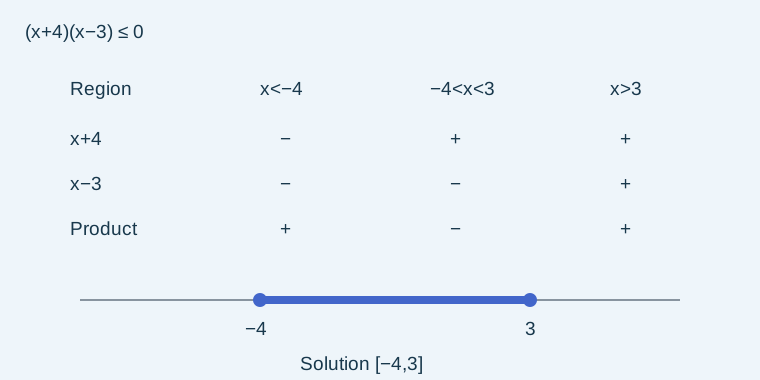
Suppose x²+x≤12. Move every term to one side to obtain x²+x−12≤0, then factor it as (x+4)(x−3)≤0. The roots are negative four and three. Those roots are boundaries, not automatically the whole answer. We need the inputs where the product is negative or zero. The number line separates three regions: x<−4, −4<x<3, and x>3. No factor can change sign inside one of these open regions without passing through a zero, so one test point per region is sufficient for this factored polynomial.
Test a point and explain the product
At x=−5, both factors are negative: (−1)(−8)=8, which is positive and fails the inequality. At x=0, the product is 4(−3)=−12, which succeeds. At x=4, the product is 8(1)=8, which fails. Therefore the open middle interval is selected. Because the original inequality includes equality, the two roots are also allowed, giving [−4,3]. The sign chart records factor signs separately so that a negative times a negative is visibly positive. Looking only at whether x itself is negative would not determine the polynomial’s sign.
Distinguish endpoint rules from interval signs
Changing ≤ to < keeps the same negative open region but removes both zero endpoints, producing (−4,3). Changing ≤ to ≥ selects the two exterior regions and includes the roots, producing (−∞,−4] ∪ [3,∞). Infinity is not a real endpoint that can be included with a square bracket. If the question then asks how many integers satisfy the original nonpositive inequality, count −4 through 3 inclusively: eight integers. The number of unit gaps, seven, is a different count. A precise interval is therefore a useful intermediate result before answering a finite counting question.
Add a third factor without changing the method
For (x+2)(x−1)(x−4)≤0, the boundaries are −2, 1 and 4. Test −3, 0, 2 and 5 in the four regions. Their products are respectively −28, 8, −8 and 28. The selected regions are x<−2 and 1<x<4, with all three roots included because equality is permitted. The final set is (−∞,−2] ∪ [1,4]. Each root here has multiplicity one, so the sign changes at every boundary. The linked lesson explains that multiplicity condition; it should not be replaced by a rule that signs always alternate for every polynomial.
An even multiplicity changes the pattern
Consider (x−1)²(x−4)>0. Except at x=1, the squared factor is positive. Thus the product’s sign is determined by x−4, and the solution is x>4. The sign does not flip when crossing x=1 because a square stays nonnegative on either side. The root at one is excluded by the strict inequality, but excluding that root does not create an allowed interval nearby. This original extension clarifies why testing factors is safer than applying alternating signs without checking multiplicity. At x=0 and x=2, the product is negative in both cases, despite crossing the double root.
A denominator adds forbidden points
For the separate rational inequality (x−1)/(x−4)≤0, the boundary at one comes from a numerator zero and the boundary at four from a denominator zero. Testing x=0 gives a positive quotient, x=2 gives a negative quotient, and x=5 gives a positive quotient. The middle region is selected. Include x=1 because it makes the expression zero, but exclude x=4 because the expression does not exist there. The solution is [1,4), containing the integers one, two and three. This extension is our own explanation; the selected source scope is polynomial inequalities rather than rational inequalities.
Write a solution another learner can audit
Begin with an equivalent comparison to zero, display the factorization, and list every zero or undefined point. Show at least one substituted test value in each region instead of merely announcing a sign pattern. Then distinguish the open-region decision from endpoint inclusion. For a polynomial, equality can include roots; for a rational expression, it never permits division by zero. Finally express the set in the requested form and, if needed, count only inputs satisfying all additional restrictions. These steps make the reasoning visible and expose errors that a final interval alone could conceal.
PAUSE & TRYDoes x=3 satisfy (x−1)/(x−3)≤0? Why?Reveal explanation
No. The denominator is zero at x=3; an inclusive inequality cannot make an undefined expression valid.
Turn the idea into practice.
A fresh set will help you use the relationship with different numbers.
Practice this skillEvidence & editorial note
New public English captions acquired. Read scope 0–512 seconds only; remaining source portions and full audiovisual presentation unreviewed. Examples, diagrams and explicitly labeled extensions are original.
Original instructional companion; not a transcript reproduction.
Caption track SHA-256: bba4e2802656986b9cfa6eef6d187431a361a0bd2ef4c70ae96a5c398d5fe231
Source segment references are retained in the catalog. Full captions remain in the local research archive.