
Practice connecting observations, individual preferences and current care instructions to a justified nurse-aide response. The cases are original teaching examples, not reproduced examination items.
Build a response rather than memorize a slogan
A nurse aide's useful contribution starts with noticing the person in front of them. A worksheet can make a decision seem simple, yet a real care plan contains individual preferences, assistance levels and reporting instructions. The purpose of these original cases is to connect an observed cue to an appropriate action, not to teach a universal shortcut that replaces the plan. Read each case, say what is known, and identify what still needs clarification. Treat the resident as a participant rather than an object of a task.
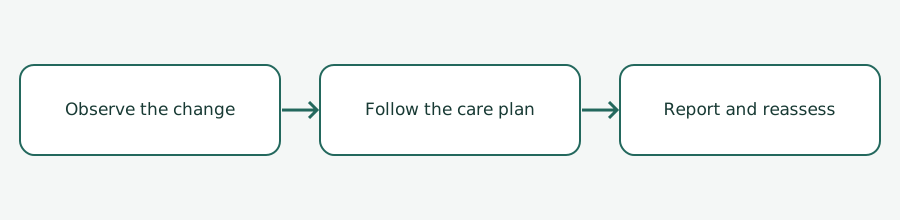
Three distinctions guide this resource. Observation is not diagnosis: describe what happened without inventing its cause. Assistance is not takeover: help with the parts that require support while preserving safe independence. Completion is not resolution: a routine task may be finished while a newly reported concern still needs the nurse's assessment. The original diagram separates those stages so a learner can explain where a proposed response goes wrong.
New changes in function
A resident who usually converses clearly is newly difficult to understand. A useful report describes what is different, when it began, and what was observed. The nurse assesses the clinical meaning; the aide does not need a diagnosis before reporting.
An appropriate response is: Promptly report the specific change, when it began, and how today's observation differs from usual function. Consider the tempting alternative, try an independently chosen treatment first and report the change only if the treatment does not work. It is inappropriate because the aide does not diagnose and treat a new functional change independently. Before choosing, identify which detail in the scenario makes this distinction relevant.
PAUSE & TRYIn this case, which stated detail should guide the aide's decision?Reveal explanation
Relevant cue: A resident who usually converses clearly is newly difficult to understand. A useful report describes what is different, when it began, and what was observed. The nurse assesses the clinical meaning; the aide does not need a diagnosis before reporting.
Accurate vital-sign records
A respiratory-rate observation differs from the expected range in the care instructions. Measure using the correct equipment and method for the task. If a reading is unexpected, follow the reporting and recheck process instead of inventing a more reassuring result.
An appropriate response is: Record the actual reading using the taught method and report it according to the assigned limits. Consider the tempting alternative, treat the unexpected measurement as a diagnosis and independently change the resident's treatment before seeking advice. It is inappropriate because a measurement supports assessment but does not authorize independent diagnosis or prescribing. Before choosing, identify which detail in the scenario makes this distinction relevant.
PAUSE & TRYIn this case, which stated detail should guide the aide's decision?Reveal explanation
Relevant cue: A respiratory-rate observation differs from the expected range in the care instructions. Measure using the correct equipment and method for the task. If a reading is unexpected, follow the reporting and recheck process instead of inventing a more reassuring result.
Consistent weight measurement
A weekly weight differs substantially from the previous entry. Weights are comparable only when the technique and units are understood. Record the measurement accurately and communicate an unexpected change for assessment.
An appropriate response is: Use the assigned safe weighing method, record the actual weight and units, and report an unusual change to the nurse. Consider the tempting alternative, record the scale display without its unit because the numerical change is the only information needed for the trend. It is inappropriate because units are necessary for a meaningful comparison. Before choosing, identify which detail in the scenario makes this distinction relevant.
PAUSE & TRYIn this case, which stated detail should guide the aide's decision?Reveal explanation
Relevant cue: A weekly weight differs substantially from the previous entry. Weights are comparable only when the technique and units are understood. Record the measurement accurately and communicate an unexpected change for assessment.
Measuring intake and output
An assigned urine collection has a measured amount different from usual. The record describes what was actually measured. Identify the container, units, and time; report unusual findings or a measurement that cannot be obtained reliably.
An appropriate response is: Document the amount actually measured in the assigned units, identifying any portion that could not be measured reliably. Consider the tempting alternative, estimate a complete amount after a spill and enter it as an exact measurement without noting the uncertainty. It is inappropriate because an estimate must not be represented as a complete measured result. Before choosing, identify which detail in the scenario makes this distinction relevant.
PAUSE & TRYIn this case, which stated detail should guide the aide's decision?Reveal explanation
Relevant cue: An assigned urine collection has a measured amount different from usual. The record describes what was actually measured. Identify the container, units, and time; report unusual findings or a measurement that cannot be obtained reliably.
Comfort-focused care
A resident receiving end-of-life care shows a new sign of discomfort. Comfort care remains active, person-centered care. Personal hygiene, presence, symptom observation, and communication continue within the plan and the aide's role.
An appropriate response is: Continue the individualized comfort measures and report new symptoms or requested changes in the plan. Consider the tempting alternative, provide every routine activity on the usual schedule without considering the resident's current comfort preferences. It is inappropriate because an individualized comfort plan takes the person's preferences into account. Before choosing, identify which detail in the scenario makes this distinction relevant.
PAUSE & TRYIn this case, which stated detail should guide the aide's decision?Reveal explanation
Relevant cue: A resident receiving end-of-life care shows a new sign of discomfort. Comfort care remains active, person-centered care. Personal hygiene, presence, symptom observation, and communication continue within the plan and the aide's role.
Responding when a resident is found on the floor
A resident is found seated on the floor after an unwitnessed event. A fall requires prompt assessment and protection. Use the facility response, stay with the person, and describe what was actually found; the aide does not independently clear injuries.
An appropriate response is: Stay with the resident and summon the nurse before an unassessed move unless immediate danger requires action. Consider the tempting alternative, leave to complete other assigned work because the resident is awake and requests only a small amount of help. It is inappropriate because a fallen resident still needs protection and timely assessment. Before choosing, identify which detail in the scenario makes this distinction relevant.
PAUSE & TRYIn this case, which stated detail should guide the aide's decision?Reveal explanation
Relevant cue: A resident is found seated on the floor after an unwitnessed event. A fall requires prompt assessment and protection. Use the facility response, stay with the person, and describe what was actually found; the aide does not independently clear injuries.
Urgent breathing changes
A resident is newly unable to speak comfortably because of breathing difficulty. A new serious breathing change is an urgent observation. Follow the emergency response and the aide's taught role rather than waiting for a diagnosis or changing treatment independently.
An appropriate response is: Immediately summon qualified help using the facility's urgent-response procedure and remain within the aide's taught emergency role. Consider the tempting alternative, give food or drink to settle the resident before notifying the nurse about the severe breathing change. It is inappropriate because oral intake does not address respiratory distress and can add risk. Before choosing, identify which detail in the scenario makes this distinction relevant.
PAUSE & TRYIn this case, which stated detail should guide the aide's decision?Reveal explanation
Relevant cue: A resident is newly unable to speak comfortably because of breathing difficulty. A new serious breathing change is an urgent observation. Follow the emergency response and the aide's taught role rather than waiting for a diagnosis or changing treatment independently.
Recording actual care
An aide notices a copied entry does not match the care provided today. A care record represents actual work and observations. Timely accurate entries and traceable corrections are more useful than a record that only looks complete.
An appropriate response is: Record care and observations that actually occurred, and use the approved traceable correction process when an existing entry is wrong. Consider the tempting alternative, enter a planned bath as completed before the resident has agreed to it or the aide has provided the care. It is inappropriate because planned care must not be represented as completed care. Before choosing, identify which detail in the scenario makes this distinction relevant.
PAUSE & TRYIn this case, which stated detail should guide the aide's decision?Reveal explanation
Relevant cue: An aide notices a copied entry does not match the care provided today. A care record represents actual work and observations. Timely accurate entries and traceable corrections are more useful than a record that only looks complete.
Limits of an aide's assessment
A resident has a new skin observation that the aide cannot explain. The aide contributes valuable observations while the licensed team assesses and plans treatment. Knowing the cause is not a prerequisite for communicating a concerning change.
An appropriate response is: Report the specific observed finding and change from baseline promptly without independently diagnosing the cause or prescribing a treatment. Consider the tempting alternative, keep the change private until the aide can explain its cause, even though the observation is new and concerning. It is inappropriate because the aide does not need to determine a cause before reporting. Before choosing, identify which detail in the scenario makes this distinction relevant.
PAUSE & TRYIn this case, which stated detail should guide the aide's decision?Reveal explanation
Relevant cue: A resident has a new skin observation that the aide cannot explain. The aide contributes valuable observations while the licensed team assesses and plans treatment. Knowing the cause is not a prerequisite for communicating a concerning change.
Transfer the method to your next practice session
Try a short mixed set before rereading. For each answer, explain the observation, the care principle and why the alternatives do not meet the need. A correct letter without that explanation can conceal guessing. If a question introduces an unfamiliar device, a new symptom or conflicting instructions, do not fill the gap with a remembered routine. Recognize the need for guidance and report the unresolved issue.
These cases are original learning examples. They are not official CNA examination items, a state handbook, a complete clinical procedure or permission to perform a task. Use the current handbook for the testing jurisdiction and supervised training for practical skills. Clinical educator review and learner calibration remain pending. No video transcript, time code or audiovisual review is claimed for this independently written guide.
Turn the idea into practice.
Apply the rule to a new case, then explain your choice.
Practice this skillSources & authorship
Independently authored educational guide informed by official curriculum, resident-rights and infection-prevention references. Raw web-read evidence is retained separately from failed direct HTTP attempts.
Original editorial explanation and original contextual cases; no official question or extended source text reproduced.
Independent educator review is pending. This guide is not an official exam paper or a video transcript.
Federal nurse aide training curriculum