
An original California road-rule guide for turning a visual control and a traffic conflict into a defensible action.
A decision method that preserves the conditions
Begin with the road user who could be harmed by an incorrect assumption. An apparent opening is not enough: it may be a forbidden lane crossing, the inside of a truck turn, or an intersection whose exit is blocked. The useful habit is to identify the control, trace the conflicting paths, and decide whether a lawful, complete movement is available.
This guide uses original examples to distinguish a permission from a physical possibility. A signal can announce a driver’s intention without changing another person’s priority. A green light can permit progress while a blocked exit still requires waiting. Each example preserves the condition attached to the rule, so it can be transferred to a different street layout.
Read signals and regulatory signs
Start by naming the control actually facing your lane. A stop sign, circular red signal, red arrow, warning sign, and flashing signal can require different decisions. Then identify the limit line, crosswalk, conflicting traffic, and available space beyond the junction. This prevents treating a familiar color as permission for every maneuver.
Stop completely at the limit line, then check and yield before proceeding. A rolling stop leaves the crossing conflict unresolved and does not satisfy a stop sign. Consider two cases: A STOP sign has a painted limit line. A quiet side street has a STOP sign but no approaching cars. In each case, the relevant action is stop completely before the limit line or crosswalk. The contrast is roll through slowly if the intersection looks empty. This comparison tests which condition controls the choice, rather than whether an action is physically possible.
Slow and give conflicting road users the right-of-way; stop when necessary. Yielding depends on the traffic conflict, whereas an unconditional rolling entry ignores it. Consider two cases: A YIELD sign faces a driver entering a road with crossing traffic. A cyclist is approaching the conflict point beside a YIELD sign. In each case, the relevant action is slow down, yield to conflicting road users, and stop when necessary. The contrast is accelerate because a yield sign grants priority. This comparison tests which condition controls the choice, rather than whether an action is physically possible.
Do not enter where prohibited. If already traveling the wrong way, correct the entry safely instead of continuing against traffic. A familiar destination never authorizes traveling against the permitted direction. Consider two cases: A driver turns onto a ramp and faces a WRONG WAY sign. Red road reflectors face a driver traveling at night against traffic. In each case, the relevant action is correct the wrong-way entry when safe. The contrast is continue until a convenient exit appears. This comparison tests which condition controls the choice, rather than whether an action is physically possible.
A red circle crossed by a diagonal line prohibits the maneuver or action pictured. The symbol is a restriction, not a recommendation whose force depends on traffic volume. Consider two cases: A turn symbol appears inside a red circle with a diagonal slash. A driver sees a crossed-out U-turn symbol before an intersection. In each case, the relevant action is do not perform the action shown inside the crossed circle. The contrast is perform it only if no police vehicle is visible. This comparison tests which condition controls the choice, rather than whether an action is physically possible.
A circular yellow railroad warning or crossbuck calls for looking, listening, slowing, and preparing to stop. A warning identifies a possible train conflict before the tracks are reached. Consider two cases: A yellow circular railroad warning sign appears ahead. A crossbuck is visible beyond a curve on a rural road. In each case, the relevant action is slow, look, listen, and prepare to stop. The contrast is assume that no gate means no train can approach. This comparison tests which condition controls the choice, rather than whether an action is physically possible.
A five-sided school sign warns the driver to slow and watch for children crossing. Children may be less visible and less predictable than vehicle traffic. Consider two cases: A five-sided school warning sign is posted beside a street. Children are gathering near a five-sided school sign. In each case, the relevant action is slow down and stop for children in the crosswalk. The contrast is keep speed because the sign concerns only school buses. This comparison tests which condition controls the choice, rather than whether an action is physically possible.
A diamond-shaped warning sign identifies a road condition or hazard to anticipate. Warnings support preparation before the hazard, rather than granting a right-of-way. Consider two cases: A diamond-shaped sign shows a curve ahead. A diamond warning sign announces a narrowing road. In each case, the relevant action is identify the indicated hazard and adjust driving before reaching it. The contrast is treat every diamond as a command to stop immediately. This comparison tests which condition controls the choice, rather than whether an action is physically possible.
At a circular red light, a right turn is permitted only after stopping, yielding, and checking for a prohibition. A possible right turn does not cancel the full stop or pedestrian priority. Consider two cases: A driver wants to turn right at a circular red light with no prohibiting sign. The road appears empty when a driver reaches a circular red signal to turn right. In each case, the relevant action is stop fully, yield, and turn only when safe and not prohibited. The contrast is turn without stopping whenever the road looks empty. This comparison tests which condition controls the choice, rather than whether an action is physically possible.
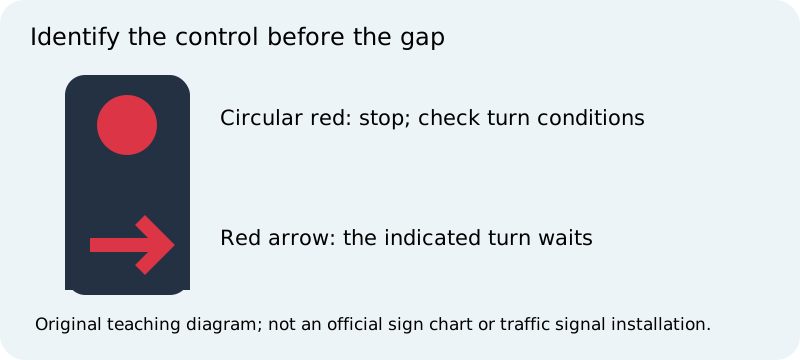
A red arrow prohibits the indicated turn until the applicable green signal appears. Stopping first does not create the right-turn permission associated with an ordinary circular red signal. Consider two cases: A driver faces a red right arrow and wants to turn right. A red left arrow faces a turn lane with no oncoming vehicles. In each case, the relevant action is wait for the green signal that permits this turn. The contrast is turn after a stop if no vehicle is approaching. This comparison tests which condition controls the choice, rather than whether an action is physically possible.
A flashing red signal requires a complete stop and then a safe, yielding entry. Flashing does not reduce red to a caution-only instruction. Consider two cases: A traffic signal flashes red on the driver's approach. Late at night, an intersection is operating with flashing red signals. In each case, the relevant action is make a complete stop and yield before proceeding safely. The contrast is slow without stopping because the red light is flashing. This comparison tests which condition controls the choice, rather than whether an action is physically possible.
A steady yellow warns of red; stop when it can be done safely, otherwise cross cautiously. The decision depends on safe stopping, not racing a signal change. Consider two cases: A signal turns yellow while the driver can stop smoothly before the line. A driver sees yellow with ample stopping space on a dry road. In each case, the relevant action is make the available safe stop. The contrast is accelerate to beat the coming red light. This comparison tests which condition controls the choice, rather than whether an action is physically possible.
A flashing yellow signal calls for slowing, alertness, and cautious progress, not an automatic stop rule. It warns of a hazard while leaving the driver responsible for actual conflicts. Consider two cases: A flashing yellow signal controls a clear approach. A driver meets flashing yellow at an intersection with limited visibility. In each case, the relevant action is slow and proceed cautiously. The contrast is accelerate because flashing yellow guarantees a clear road. This comparison tests which condition controls the choice, rather than whether an action is physically possible.
A green light does not authorize entering an intersection without an available exit space. Blocking the intersection transfers a downstream queue into crossing traffic and pedestrian space. Consider two cases: The light is green but vehicles fill the lane beyond the intersection. A queue ends inside the far crosswalk while the driver's signal is green. In each case, the relevant action is wait outside the intersection until its exit lane clears. The contrast is enter because green always overrides downstream congestion. This comparison tests which condition controls the choice, rather than whether an action is physically possible.
Compare a circular red with a red arrow: a complete stop is necessary in both situations, but it does not create the same turn permission. Explain which control applies before discussing traffic gaps. Repeat the comparison with a warning sign and a mandatory prohibition.
PAUSE & TRYA following vehicle honks while the green-light exit lane remains blocked. Which response follows the applicable California handbook rule?Reveal explanation
Wait outside the intersection until its exit lane clears. Blocking the intersection transfers a downstream queue into crossing traffic and pedestrian space.
Resolve right-of-way conflicts
Describe arrival order, road layout, and intended movement before asserting priority. A simultaneous arrival, an earlier arrival, and a vehicle joining a through road are different cases. An unprotected left turn creates a conflict with approaching traffic even when the driver has already signaled. The aim is to avoid a collision, not to defend an assumed entitlement.
At an all-way stop, the first vehicle to arrive and stop goes first when the movement is safe. Arrival order resolves this case; arrival at the same time requires a different tie rule. Consider two cases: At a four-way stop, another vehicle has stopped before the driver arrives. A driver reaches an all-way stop after a cyclist has already stopped. In each case, the relevant action is yield to the road user that stopped before you. The contrast is go first because vehicles on the right always outrank earlier arrivals. This comparison tests which condition controls the choice, rather than whether an action is physically possible.
At an uncontrolled intersection, simultaneous arrivals yield to the road user on the right. The rule breaks a simultaneous-arrival tie; it does not cancel pedestrians or obvious collision risks. Consider two cases: Two vehicles reach an uncontrolled intersection at the same time, one on the driver's right. A cyclist approaches from the right as a driver simultaneously reaches an uncontrolled intersection. In each case, the relevant action is yield to the road user on the right. The contrast is accelerate to turn the simultaneous arrival into a race. This comparison tests which condition controls the choice, rather than whether an action is physically possible.
At an uncontrolled T intersection, traffic on the through road has priority over traffic from the terminating road. Joining the through movement creates the conflict that must be yielded to. Consider two cases: A driver reaches the end of a road at an uncontrolled T intersection. A cyclist on the through road approaches a vehicle waiting at the terminating road. In each case, the relevant action is yield to road users on the through road. The contrast is enter first because the turn signal has been on longer. This comparison tests which condition controls the choice, rather than whether an action is physically possible.
An unprotected left turn yields to pedestrians and dangerously close approaching traffic. A turn signal announces intention; it does not reserve a gap through opposing traffic. Consider two cases: A driver wants an unprotected left turn as an oncoming car approaches closely. A pedestrian crosses the destination road during an unprotected left turn. In each case, the relevant action is yield until pedestrians and approaching traffic leave a safe opening. The contrast is turn because signaling creates the right-of-way. This comparison tests which condition controls the choice, rather than whether an action is physically possible.
Sketch two paths and mark where they intersect. Decide which road user must wait and why. Change one fact, such as arrival time or the presence of a through road, and explain whether the decision changes. A right-of-way rule never excuses deliberately entering an obvious collision.
PAUSE & TRYThe through signal is green while the driver waits for an unprotected left turn. Which response follows the applicable California handbook rule?Reveal explanation
Yield until pedestrians and approaching traffic leave a safe opening. A turn signal announces intention; it does not reserve a gap through opposing traffic.
Share space with vulnerable and large road users
People and vehicles do not have equal visibility, stopping distance, or maneuvering needs. A truck can hide a car in its blind area, a stopped car can hide a pedestrian, and a motorcycle may need the entire lane to avoid surface hazards. Identify what you cannot currently see before treating an apparent gap as available space.
If the truck's side mirrors cannot be seen, the driver may be unable to see your vehicle. Large vehicle blind spots can hide a nearby vehicle despite the truck having large mirrors. Consider two cases: A car follows a truck where the truck's side mirrors are not visible. A car stays beside the rear quarter of a large truck. In each case, the relevant action is leave the blind area when safe. The contrast is assume large mirrors eliminate every blind spot. This comparison tests which condition controls the choice, rather than whether an action is physically possible.
Avoid cutting into a truck's stopping space and then slowing suddenly. A truck needs more stopping distance than a passenger vehicle traveling at the same speed. Consider two cases: A driver passes a large truck just before a red light. A freeway exit is close after a driver draws alongside a truck. In each case, the relevant action is keep enough space ahead of the truck for its longer stopping distance. The contrast is merge as soon as the car's front bumper clears the truck. This comparison tests which condition controls the choice, rather than whether an action is physically possible.
Stay out of the space beside a turning truck because its rear wheels track inside the front wheels. A wide initial movement can be part of a tight turn, not an invitation to squeeze alongside. Consider two cases: A truck swings left before a right turn. A large vehicle's right signal is on but it moves away from the curb. In each case, the relevant action is wait behind the truck while its rear wheels complete the turn. The contrast is pass on the right because the truck initially moved left. This comparison tests which condition controls the choice, rather than whether an action is physically possible.
Give a motorcycle its lane space and do not try to pass it within the same lane. A small physical width does not remove the rider's need for maneuvering space. Consider two cases: A motorcycle occupies a lane wide enough to tempt a car to squeeze past. A driver follows a motorcycle approaching a rough patch. In each case, the relevant action is wait or use a legal separate-lane passing opportunity. The contrast is pass inside the same lane because the motorcycle is narrow. This comparison tests which condition controls the choice, rather than whether an action is physically possible.
For an approaching emergency vehicle using siren and red lights, move right and stop safely; clear an intersection first. An emergency route must remain open without creating a new obstruction in the junction. Consider two cases: An ambulance with siren and red lights approaches from behind on a clear road. A fire engine with siren and red lights approaches while a driver is inside an intersection. In each case, the relevant action is clear any intersection, then move to the right and stop safely until it passes. The contrast is stop immediately in the middle of the intersection. This comparison tests which condition controls the choice, rather than whether an action is physically possible.
Yield to a pedestrian crossing at a marked or unmarked crosswalk. Paint is not the only basis for pedestrian priority at a crossing. Consider two cases: A pedestrian crosses an unmarked crosswalk at an intersection. A driver turns into a road where a pedestrian is already crossing. In each case, the relevant action is allow the pedestrian to finish safely. The contrast is proceed because the crossing has no flashing lights. This comparison tests which condition controls the choice, rather than whether an action is physically possible.
Do not pass a vehicle stopped at a crosswalk because it may be screening a pedestrian. The stopped vehicle can hide the very person for whom it is yielding. Consider two cases: A car ahead stops immediately before a crosswalk. A vehicle in the neighboring lane has stopped at a pedestrian crossing. In each case, the relevant action is stay back rather than passing the stopped vehicle. The contrast is pass because no pedestrian is visible from the driver's seat. This comparison tests which condition controls the choice, rather than whether an action is physically possible.
For each case ask what might be hidden and what escape space the other road user needs. Contrast waiting behind a turning truck with squeezing alongside it. Contrast yielding at an unmarked crosswalk with assuming that only paint creates a pedestrian crossing.
PAUSE & TRYThe driver cannot see why another car has stopped at a crosswalk. Which response follows the applicable California handbook rule?Reveal explanation
Stay back rather than passing the stopped vehicle. The stopped vehicle can hide the very person for whom it is yielding.
Respect lane barriers and special lanes
Read the line pattern and lane purpose before selecting a path. Double white lines, shared center turning lanes, and turnouts serve different functions. Physical pavement is not automatically a legal travel lane. The convenience of reaching an exit or bypassing a queue does not change the meaning of a lane barrier.
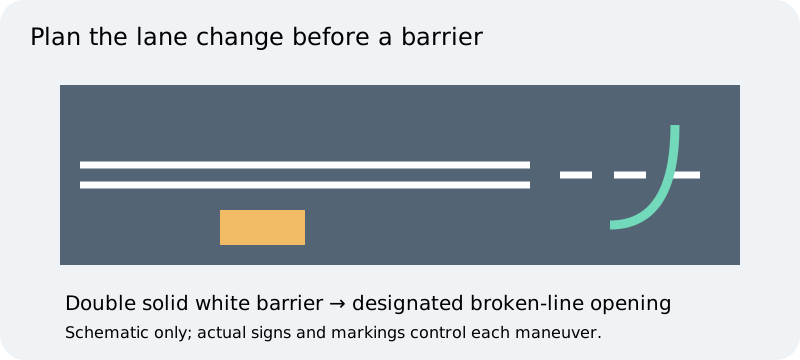
Do not change lanes across double solid white lines; use a designated broken-line opening. These lines form a lane barrier even if the adjacent lane seems convenient. Consider two cases: Double solid white lines separate a carpool lane from regular traffic. A driver sees a tempting gap across double white lines. In each case, the relevant action is stay in the lane until a permitted broken-line opening appears. The contrast is cross because white lines never restrict lane changes. This comparison tests which condition controls the choice, rather than whether an action is physically possible.
Use a center left-turn lane only to prepare for a permitted turn, not for through travel or passing. Its shared two-way turning function makes prolonged travel conflict with opposing users. Consider two cases: Traffic is queued beside a center left-turn lane. A driver considers using the center turn lane to pass several cars. In each case, the relevant action is use it only for lawful turn preparation. The contrast is drive through it until congestion ends. This comparison tests which condition controls the choice, rather than whether an action is physically possible.
On a slow two-lane trip where passing is unsafe and five or more vehicles follow, use a turnout to let them pass. A turnout relieves the queue without pressuring others into unsafe opposing-lane passes. Consider two cases: A slow vehicle has five cars queued behind on a two-lane road where passing is unsafe. Six vehicles follow a slow camper approaching a signed turnout. In each case, the relevant action is use the turnout when safe. The contrast is block the turnout to keep a fixed place in traffic. This comparison tests which condition controls the choice, rather than whether an action is physically possible.
Describe a legal alternative when the desired lane change is blocked. Compare a designated HOV opening with a double-white barrier, and a short turn preparation with using the shared center lane to bypass traffic. Plan early enough that the lawful option is still available.
PAUSE & TRYA turnout appears while at least five vehicles remain trapped behind a slow driver. Which response follows the applicable California handbook rule?Reveal explanation
Use the turnout when safe. A turnout relieves the queue without pressuring others into unsafe opposing-lane passes.
Prepare a turn without surprising others
Communicate early and then check for conflicts. A turn signal tells others what you intend; it does not require a pedestrian or cyclist to surrender priority. A bicycle lane has a limited turn-approach allowance, not a general car lane function. Missing a turn is a routing problem that can be corrected safely farther along.
Signal about 100 feet before a turn while still checking for conflicting road users. The signal communicates a planned maneuver; it does not grant priority or replace observation. Consider two cases: A driver plans a right turn at the next intersection. A driveway left turn is approaching. In each case, the relevant action is signal early and check for conflicts. The contrast is signal only after beginning the turn. This comparison tests which condition controls the choice, rather than whether an action is physically possible.
When turning right, enter a permitted bicycle lane only within 200 feet of the turn and after checking for bicyclists. The limited approach allowance does not make a bicycle lane a general driving lane. Consider two cases: A right turn is approaching beside a bicycle lane. A driver wants to merge into a bicycle lane several blocks before turning. In each case, the relevant action is check bicyclists; enter within 200 feet of turning. The contrast is drive in the bicycle lane for the entire block whenever convenient. This comparison tests which condition controls the choice, rather than whether an action is physically possible.
If a turn is missed, continue until a safe and legal opportunity to change route appears. A route error is less dangerous than a last-second lane change or abrupt stop. Consider two cases: A driver realizes a planned turn was just missed. A navigation app announces a turn too late for a safe lane change. In each case, the relevant action is continue to a safe rerouting opportunity. The contrast is cut across lanes immediately to avoid extra distance. This comparison tests which condition controls the choice, rather than whether an action is physically possible.
Review the sequence signal, mirrors, blind area, position, speed, and yielding. Explain why a last-second route instruction does not justify a sudden lane crossing. For a bicycle-lane approach, include both the permitted distance and the cyclist check.
PAUSE & TRYA passenger suddenly requests a turn while the car enters the junction from a position where that turn cannot be made safely and legally. Which response follows the applicable California handbook rule?Reveal explanation
Continue to a safe rerouting opportunity. A route error is less dangerous than a last-second lane change or abrupt stop.
Decide whether a pass has a safe completion
A pass is not complete merely when your vehicle draws level with another. You need lawful space for the initial move, room for the entire maneuver, and a safe return. A road edge or shoulder does not become a passing lane because it looks wide enough. If any required part of the maneuver is unavailable, waiting preserves the options.
Do not leave the paved or main-traveled road to pass another vehicle on the right. A shoulder or road edge is not automatically an additional passing lane. Consider two cases: A car ahead waits to turn left and the only right-side space is an unpaved shoulder. A driver sees dirt beside a slow vehicle and considers passing there. In each case, the relevant action is wait instead of passing on the shoulder. The contrast is use the shoulder whenever it is physically wide enough. This comparison tests which condition controls the choice, rather than whether an action is physically possible.
Before passing, make sure there is enough space to return safely to your lane. Returning too early can cut off the passed vehicle and remove its stopping space. Consider two cases: A driver is almost past a car on a two-lane road. A driver sees only part of the passed vehicle in the rearview mirror. In each case, the relevant action is pass only with a safe return space. The contrast is return as soon as the driver's seat is ahead of the other bumper. This comparison tests which condition controls the choice, rather than whether an action is physically possible.
Before choosing to pass, explain where the vehicle will return and whether the path remains on the paved or main-traveled roadway. Identify the hidden assumption in a plan that counts only the first half of a pass. Never rely on another driver making an emergency stop to complete your maneuver.
PAUSE & TRYA driver wants to merge back before the passed vehicle is fully visible. Which response follows the applicable California handbook rule?Reveal explanation
Pass only with a safe return space. Returning too early can cut off the passed vehicle and remove its stopping space.
Turn the idea into practice.
Apply the rule to a new case, then explain your choice.
Practice this skillSources & authorship
Independent teaching guide based on the linked official references. It is not a video transcript or an official sample exam. Worked traffic situations and illustrations are original.
Original instructional synthesis and scenarios.
Independent educator review is pending. This guide is not an official exam paper or a video transcript.
California DMV navigating the roadsCalifornia DMV laws and rules of the roadCalifornia DMV laws and rules of the road cont1