
An original guide connecting visibility, following space, low-traction control, vehicle security, and readiness to drive.
A decision method that preserves the conditions
Many avoidable driving errors begin before a visible emergency. The driver is following too closely, looking only at the nearest bumper, selecting a speed for yesterday’s conditions, or assuming a medication cannot matter because it was prescribed. Preparation means noticing those conditions while a smooth correction is still possible.
Use the following comparisons as explanations rather than a list of guaranteed safe numbers. The handbook provides specific numbers for particular settings, but safe behavior also depends on visibility, other road users, surface grip, and the driver’s ability to observe and respond. A study exercise cannot replace supervised driving instruction or official assessment.
Select a speed for the visible conditions
Distinguish a posted maximum from a speed that is safe for the actual road. Restricted views and narrow access points require early speed control. The California handbook also specifies limits for alleys, blind intersections, and certain obstructed railroad approaches. Learn the condition attached to each number rather than assigning the number to every nearby road.
Drive at a speed safe for current conditions even when it is below the posted maximum. A posted maximum does not establish a safe speed for every weather, visibility, or traffic condition. Consider two cases: Heavy rain reduces visibility on a road posted at its normal maximum. Dense traffic leaves little room to react even below the speed limit. In each case, the relevant action is reduce speed to account for the current visibility and road conditions. The contrast is maintain the posted maximum because it is always safe. This comparison tests which condition controls the choice, rather than whether an action is physically possible.
At a blind intersection without corner stop signs, the California handbook gives a 15 mph limit. A restricted view requires time to discover crossing traffic before entering the conflict. Consider two cases: No STOP signs control a blind intersection and the driver cannot see crossing traffic clearly. A building hides the side road at an unsigned intersection. In each case, the relevant action is approach at no more than 15 mph. The contrast is use 25 mph because every city intersection has that limit. This comparison tests which condition controls the choice, rather than whether an action is physically possible.
California's handbook sets the speed limit in an alley at 15 mph. An alley combines limited sight lines and close access points, so a normal street speed is inappropriate. Consider two cases: A driver enters an alley behind a commercial building. A delivery pickup travels through a California alley. In each case, the relevant action is use 15 mph or less as conditions require. The contrast is use the surrounding highway's speed limit. This comparison tests which condition controls the choice, rather than whether an action is physically possible.
Within 100 feet of a railroad crossing with an obstructed 400-foot view in either direction, the handbook's limit is 15 mph unless specified control conditions apply. The restricted-view rule concerns discovering a train early enough; it is not a universal speed for every crossing. Consider two cases: Within 100 feet of an uncontrolled railroad crossing, the driver cannot see 400 feet along the tracks. Buildings block the 400-foot track view at an uncontrolled crossing with no gates, warning signal, or flag person. In each case, the relevant action is use the applicable restricted-view limit of 15 mph or less. The contrast is apply 15 mph only after the vehicle reaches the rails. This comparison tests which condition controls the choice, rather than whether an action is physically possible.
Explain why driving at a posted maximum can still be unsafe in rain or congestion. For a numerical rule, state the location and exceptions in words before recalling the number. Check that the described crossing is uncontrolled and has the restricted view relevant to the question.
PAUSE & TRYA driver approaches tracks under the handbook's restricted-view crossing conditions. Which response follows the applicable California handbook rule?Reveal explanation
Use the applicable restricted-view limit of 15 mph or less. The restricted-view rule concerns discovering a train early enough; it is not a universal speed for every crossing.
Prepare for rain, fog, and low traction
Reduce the demand on traction and visibility before reaching the hazard. Rain, fog, pooled water, and wet leaves can impair the information or tire grip needed to maneuver. More light is not always better: high beams can create reflected glare. Smooth steering and early speed reduction are more reliable than a sudden correction after grip has already deteriorated.
Use low-beam headlights in rain instead of relying on parking lights. Low beams improve visibility without the problems associated with high-beam glare in poor weather. Consider two cases: Rain starts while the driver is using only parking lights. A driver switches on windshield wipers during a daytime shower. In each case, the relevant action is use low-beam headlights and adjust speed and space. The contrast is use parking lights alone because it is daytime. This comparison tests which condition controls the choice, rather than whether an action is physically possible.
In fog, reduce speed and use low beams rather than high beams. High beams reflect back from fog and can worsen the driver's view. Consider two cases: Fog makes a freeway's distant lanes disappear. A driver enters a fog bank on an unfamiliar road. In each case, the relevant action is slow and use low beams, keeping enough stopping space. The contrast is use high beams to see through the fog. This comparison tests which condition controls the choice, rather than whether an action is physically possible.
Slow before standing water and avoid abrupt control inputs on slippery surfaces. Reduced tire-road contact makes sudden steering or braking more likely to destabilize the vehicle. Consider two cases: Standing water is visible across part of the lane. A driver approaches wet leaves on a curve. In each case, the relevant action is slow early and use smooth inputs. The contrast is accelerate to force the tires through the water. This comparison tests which condition controls the choice, rather than whether an action is physically possible.
Choose one weather condition and list the change to observation, lighting, speed, and following space. Explain why the tempting action of making a sudden turn or using brighter beams may worsen that specific condition. Do not apply a dry-road following assumption unchanged in poor weather.
PAUSE & TRYA driver must cross a shallow area of pooled water. Which response follows the applicable California handbook rule?Reveal explanation
Slow early and use smooth inputs. Reduced tire-road contact makes sudden steering or braking more likely to destabilize the vehicle.
Build observation and following space
Look beyond the vehicle immediately ahead while continuing to monitor nearby traffic and mirrors. A time-based following gap adapts to speed better than a fixed visual distance. A cut-in is a reason to restore space, not an invitation to compete. Mirrors and electronic information do not remove the need to check the actual blind area before changing lanes.
Scan at least 10 seconds ahead while continuing to observe nearby traffic. Looking farther ahead reveals developing conflicts before they demand emergency action. Consider two cases: A driver is focusing only on the bumper immediately ahead. A queue is beginning to form farther down the road. In each case, the relevant action is scan at least 10 seconds ahead. The contrast is watch only the center of the car immediately ahead. This comparison tests which condition controls the choice, rather than whether an action is physically possible.
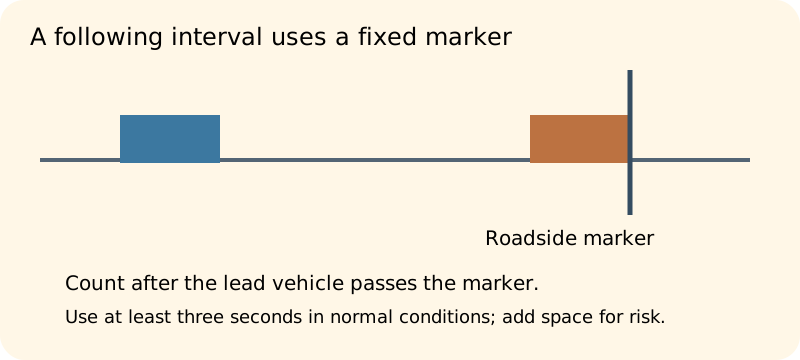
Use the three-second rule for a safe following distance, adding space when conditions require it. A time gap scales with vehicle speed and provides room for perception and response. Consider two cases: A car ahead passes a fixed roadside marker. A driver wants a repeatable way to assess the gap in normal conditions. In each case, the relevant action is use a three-second minimum, adding space for risk. The contrast is use one car length at every speed. This comparison tests which condition controls the choice, rather than whether an action is physically possible.
If a vehicle merges too close ahead, ease off the accelerator to restore space. Restoring a cushion reduces the chance that the merge becomes a rear-end conflict. Consider two cases: A vehicle merges directly into the driver's following gap. A car changes lanes leaving too little room ahead. In each case, the relevant action is ease off and restore the gap. The contrast is accelerate to close the gap in protest. This comparison tests which condition controls the choice, rather than whether an action is physically possible.
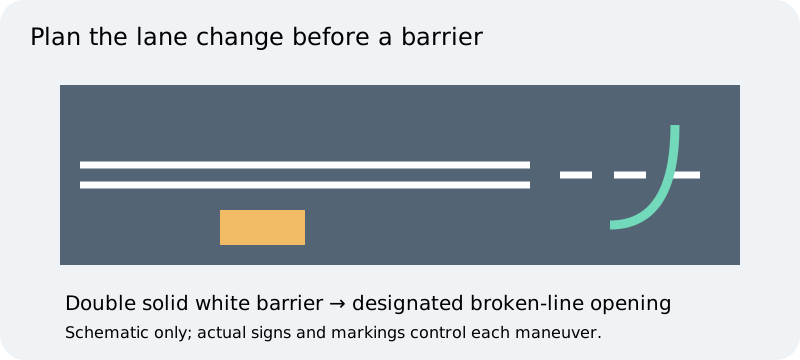
Use a brief shoulder check in addition to mirrors before a lane change. Mirrors do not show every area beside and slightly behind a vehicle. Consider two cases: A driver wants to move into a neighboring lane. Mirrors appear clear but a motorcycle may be beside the rear quarter. In each case, the relevant action is check mirrors and blind areas before moving. The contrast is rely exclusively on mirrors because they cover every area. This comparison tests which condition controls the choice, rather than whether an action is physically possible.
Do not read or send texts while driving; stop safely off the road if a necessary call or message must be handled. A short glance can remove observation and response capacity during a developing hazard. Consider two cases: A text notification appears while the driver is moving. A driver wants to type a destination while traveling through an intersection. In each case, the relevant action is leave the device alone until safely parked. The contrast is read the text quickly because traffic is slow. This comparison tests which condition controls the choice, rather than whether an action is physically possible.
Use a fixed roadside object to explain a time gap without calculating a distance. Then describe how a close merge changes the gap and what a smooth response looks like. Give a reason for a shoulder check that is different from checking only the rearview mirror.
PAUSE & TRYA driver considers reading a message because traffic is moving slowly. Which response follows the applicable California handbook rule?Reveal explanation
Leave the device alone until safely parked. A short glance can remove observation and response capacity during a developing hazard.
Use slope and curb information when parking
Parking has two separate questions: whether the location is lawful, and how the vehicle will remain secure. Curb colors regulate who may stop and for what purpose. On a slope, wheel direction and the parking brake reduce the risk that a mechanical failure puts the vehicle into traffic. Uphill and downhill positions next to a curb are not interchangeable.
When parking downhill at a curb, turn the front wheels toward the curb and set the parking brake. If the vehicle rolls, the curb can help stop it from moving into traffic. Consider two cases: A driver parks facing downhill beside a raised curb. A car is left on a downhill street with a curb. In each case, the relevant action is point wheels toward the curb; set the brake. The contrast is point the wheels away from the curb into traffic. This comparison tests which condition controls the choice, rather than whether an action is physically possible.
When parking uphill at a curb, turn the front wheels away from the curb, allowing the curb to catch a roll back. The required direction differs from downhill parking because the potential roll is reversed. Consider two cases: A car is parked facing uphill beside a curb. A driver wants a backup against rolling backward from an uphill curbside space. In each case, the relevant action is point wheels away from the curb; set the brake. The contrast is use the downhill rule and point the wheels toward the curb. This comparison tests which condition controls the choice, rather than whether an action is physically possible.
A red curb prohibits stopping, standing, or parking, subject to specified signed exceptions such as authorized buses. A quick passenger drop-off is still a stop and is not a general red-curb exception. Consider two cases: A driver wants a brief drop-off at a red curb without any applicable exception. A passenger asks the driver to wait at an ordinary red curb. In each case, the relevant action is find a lawful stopping location. The contrast is stop if the hazard flashers are on. This comparison tests which condition controls the choice, rather than whether an action is physically possible.
A blue curb reserves parking for an eligible vehicle displaying the required disabled-person placard or plates. An empty reserved space does not remove its eligibility restriction. Consider two cases: A driver without qualifying placard or plates finds an empty blue-curb space. A driver without a qualifying placard or plates wants to use a blue space for a very short errand. In each case, the relevant action is choose a regular lawful space without the disabled-parking eligibility restriction. The contrast is use the space for any visit shorter than five minutes. This comparison tests which condition controls the choice, rather than whether an action is physically possible.
Draw the direction a parked vehicle would roll if its restraint failed, then choose the wheel direction that uses the curb appropriately. In a colored-curb case, state whether a quick drop-off is still a stop and whether an empty reserved space changes eligibility.
PAUSE & TRYA driver without qualifying disabled-parking credentials finds a shopping lot blue space empty while regular spaces are full. Which response follows the applicable California handbook rule?Reveal explanation
Choose a regular lawful space without the disabled-parking eligibility restriction. An empty reserved space does not remove its eligibility restriction.
Recognize alcohol and medication impairment
A numerical alcohol threshold is not a guarantee of safe driving. Prescription and nonprescription medicines can impair perception and reaction, and younger drivers have a different numerical BAC rule. An open container also has a location rule separate from whether the driver is drinking. Read the precise condition instead of relying on a general impression that an action is harmless.
Do not drive when a medication or drug impairs safe driving, even if it was legally prescribed. Legality of possession does not guarantee unimpaired perception, judgment, or reaction. Consider two cases: A prescribed medicine makes a driver drowsy. An over-the-counter remedy warns against operating machinery. In each case, the relevant action is arrange another safe way to travel. The contrast is drive because only illegal drugs are covered by DUI rules. This comparison tests which condition controls the choice, rather than whether an action is physically possible.
A BAC below the numerical legal limit does not establish that driving is safe or exclude impairment-based DUI consequences. Impairment is a functional safety issue, not a permission granted by a low numerical reading. Consider two cases: A driver feels impaired despite a BAC below the usual adult limit. A driver claims a low BAC makes slowed reactions irrelevant. In each case, the relevant action is arrange other transport if alcohol is impairing safe vehicle control. The contrast is treat every below-limit reading as a safety guarantee. This comparison tests which condition controls the choice, rather than whether an action is physically possible.
In an ordinary passenger car, store an open alcohol container in the trunk or another permitted non-passenger area, not the glove box. Closing the glove box does not convert an open container into a sealed one. Consider two cases: An opened bottle is carried in the passenger area of an ordinary car. A driver puts an open alcohol container in the glove box. In each case, the relevant action is use a legally permitted non-passenger storage area. The contrast is hide it in the glove box. This comparison tests which condition controls the choice, rather than whether an action is physically possible.
The handbook lists 0.01% BAC as an illegal threshold for drivers under 21. The under-21 rule must not be replaced with the ordinary adult threshold. Consider two cases: A 20-year-old driver asks which BAC threshold applies. A 19-year-old assumes the ordinary adult BAC number applies. In each case, the relevant action is apply the under-21 0.01% rule rather than the ordinary adult threshold. The contrast is apply only the ordinary 0.08% adult threshold. This comparison tests which condition controls the choice, rather than whether an action is physically possible.
Compare three questions: Is the person impaired? Which BAC rule applies? Where may an opened container be carried? Keep these questions separate. Explain why a legal prescription, a below-limit reading, or a closed glove box does not automatically resolve the relevant rule.
PAUSE & TRYA driver under 21 has a BAC of 0.01%. Which response follows the applicable California handbook rule?Reveal explanation
Apply the under-21 0.01% rule rather than the ordinary adult threshold. The under-21 rule must not be replaced with the ordinary adult threshold.
Separate practice from official licensing steps
An instruction permit authorizes a defined form of supervised practice. It is not the same as a full license, and a learning website cannot issue it. Supervising-driver age requirements depend on the learner’s age. Official knowledge tests have their own conduct rules, so open-book studying should not be confused with permission to use aids during the actual examination.
Do not use a handbook, phone, or other testing aid during the official knowledge test. Practice can be open-book, but the official knowledge test has separate conduct requirements. Consider two cases: An applicant wants to consult a phone during a DMV knowledge test. A learner asks whether the handbook can stay open during the official exam. In each case, the relevant action is put away the handbook, phone, and other testing aids. The contrast is use the handbook because it is published by DMV. This comparison tests which condition controls the choice, rather than whether an action is physically possible.
An adult permit holder practices with a California-licensed driver at least 18; for minors the supervising driver must be at least 25, sitting close enough to take control. A permit is supervised practice authority, not an unrestricted independent license. Consider two cases: A 17-year-old permit holder plans ordinary practice with a 22-year-old licensed friend. A minor learner asks whether an 18-year-old licensed sibling can supervise ordinary practice. In each case, the relevant action is use a California-licensed supervisor aged at least 18 for an adult learner or 25 for a minor, seated close enough to take control. The contrast is treat any licensed teenager as an eligible supervisor for a minor. This comparison tests which condition controls the choice, rather than whether an action is physically possible.
A first-time applicant without another state or California license must obtain an instruction permit before the behind-the-wheel test. Knowledge preparation, supervised practice, and practical assessment are different stages. Consider two cases: A first-time unlicensed applicant wants to book a road test before obtaining a permit. An applicant has no existing California or out-of-state license. In each case, the relevant action is complete the permit stage first. The contrast is treat a third-party practice score as an instruction permit. This comparison tests which condition controls the choice, rather than whether an action is physically possible.
Explain the difference between studying, taking the knowledge test, supervised practice, and the behind-the-wheel test. Check the learner’s age before choosing a supervisor. Use the official application information for documents, current fees, appointment availability, and any exceptions.
PAUSE & TRYAn unlicensed learner wants to skip the permit stage. Which response follows the applicable California handbook rule?Reveal explanation
Complete the permit stage first. Knowledge preparation, supervised practice, and practical assessment are different stages.
Turn the idea into practice.
Apply the rule to a new case, then explain your choice.
Practice this skillSources & authorship
Independent teaching guide based on the linked official references. It is not a video transcript or an official sample exam. Worked traffic situations and illustrations are original.
Original instructional synthesis and scenarios.
Independent educator review is pending. This guide is not an official exam paper or a video transcript.
California DMV navigating the roads cont1California DMV laws and rules of the road cont1California DMV safe drivingCalifornia DMV safe driving cont2California DMV alcohol and drugsCalifornia DMV the testing processCalifornia DMV getting an instruction permit and drivers license