
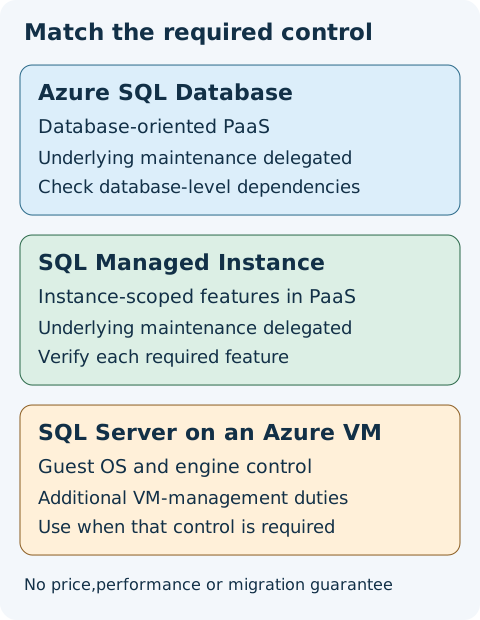
A service comparison needs an explicit requirement. Use a fictional compatibility checklist to distinguish managed database and instance options, recognize when host control changes the decision, and keep unknown costs or dependencies visible.
A useful answer names the boundary
Azure SQL Database and Azure SQL Managed Instance both provide managed SQL Server database platforms. The important distinction is not that one is managed and the other is unmanaged. SQL Database is oriented around database-level capabilities, with options such as a single database or a pool. Managed Instance supplies additional instance-scoped capabilities and a collection of databases sharing instance resources. SQL Server on Azure Virtual Machines adds control over the guest operating system and database engine, with additional responsibility for managing that virtual machine.
Start by writing down the requirement that would actually change the choice. A new application might need a supported relational schema and queries while wanting to delegate underlying maintenance. An existing application might depend on a supported instance feature. Another system might require a particular service installed on the database host. Those are different constraints. A familiar product name, an unmeasured performance claim or a desire to “move to the cloud” cannot replace the missing requirement.
Build a small evidence ledger
For a conceptual comparison, use three entries: what must remain, what may change, and what the team wants the provider to operate. Record a required database feature separately from a requirement for OS administration. Compatibility with a database engine does not automatically grant access to the machine underneath it. Likewise, the ability to create several databases does not prove that a particular instance-scoped dependency is supported.
The retained Microsoft overview describes SQL Database and Managed Instance as PaaS options that delegate underlying OS and database software maintenance, including built-in backup and patching capabilities. The same overview describes the VM option as providing full administrative control over its SQL Server instance and guest OS. More control changes the responsibility ledger. It is not evidence that one option is always cheaper, that a team has no remaining work on PaaS, or that every application will migrate unchanged.
Worked case: a small publishing cooperative
Fictional case: a publishing cooperative is replacing two internal applications. Its new rights-register application needs ordinary relational tables and supported database-level queries. The team wants the provider to handle underlying OS maintenance. A second, older catalog application depends on an instance-scoped facility that a separate compatibility review has explicitly confirmed is supported by Managed Instance and unavailable in the cooperative’s proposed SQL Database configuration. Neither application needs an agent installed on the database host.
First evaluate the new rights register. The stated database-level needs do not establish a requirement for the older application’s instance facility. SQL Database remains a candidate without borrowing that unrelated dependency. Now evaluate the catalog application. The explicit compatibility result makes Managed Instance the supported managed candidate for that particular facility. This is a conditional conclusion: the case supplies the compatibility result, rather than assuming every unspecified instance feature works. Both applications can still require customer decisions about schemas, queries, data quality and permitted access.
Finally challenge the comparison by asking what evidence would reverse it. If the catalog facility could be removed without violating the requirements, its reason for preferring Managed Instance would weaken. If the rights register acquired a verified unsupported dependency, it would need a fresh comparison. Treat each dependency as evidence that belongs to one workload; do not turn a successful choice for one application into a rule for the entire organization.
A changed host condition changes the decision
Suppose a third cooperative application must run a required custom process on the same Windows guest host as SQL Server. Its team explicitly accepts operating-system administration. Database compatibility is no longer the only controlling constraint. SQL Server on an Azure VM exposes that guest-host control; the two managed database options do not provide the same OS-administration boundary. Identify the host requirement before comparing managed database features.
The reverse counterexample is equally important. A team that merely wants to query data does not establish a need to administer an OS. Choosing a VM solely because it offers more controls adds a management obligation without showing that the controls are needed. Conversely, choosing PaaS while retaining an essential unsupported host dependency ignores the requirement. A justified decision explains both why the selected boundary fits and why the strongest alternative fails an explicit condition.
What the comparison cannot settle
These conceptual cases do not determine a real bill, a capacity license, a current regional offering or a measured response time. No price values or service-level promises are supplied. Keep those fields unknown instead of deriving them from the word managed. The choice also does not certify an application’s security or prove that every query is correct. A data-access rule still needs the organization’s requirements, and a query still needs a check against its actual rows and relationships.
Use the two application checks below to test the boundary rather than memorize a universal product ranking. This article is a standalone decision clinic. The relational lesson separately teaches rows, keys, normalization and basic SQL interpretation. Read it when the uncertainty concerns the data relationship or query result; return here when the uncertainty concerns the service control or compatibility requirement. Both are foundations, not instructions to migrate a live system.
Apply the guide
A fictional application needs a confirmed supported instance-scoped facility, wants underlying OS patching delegated, and does not require guest OS administration. Does that fact pattern justify choosing a VM just because it offers more control? Explain the stronger managed candidate and the necessary compatibility assumption.Reveal explanation
No. A Managed Instance candidate can match the stated instance scope while keeping PaaS maintenance delegation, provided that the actual required facility is confirmed supported. More VM control is not a reason without a requirement for it; generic compatibility claims cannot replace the explicit feature check.
A proposal compares two managed SQL options but only says “the existing app must keep working.” Name the missing evidence before declaring either option the unique correct choice.Reveal explanation
List the actual database-level, instance-scoped and host/OS dependencies, then check which candidate supports them and which operations the team wants delegated. Without those conditions, neither a unique service choice nor an unchanged-migration claim follows.
Turn the idea into practice.
Apply the rule to a new case, then explain your choice.
Practice this skillSources & authorship
Original comparison grounded in retained Microsoft Learn Azure SQL overview paragraphs, reviewed 2026-11-02. Cases and compatibility assumptions are fictional; no Microsoft example, exam item or artwork is reproduced.
Original OpenExam prose and diagram, authored 2026-11-02.
Independent educator review is pending. This guide is not an official exam paper or a video transcript.
What Is Azure SQL? - Azure SQL | Microsoft Learn