
Original teaching cases for selected Part 107foundations, with explicit operational and source-version boundaries. Not a transcript, official test or operational approval.
A checklist is a process, not an aircraft repair
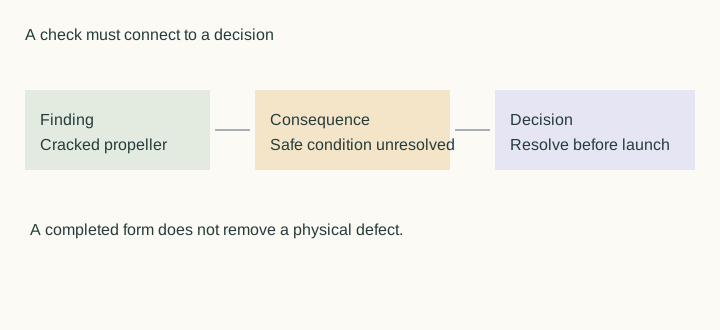
A checklist is valuable when each finding can change the operational decision. Imagine a crew discovers a cracked propeller but checks every remaining box and launches because the mission is short. The completed form has not established a safe aircraft. The unresolved defect is still present. A proper response follows applicable aircraft instructions and resolves the condition before relying on the affected component. The same reasoning applies to intermittent control links, insecure payloads and other flight-critical findings.
It helps to say what a check proves and what it does not. A working video feed shows something about the image link, but it does not automatically establish that every command-and-control function is reliable. A high battery percentage does not establish that a damaged or degraded battery retains its original usable capacity. A newly registered aircraft is not necessarily airworthy for the actual mission. Separate these claims rather than treating one successful check as proof of the whole system.
Plan the actual energy and loading problem
An original energy model can make the logic visible. Suppose a planning exercise provides one hundred watt-hours, requires twenty watt-hours to remain in reserve and assumes a constant draw of two hundred forty watts. Eighty watt-hours remain before the reserve. Dividing by the draw gives one-third of an hour, or twenty minutes. Using the entire one hundred watt-hours would spend the specified reserve. The result belongs to the supplied idealized model; it is not guaranteed real endurance.
Actual planning must consider loading, battery condition, wind, temperatures, hovering and the intended route. Total mass is only one issue. A payload can remain below a mass limit yet shift balance outside an allowed range, interfere with a sensor or move during flight. Each change may require a different assessment. The useful lesson is to track assumptions explicitly and revisit the ones that changed, rather than using a previous successful flight as an unlimited capability claim.
Give each crew member a clear role
A visual observer can contribute only if the relevant information reaches the person making the flight decision. Before launch, decide how traffic, lost visual contact, people entering the route and other hazards will be called out. A crew that has no effective communication path has not solved the coordination problem merely by assigning the title observer. The remote pilot in command retains the operational responsibility described by the rule.
Visual contact also has a specific purpose. A clear camera image is not automatically the same as the visual line of sight needed to assess aircraft location, attitude, direction and surrounding traffic. When a building blocks the aircraft, the continuing video stream does not itself remove the visual-contact issue. Use the actual rule and any applicable granted relief. Do not treat the customer's desire for a particular shot as permission to cross that boundary.
Trace a contingency through the real site
Automatic behavior must be examined in the environment where it will occur. A return-to-home mode may be useful, but its programmed altitude or path can conflict with an obstacle, changed home point, people or applicable restrictions. The right question is not simply whether the aircraft has the feature. Ask what it actually does when the link is lost, where it will go and which assumptions that behavior depends on.
The plan should also identify an appropriate response when conditions change. An unexpected crowd, deteriorating weather or a blocked return route may invalidate the original assessment. Reassess, alter or safely terminate an operation that no longer fits its limits. In a genuine in-flight emergency, a necessary response has a specific safety purpose; it is not a general permission for future convenience. Any applicable requested explanation or accident reporting remains a separate question.
Preserve the record without confusing its role
After an abnormal event, accurate records help establish what happened. The FAA accident-reporting rule distinguishes qualifying injury and other-property damage from damage to the small unmanned aircraft itself. In a supplied property example, repair cost of seven hundred dollars and replacement cost of four hundred dollars lead to a lower qualifying cost of four hundred, not their sum. That comparison addresses one specified trigger; it does not answer every possible reporting question for every agency.
Build the final habit around a short chain: finding, consequence, decision and evidence. A failed required light affects a night-operation condition. A changed payload affects balance or endurance assumptions. A working Remote ID system does not establish that a pilot has met the separate knowledge-recency condition. A good learning explanation names that connection. It does not claim that this guide grants an approval, certifies field competence or replaces current official and aircraft-specific instructions.
Turn the idea into practice.
Apply the rule to a new case, then explain your choice.
Practice this skillSources & authorship
Independently written explanation and examples informed by linked FAA primary references. The older study guide supports stable weather/chart/performance topics only; currentnight distinctions use current FAA guidance and AC107-2A.
Original teaching and schematic diagrams; not officialquestion reproduction.
Independent educator review is pending. This guide is not an official exam paper or a video transcript.
Faa People NightFaa RemoteidFaa RegistrationFaa Ac107 2A