
Original teaching cases for selected Part 107foundations, with explicit operational and source-version boundaries. Not a transcript, official test or operational approval.
Four questions rather than one document
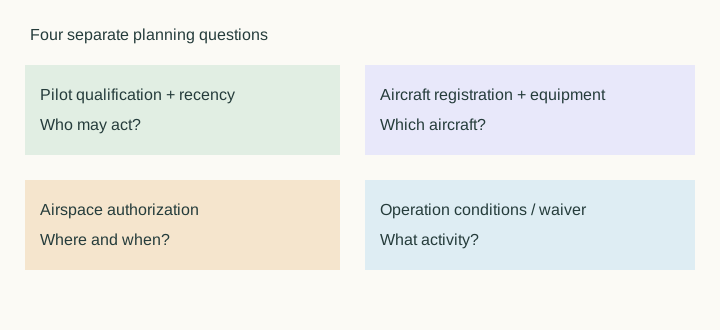
A useful planning folder has four different questions at its top. Is the person qualified and current? Is this aircraft registered and equipped as required? Does this location and altitude require airspace permission? Does the proposed operation fit the ordinary operating conditions or an actually granted exception? These questions interact, but a yes in one column cannot automatically fill the others. A pilot certificate is not aircraft registration, and neither is permission to enter controlled airspace.
Consider an original project involving a registered camera drone, a certificated pilot and a launch site inside controlled airport airspace. The first two facts do not answer the third question. The planner still needs the applicable airspace authorization. Change the site to an otherwise permissible uncontrolled location, and that particular authorization issue may change; the aircraft and pilot requirements remain. This is a better study habit than memorizing one document as a universal permission slip.
Read a granted authorization as a bounded object
A facility map can help identify an altitude at which an authorization request may be considered, but the displayed grid value is not itself a granted authorization. Imagine a map cell showing one hundred feet and a crew that has saved only a screenshot. The screenshot is evidence of a planning display, not evidence that the actual operation was authorized. A valid authorization has a scope that may include place, time, altitude and conditions. Keep that actual instrument in the planning chain.
Now suppose the project moves to another parcel or changes its operating time. The old approval should not simply be copied into the new folder without comparison. Ask which conditions changed and whether the approval still applies. This is a general reasoning pattern: evidence supports a claim only within the conditions that make it relevant. The same pattern appears in training records, aircraft configuration data and weather briefings.
Distinguish an airspace approval from a rule waiver
An operator may have airspace permission yet still lack authority for a proposed operation beyond visual line of sight. Airspace authorization answers an airspace question. A waiver, where available and granted, provides relief from its specified operating provision under stated conditions. Filing a request is not receiving that relief. Another operator's waiver also does not become yours merely because the aircraft model or customer project is similar.
Use a concrete transfer check. A pilot receives an authorization for a certain location and altitude, then decides to fly behind a building where required visual contact cannot be maintained. Which document addresses that new issue? The original airspace authorization alone does not. The pilot must examine the actual visual-contact requirement and any relevant granted relief, then alter or cancel a plan that does not fit. A good answer names the missing permission instead of saying only that the drone is registered.
Update old rules without overgeneralizing new ones
Night operation is a useful example of version-sensitive reasoning. An older study statement can describe a rule that has since changed. Current FAA guidance allows routine night operations under specified pilot-training and lighting conditions rather than treating every night mission as automatically waiver-only. The update does not mean that training alone is enough, or that a camera light substitutes for the required anti-collision system. Each condition still needs its own evidence.
Over-people categories add another layer. Aircraft eligibility and the planned operation both matter, and sustained flight over an open-air assembly can raise additional conditions. Installing Remote ID does not turn every aircraft into every category or remove every restriction. When studying a multiple-choice case, make a short checklist of the actual conditions rather than choosing whichever option contains the largest collection of permission-related words.
Turn the matrix into a defensible decision
Before launch, write one sentence for each permission column, together with the record that supports it. A person column might identify the applicable training record; an aircraft column might identify registration and the actual configuration. An airspace column should state the relevant classification and approval, if needed. The operation column should identify the planned activity and any particular category or waiver conditions being relied on.
Finally, ask what change would invalidate the plan. A new payload, a failed light, an unexpected crowd, a location change or lapsed knowledge recency can affect different columns. This exercise develops conditional reasoning without pretending that a learning app issues approvals. The original cases in this path are practice for reading and explaining such distinctions. Actual operations still require current sources, aircraft-specific knowledge and a complete assessment of the real flight.
Turn the idea into practice.
Apply the rule to a new case, then explain your choice.
Practice this skillSources & authorship
Independently written explanation and examples informed by linked FAA primary references. The older study guide supports stable weather/chart/performance topics only; currentnight distinctions use current FAA guidance and AC107-2A.
Original teaching and schematic diagrams; not officialquestion reproduction.
Independent educator review is pending. This guide is not an official exam paper or a video transcript.
Faa CertificationFaa People NightFaa WaiversFaa LaancFaa Registration