
The source demonstrates rewriting quadratic equations in zero form, finding factor pairs, and applying the zero-product property.
Distinguish the equation from the business condition
A quadratic equation can produce more than one algebraic answer. A quantity in a business story may have additional restrictions, such as a positive number of batches or a whole number of orders. The equation and the restriction contribute different information. Solving accurately and then returning a value that the story forbids is still an incorrect solution.
The source video illustrates standard zero form, factor pairs and the zero-product property. This companion adds new examples about admissible quantities and profit models. Its teaching text and diagrams are original. The selected caption segments are a concept reference, not a transcript replacement, and the video’s SAT description should not be treated as a statement about the GMAT syllabus.
Create a zero product deliberately
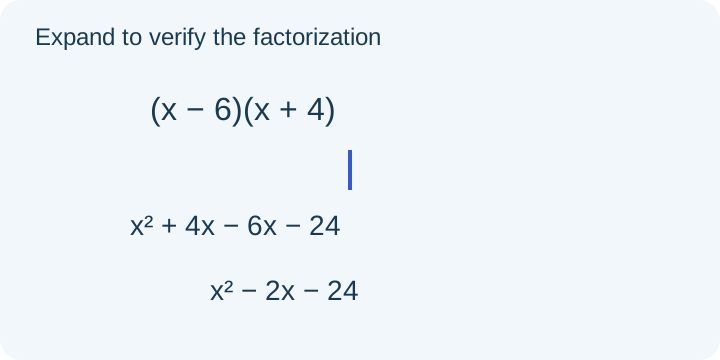
Suppose a positive quantity x satisfies x² − 2x = 24. Moving twenty-four to the left gives x² − 2x − 24 = 0. We seek two numbers with product negative twenty-four and sum negative two. Negative six and positive four satisfy both requirements, so the expression factors as (x − 6)(x + 4). Expanding gives x² + 4x − 6x − 24, which confirms the middle coefficient.
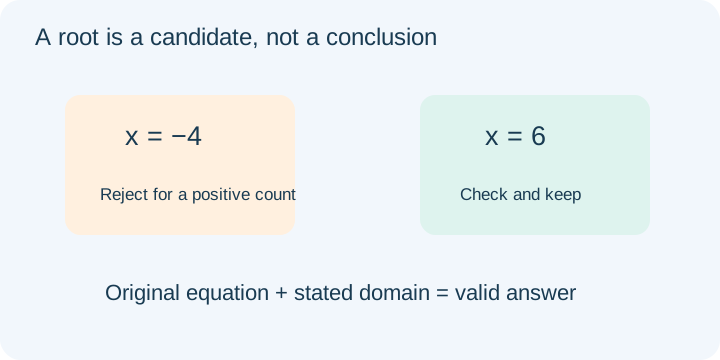
Because the product equals zero, at least one factor must equal zero. The candidates are x = 6 and x = −4. Substitution into the original equation checks each: thirty-six minus twelve equals twenty-four, and sixteen plus eight also equals twenty-four. Both satisfy the equation. The positivity condition is the separate reason that only six is allowed in this problem.
Use the right restriction at the right time
If x counted completed batches, the restriction would normally include integer and nonnegative conditions. If x were a signed change in inventory, a negative value might be meaningful. Read the actual statement rather than importing an assumption from another problem. A convenient context does not automatically justify every familiar restriction, and a purely algebraic prompt may allow all real solutions.
Denominators create another kind of restriction. Before multiplying through a fractional equation, note which inputs make an original denominator zero. A later polynomial may have such an input as a root, but it cannot be used in the original fraction. Checking the original equation is therefore stronger than checking only the equation after multiplication. It protects against transformations that enlarge the candidate set.
Answer the quantity that was requested
For the factored expression (x − 6)(x + 4), the roots sum to two and have product negative twenty-four. If a question asks for their product, selecting six would confuse one root with the requested combination. Expansion of (x − r)(x − t) gives x² − (r + t)x + rt, which explains how the coefficients encode those combinations without relying on a memorized sign pattern.
The pattern changes when the leading coefficient is not one. For ax² + bx + c = 0, with a nonzero, the root sum is −b/a and the root product is c/a. You can recover this by dividing the whole equation by a. Dividing only some terms breaks the relationship. As a quick check, 2x² − 4x − 48 = 0 has the same two roots as the original polynomial.
Recognize a maximum when a square exposes it
Not every quadratic question asks for roots. Consider a model P = 144 − (q − 8)² for a real quantity q greater than or equal to zero. Since a square cannot be negative, subtracting it can never produce more than one hundred forty-four. The bound is reached at q = 8, where the square equals zero. Thus the maximum value of P is one hundred forty-four, while the maximizing input is eight.
This reasoning avoids expanding and then trying to reverse the expansion. It also checks attainability: eight lies inside the stated domain. If the allowed inputs excluded eight, the same upper bound would not automatically be an attained maximum. Always examine the permitted inputs after identifying a candidate best value. Algebraic shape and domain jointly determine the answer.
Combine expansion, substitution and interpretation
For another original practice example, x² + x = 30 becomes (x + 6)(x − 5) = 0. The roots are negative six and five, and only five remains under a positive-input condition. Their sum is negative one and their product is negative thirty. These four conclusions come from one equation but answer different possible questions, so mark the target before doing arithmetic.
A robust final check has three parts. Expand factors to confirm the polynomial, substitute candidate roots into the original equation, and apply the stated restrictions before selecting the requested quantity. For a maximum problem, replace root substitution with checking the proposed input and the bound. None of these checks depends on a calculator; they depend on keeping each mathematical claim attached to the condition that justifies it.
PAUSE & TRYFor x² − 2x = 24 with x > 0, what is x?Reveal explanation
6
Turn the idea into practice.
A fresh set will help you use the relationship with different numbers.
Practice this skillEvidence & editorial note
Shared foundational video source already acquired for the SAT pilot. The indicated caption segments were read for this companion; full audiovisual review was not performed. New examples and instructional text are original and specific to this exam scope. The video’s SAT label is not evidence of current GRE or GMAT exam rules.
Original teaching text and diagrams; brief source synopsis only.
Caption track SHA-256: e8cd3ef004b42dc23f0cfa85bd3314b2b7a16612426c002ce58f3d5ebed9efc2
Source segment references are retained in the catalog. Full captions remain in the local research archive.