
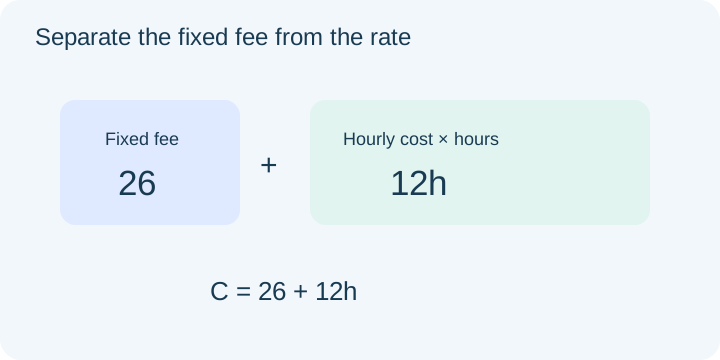
The source explains slope as change in output divided by change in input, then separates a constant charge from a variable charge.
Turn a price story into a model
A rental quote often combines an amount that is charged once with an amount that grows with usage. The two parts have different roles. A business decision requires the total at the intended usage, while a rate question asks how quickly that total changes. Keeping these objects separate is a useful foundation for quantitative problem solving, especially when answer choices include an intermediate result.
The source video introduces slope through changes in coordinates and later separates fixed and variable charges. This original companion develops new rental examples and a break-even comparison. The caption references document those foundational ideas; they do not establish current GMAT rules or supply these worked examples. Practise the arithmetic by hand because the official Quantitative Reasoning section does not allow a calculator.
Recover the rate before the fixed fee
Suppose a rental costs sixty-two dollars for three hours and one hundred ten dollars for seven hours. The prompt states that the price is a fixed fee plus a constant hourly charge. The extra four hours cost forty-eight dollars, so the hourly charge is twelve dollars. Dividing total cost by total hours would include the fixed fee and would not recover the marginal hourly rate.
Write the model as C = 12h + b, where h is hours and C is dollars. The first quote gives 62 = 36 + b, so the fixed fee is twenty-six dollars. Check the second quote independently: twelve times seven plus twenty-six equals one hundred ten. A model that fits only one observation is not enough when the question supplies two.
Read the model in more than one way
The equation C = 26 + 12h predicts a charge of twenty-six at zero hours. That is an algebraic intercept. In this story it also represents the fixed charge because the wording explicitly describes one. In other contexts, zero may fall outside a realistic domain, so an intercept need not be an observable transaction. The stated model and its allowed input range control the interpretation.
The change from three to seven hours is forty-eight dollars. Notice that the fixed fee disappears when two costs are subtracted. For any increase of two hours, the model predicts an extra twenty-four dollars, provided the constant-rate rule still applies. This lets you answer a change question without calculating complete totals. It also explains why a fixed fee affects average cost per hour but not the added cost of another hour.
Compare two offers at the same usage
Now consider a second offer with a fifty-dollar fixed fee and an eight-dollar hourly charge. Its lower hourly rate makes long rentals attractive, but the larger initial charge can make short rentals more expensive. Set the total costs equal: 26 + 12h = 50 + 8h. Subtracting the variable terms leaves 4h = 24, so the break-even usage is six hours.
At six hours, both plans cost ninety-eight dollars. This output is a different quantity from the six-hour input. Test one value on each side: at four hours the first plan costs seventy-four and the second eighty-two; at eight hours the first costs one hundred twenty-two and the second one hundred fourteen. These checks confirm the direction of the comparison rather than merely the location of equality.
Apply the actual decision constraint
If a business needs exactly five hours, the lower total determines the choice even though the other plan advertises a better hourly rate. If usage must be purchased in whole hours, a fractional algebraic crossing point might not be an available purchase. You would compare the neighboring integer quantities. Do not round a solution blindly; ask whether rounding preserves the intended inequality or reverses the decision.
An answer choice may give a rate, a fixed fee, a crossing time or a crossing cost. All can be meaningful numbers from the same story. Before selecting an answer, reread the requested unit. A dollar answer cannot answer a question asking for hours, even if it appears naturally in your calculation. Writing the unit next to each intermediate value reduces this particular error.
Check before moving to the next problem
Try a short transfer exercise under the first model. Nine hours cost one hundred thirty-four dollars. Increasing from three to seven hours costs forty-eight more dollars. Explain why the first calculation includes twenty-six and the second does not. Then explain why the first plan is less expensive below six hours and more expensive above six hours without drawing a detailed graph.
A compact solution routine is to identify the fixed and variable components, write an equation with units, solve for the requested quantity, and substitute into the original conditions. When the question compares two choices, add a sign check on each side of the crossing. These steps are small enough for mental arithmetic but precise enough to catch several common reasoning mistakes.
PAUSE & TRYFor C = 26 + 12h, find the added cost from h = 3 to h = 7.Reveal explanation
48
Turn the idea into practice.
A fresh set will help you use the relationship with different numbers.
Practice this skillEvidence & editorial note
Shared foundational video source already acquired for the SAT pilot. The indicated caption segments were read for this companion; full audiovisual review was not performed. New examples and instructional text are original and specific to this exam scope. The video’s SAT label is not evidence of current GRE or GMAT exam rules.
Original teaching text and diagrams; brief source synopsis only.
Caption track SHA-256: 950946b8f5c3b339f834de1c5cb2510c365a313ba18bcb0e1aae568aae2f77b2
Source segment references are retained in the catalog. Full captions remain in the local research archive.