
The selected source passage uses a work-time-rate table, converts hours and minutes, and explains why combined work adds rates rather than solo times.
Choose the quantity that can be combined
A completion time and a work rate describe the same process from opposite directions, but they behave differently when workers cooperate. Two workers finishing one shared job do not add their solo completion times. Under the usual assumption of independent constant contributions, they add the fractions of the job completed per hour. Deciding what is additive is the main reasoning step, not an optional detail after calculation.
The selected source passage from GMAT Ninja organizes machine work into work, time and rate, converts mixed time units and combines rates. This article uses independently written examples and a new staged-work diagram. Only the specified caption ranges support the companion; the full sixty-nine-minute video was not audiovisually reviewed. The source also discusses Data Insights elsewhere, but this companion stays within quantitative foundation learning.
Build a small table with consistent units
Suppose machine A completes a batch in ten hours and machine B completes the same batch in fifteen hours. Choose one batch as the work unit. Their rates are one tenth and one fifteenth of a batch per hour. With common denominator thirty, these are three thirtieths and two thirtieths, totaling five thirtieths, or one sixth. Together they therefore require six hours for a complete batch.
Check the result before moving on. Six hours is shorter than either solo time, as expected when both machines contribute positive output independently. In six hours A completes six tenths of the batch and B completes six fifteenths. Those contributions sum to one. Averaging ten and fifteen would give twelve and one half hours, which is slower than the faster machine alone and contradicts the collaboration model.
Keep stages separate when the team changes
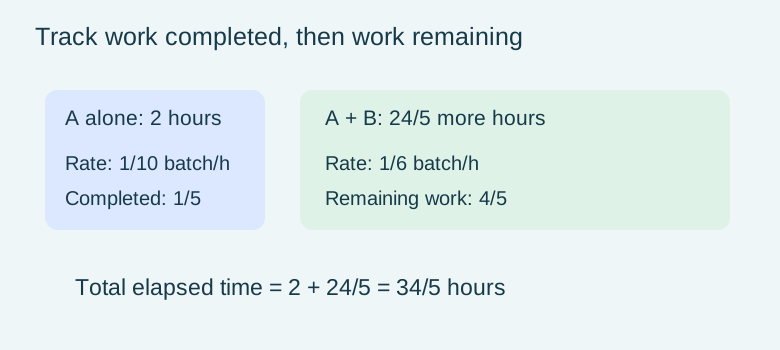
Now let A work alone for two hours before B joins. During the solo stage, A completes two tenths, or one fifth, of the batch. Four fifths remain. The joint rate is still one sixth of a batch per hour, so the additional time is four fifths divided by one sixth, or twenty-four fifths of an hour. This is four hours and forty-eight minutes.
The total time from A starting is two plus twenty-four fifths, or thirty-four fifths of an hour: six hours and forty-eight minutes. These two answers describe different clocks. A question asking for additional time needs twenty-four fifths; one asking for total elapsed time needs thirty-four fifths. Mark the starting event for the clock before selecting an answer. The timeline diagram makes that boundary explicit.
Find an unknown worker by subtracting rates
If two machines together finish a batch in four hours and A alone needs twelve hours, the joint rate is one quarter and A contributes one twelfth. B must contribute the difference, one sixth of a batch per hour, and therefore takes six hours alone. Subtracting twelve minus four to obtain eight hours mixes completion times in a way that does not conserve completed work.
Unit conversion belongs before rate combination. A machine completing a batch in two hours and thirty minutes takes five halves of an hour, so its rate is two fifths of a batch per hour. Writing the time as 2.30 hours would be wrong because thirty minutes is half an hour, not thirty hundredths. Decide whether minutes or hours make the arithmetic simpler and keep the same unit for every row.
Distinguish removal from productive contribution
A leak is a negative contribution to filling. If an inlet fills a tank in six hours while a leak empties a full tank in fifteen hours, the net rate is one sixth minus one fifteenth, or one tenth of a tank per hour. An initially empty tank fills in ten hours under the stated constant-rate assumptions. Adding the two rates would treat the leak as another inlet and predict an unrealistically quick fill.
The sign comes from the physical direction of the contribution, not from whether the rate number is larger or smaller. If removal equals input, the tank level does not increase. If removal exceeds input, an empty tank cannot fill under that model. A negative algebraic completion time is a signal to revisit feasibility, not a legitimate time to report as the solution.
Transfer the rate table to production decisions
Four identical machines make ninety-six units in three hours. That is twelve machine-hours of operation, so each machine produces eight units per hour. Six machines operating for five hours provide thirty machine-hours and produce two hundred forty units under the same constant-rate assumption. Scaling only the machine count or only the duration would miss one of the two changes.
For a final check, write work equals rate times time for every stage or machine group. Verify that partial contributions sum to the requested total, confirm whether an answer is a rate or a time, and state which clock the time measures. These checks expose common distractors without depending on an option’s position, numerical size or resemblance to a memorized formula. They also clarify exactly which assumptions your model needs.
Turn the idea into practice.
A fresh set will help you use the relationship with different numbers.
Practice this skillEvidence & editorial note
New GMAT Ninja caption source. Only indicated caption ranges reviewed for this companion; full audiovisual review not performed. Original examples and diagram. The en-orig caption track succeeded; the additional en track returned HTTP429 and was not retried. Metadata was obtained separately without media download. Data Insights portions of the source are outside this companion scope.
Caption track SHA-256: 4ee6ff873311d2851790a993013e9229b336d1b129162faa0862d4522480768a
Source segment references are retained in the catalog. Full captions remain in the local research archive.