
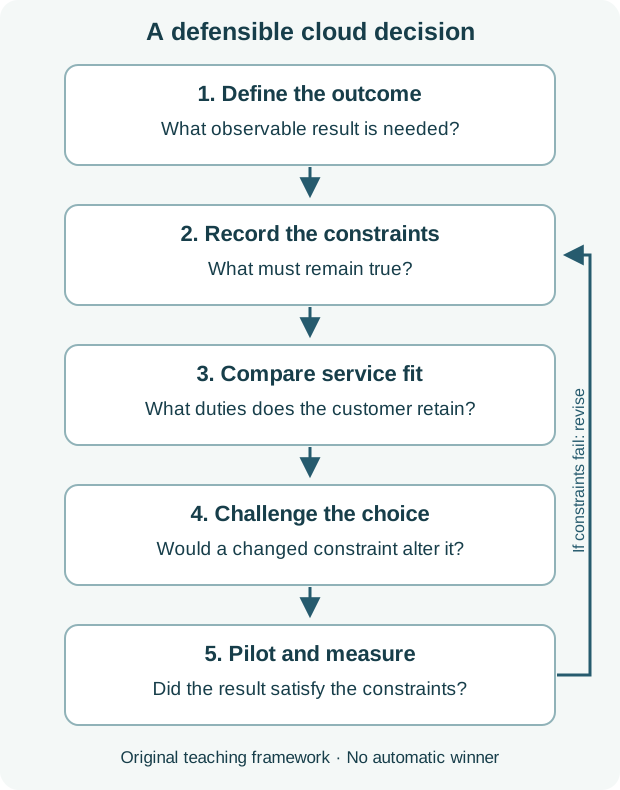
A structured method for comparing a finished application, managed application platform, and virtual infrastructure without mistaking a cloud label for proof of business value. Two fictional decisions show how a changed requirement changes the recommendation.
Make the business question answerable
A cloud recommendation should explain why a particular change serves a particular business need. Start by replacing the proposed purchase with the problem it is meant to solve. “Use a managed platform” is a proposal. “Launch a new booking workflow within eight weeks using our existing application team” states a business outcome and a resource constraint. The second statement creates criteria for comparing approaches. It also gives the team a way to discover that a technically attractive service is unsuitable.
Write down what must remain true: a required workflow, an operating-system dependency, the location of an existing system, an acceptable recovery requirement, or a limit on operational effort. Do not add convenient assumptions after seeing the available choices. If a requirement is unknown and would change the decision, identify the question to investigate. Uncertainty should lead to a bounded pilot or a request for evidence rather than a confident recommendation built on an invented fact.
Read the service boundary as a work assignment
Google Cloud’s shared-responsibility guidance distinguishes infrastructure, platform, and software service models. The practical use of this distinction is to ask which party operates which layer. With infrastructure as a service, the customer retains substantial responsibility for operating software on the provided infrastructure. A platform service manages more of the platform so a team can focus on its application. A software service supplies a finished application. These are starting categories; inspect the specific service and configuration before assigning a particular task.
Now separate an operating task from a business decision. Delegating platform maintenance does not determine which staff should access customer records, which data the organization should collect, or whether the application meets a required workflow. “Managed” therefore cannot be a complete security, compliance, or value argument. Create a short responsibility list alongside the service comparison: provider-operated components, customer-operated components, and decisions that still require an accountable owner.
Worked decision: an appointment service
Fictional case: a neighborhood repair network wants customers to book available appointment slots online. It needs a pilot in six weeks. Its developers can write a small application, but the operations team cannot take on another server-maintenance schedule. Booking rules must integrate with its existing scheduling process. There is no stated requirement for special operating-system components. The decision is about delivering this pilot within these constraints, not selecting a universal winner for every future workload.
First investigate whether an existing finished application satisfies the booking and integration requirements. If it does, developing a replacement needs an additional business justification. If a custom workflow is necessary, investigate a managed application platform because reducing platform operation directly addresses the maintenance constraint. Compare it with virtual infrastructure, which may provide useful control but also leaves more software operation for the customer. The claim is a reasoned evaluation priority, not proof that one option is cheapest or that it meets every integration requirement.
Before the pilot, assign ownership of booking permissions, application behavior, data handling, and the connection to the scheduling process. Measure whether a customer can complete the booking correctly and whether staff can resolve exceptions. A deployment that starts successfully can still fail this business test. Review the evidence against the six-week objective and the actual operating effort; do not replace these checks with a count of cloud services adopted.
Change one requirement and reconsider
Now change the case: the application depends on a vendor-supported agent requiring a specific guest-operating-system configuration, and the proposed managed platform cannot run it. That new fact makes virtual infrastructure a stronger candidate despite its maintenance burden. The original recommendation should change because an explicit constraint changed. It would be a mistake to keep recommending the same platform simply because it previously reduced operational effort. A benefit cannot cancel a mandatory compatibility requirement.
An alternative response is to remove or replace the dependency, but that is another project with its own cost, risk, and schedule. Name it openly rather than pretending the requirement has disappeared. This comparison is also a useful exam technique: find the condition that actually separates the strongest two choices. When a scenario supplies no such condition, a careful explanation should acknowledge what remains uncertain instead of inventing a performance target, a licensing rule, or an internal staffing capability.
Keep location and economics in the comparison
A local dependency can remain in place while a new cloud component is evaluated. That arrangement introduces questions about connectivity, data movement, change coordination, and the owner of each side. The service-model category alone does not answer these questions. Start from the dependency and its constraints, then verify that the proposed arrangement can satisfy them. Do not assume that a staged project requires an immediate migration of every connected system.
On-demand consumption can align resource acquisition with work, especially when demand varies. It does not make total project cost a known value. Compare the workload that will actually run, retained data, migration effort, operating tasks, and applicable service pricing. A pilot can produce useful measurements, but a short pilot is not evidence for every seasonal condition. Use the diagram as a reasoning sequence, then complete the two application checks below. Return to unit one’s cards if you cannot explain the retained customer obligation in your own words.
Apply the guide
A company wants standard staff email quickly, has no custom mail-software requirement, and cannot operate mail servers. Which service-model category should it investigate first, and why?Reveal explanation
Investigate software as a service first: the need is a finished application, and the team wants to avoid operating mail infrastructure. Check suitability and configure account access; selecting SaaS does not decide who should receive access.
A managed application platform initially fits a six-week booking pilot. Investigation then finds a mandatory guest-OS agent that this platform cannot run. What changes in the recommendation?Reveal explanation
Compatibility becomes a blocking constraint. Evaluate infrastructure that supports the required guest OS, accepting the additional software-operating responsibility, or explicitly assess replacing the dependency as a separate project. Reduced maintenance alone cannot justify a platform that fails the mandatory requirement.
Turn the idea into practice.
Apply the rule to a new case, then explain your choice.
Practice this skillSources & authorship
Original teaching guide based on the referenced Google Cloud responsibility and cloud-computing guidance. The outcome-and-constraint method is an author-created teaching framework. Fictional cases and the decision diagram are author-created; this is not an official exam question or a video companion.
OpenExam original teaching content; fictional scenarios and original diagram.
Independent educator review is pending. This guide is not an official exam paper or a video transcript.
What is Cloud Computing? | Google CloudShared responsibilities and shared fate on Google Cloud | Cloud Architecture Center | Google Cloud Documentation