
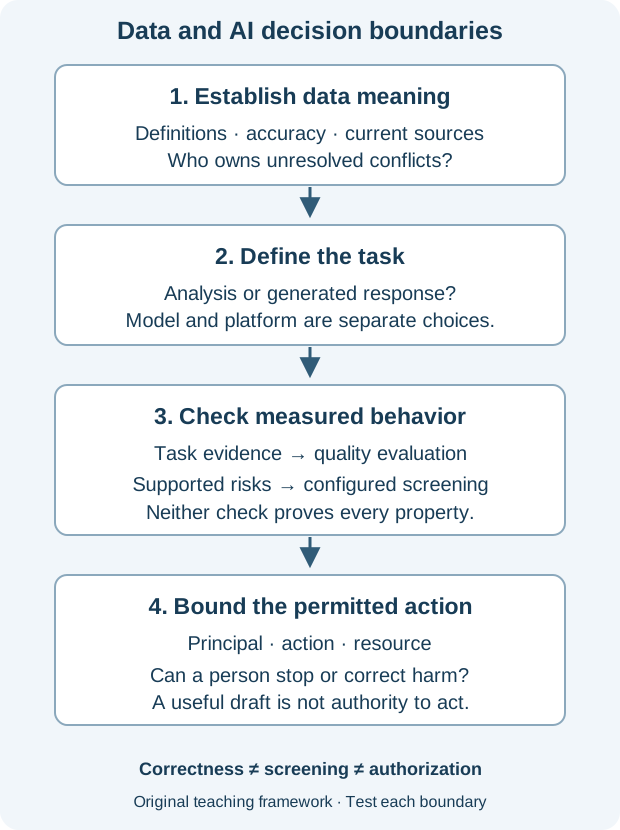
Follow a fictional service organization from conflicting source records to an AI-assisted workflow. Separate analytics, generated language, evaluation evidence, safety screening, and authorization so that a successful demo does not become an unsupported deployment claim.
Begin with the work, not an AI label
A team can agree to “use AI” while disagreeing about the job it expects the system to perform. One person may want a weekly analytical summary, another a natural-language draft, and another an agent that updates records. These are different requirements. Write the input, the desired output, the person using it, and the consequences of an error. The purpose of this guide’s decision framework is to keep those differences visible while comparing tools. It is an original teaching framework, not a guarantee of any product’s results.
Fictional case: a community repair cooperative receives equipment-service records from several branches. Its managers want to compare turnaround times, and its customer team wants draft explanations of service status. The cooperative also considers allowing an agent to change appointment dates. Begin by separating these three requests. An analytical comparison needs consistent records and a defined measure. A generated explanation needs appropriate context and factual evaluation. Changing an appointment adds an authorization and consequence boundary.
Boundary one: data meaning precedes fluent output
Two branches record “completion time” differently: one records the end of repair work, while another records customer collection. Combining those timestamps produces a number, but it does not produce one consistent turnaround measure. The cooperative must settle the definition or report the two measures separately. Transforming or aggregating records in Dataflow can implement an agreed rule. It cannot decide which business meaning the managers intended. A fast processing path and a polished dashboard can faithfully present the wrong comparison.
BigQuery provides managed analytical capabilities, while Dataflow supports processing batch and streaming data. Choose the processing schedule from the reporting deadline rather than assuming continuous processing improves every decision. For the cooperative’s weekly meeting, a scheduled export may be sufficient. Before adding a language model, inspect invalid identifiers, obsolete records, definitions, and who is permitted to see the source data. Google’s responsible-AI guidance also identifies input quality, accuracy, and bias as influences on model responses; the same unresolved source problem can therefore damage both analytics and generated text.
Boundary two: a platform is not the task result
The captured October 2026 documentation describes Gemini Enterprise Agent Platform as an evolution of Vertex AI, supporting the lifecycle of agents and model-based solutions. Model Garden provides access to Gemini and other models. Selecting this platform does not establish which model meets the cooperative’s needs, and selecting a model does not establish a safe workflow. Keep platform capability, model selection, and task evidence as separate decisions. This also avoids treating an older product name in study material as a complete statement about every current feature.
For a status explanation, supply the relevant approved records and policies, then ask the model to produce a draft that distinguishes known facts from missing information. Enterprise-data grounding can help reduce hallucinations, according to the platform documentation, but it does not make an obsolete repair record current. A response should not invent a completion date merely because a customer asks confidently. Design how the system handles missing or conflicting information and include those cases in evaluation.
Boundary three: evaluate the actual workflow
The Gen AI evaluation documentation describes datasets, rubrics, computation-based metrics, and custom evaluation functions. Assemble examples that represent the cooperative’s questions, including incomplete records, confusing branch terms, and the languages customers actually use. Evaluate whether each draft agrees with the available record and asks for help when information is missing. Inspect individual responses alongside aggregate results. A high overall score can still hide a failure that matters to one branch or user group.
Compare the draft-and-review workflow with the present process, including correction effort and unresolved cases. If a new model version or policy is introduced, repeat the relevant comparison rather than treating old results as evidence for the new condition. Public benchmarks can support exploration but cannot establish performance on these local criteria. Model Armor screening is another useful layer for supported safety and security concerns. Passing a configured filter is distinct from satisfying a factuality rubric; both observations should be reported with their actual scope.
Boundary four: useful advice is not permission to act
Now consider the appointment-changing agent. A correct proposed date does not automatically authorize changing a member’s booking. Identify the principal, the action, and the resource, then configure permissions and approval rules appropriate to the workflow. Start with the smallest action set needed for the approved task. Test what happens when the requested change conflicts with a record or when a message contains an instruction to ignore the organization’s rules. Tool behavior belongs in the evaluation, not just the final wording of an answer.
For consequential decisions, meaningful human oversight must allow a responsible person to inspect evidence and stop or correct the outcome. A label saying “human reviewed” is insufficient if the record has already changed irreversibly before review. Use the diagram to identify which boundary an argument actually addresses: better data, a suitable task, measured behavior, or permission to act. Complete the two checks below, then return to units five and six if a fluent answer still feels like proof of the entire workflow.
Apply the guide
A generated weekly report sounds convincing, but branch timestamps represent two different business events. Which boundary should be repaired first?Reveal explanation
Repair or explicitly preserve the difference in data meaning before interpreting the combined metric. A more fluent model or faster pipeline cannot decide which event the business intended to measure.
An appointment-changing agent produces an accurate proposed date and passes content screening. Is this sufficient evidence to let it update every booking?Reveal explanation
No. Accuracy and screening do not establish authorization or appropriate action scope. Define and test permissions, business approval, exception handling, and any required human ability to stop or correct the change.
Turn the idea into practice.
Apply the rule to a new case, then explain your choice.
Practice this skillSources & authorship
Original teaching guide using the referenced official Google Cloud documentation. Cases, reasoning frameworks, checks, and diagram are author-created. This is not an official exam item or a video companion.
OpenExam original teaching content; fictional scenarios and original diagram.
Independent educator review is pending. This guide is not an official exam paper or a video transcript.
Agent Platform overview | Gemini Enterprise Agent Platform | Google Cloud DocumentationGen AI evaluation service overview | Gemini Enterprise Agent Platform | Google Cloud DocumentationBigQuery overview | Google Cloud DocumentationDataflow overview | Google Cloud DocumentationIAM overview | Identity and Access Management (IAM) | Google Cloud DocumentationModel Armor overview | Google Cloud DocumentationResponsible AI | Gemini Enterprise Agent Platform | Google Cloud Documentation