
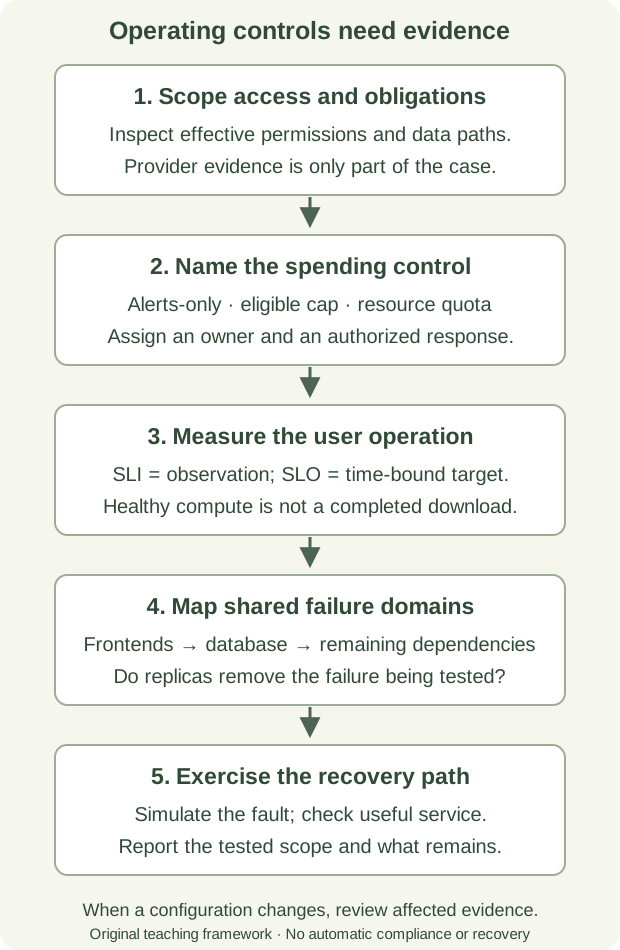
A fictional records portal illustrates why access settings, budget alerts, healthy replicas, and provider certifications answer different questions. Build an owned operating plan that connects each control to its scope and verifies the service behavior that users need.
Start with an owned service obligation
An operating plan should explain what the service must do, who is responsible for each decision, and which evidence shows that a control works. Buying several managed services does not automatically provide that explanation. Security, cost, and reliability interact: stopping a workload can reduce future consumption while also stopping a legitimate business process. A decision should name the tradeoff and the person authorized to make it. This guide’s operating sequence is an original teaching framework for keeping those obligations visible.
Fictional case: a professional association runs a portal through which members download approved records. Its team wants to restrict sensitive content, receive early warning of unexpected charges, and maintain the member download workflow during an infrastructure failure. Treat these as three requirements with different controls. Do not substitute “the provider is certified,” “a budget exists,” or “two replicas are running” for the actual requirement. Each statement supplies only part of the evidence the team needs.
Access and compliance require a workload view
For access, identify the member or service principal, the required operation, and the resource. IAM roles contain permissions, and allow policies can inherit from ancestor resources. Therefore, examine inherited grants when testing whether a member can read only the approved records. Removing a local binding does not necessarily remove a broader project grant. Use appropriate positive and negative checks: the intended read succeeds and an operation outside the approved scope does not. Record the actual policy context rather than reporting only a role name.
Google’s default-encryption document describes protecting customer content at rest, with an explicit May 2024 technical scope. That protection does not by itself decide access, network protection, or legal compliance. The association must assess its own applicable requirements and the chosen services’ behavior, including data location and processing. Provider certifications can supply evidence for inherited controls. They do not certify every customer choice. Security Command Center can generate findings within configured coverage, but enabling it does not prove the whole portal has been assessed against every obligation.
Spending controls need their exact type and scope
The current captured Cloud Billing documentation distinguishes alerts-only budgets from spend-cap budgets. An alerts-only budget monitors planned versus actual costs and triggers configured notifications; reaching a threshold does not automatically prevent further usage or billing. Spend-cap budgets are separately described for supported services and projects. Verify eligibility, scope, and configuration before relying on a cap. The correct distinction avoids both false assurances that an alert stops all charges and the outdated absolute claim that no Google Cloud budget can ever cap spending.
A quota controls specified resource consumption, such as an API-call count. It is not an aggregate currency limit for every resource in the project. The association should assign an owner to budget notifications, define the investigation and response, and check which actions are authorized. If it automates a response, test that mechanism separately from the alert configuration. Suspending a portal can affect members, and restricting one resource can leave charges from another resource unchanged. The response needs the same explicit scope as the control.
Measure the user operation before declaring reliability
A service-level indicator measures performance; a service-level objective sets the desired level over a time period. For this portal, a useful observation concerns whether an authorized member can retrieve the correct approved record. A healthy frontend process is related evidence, but it does not prove that the download succeeds. Define which attempts count, what qualifies as success, and the observation period. Keep the reliability error budget separate from the financial spending budget: they describe different allowances and support different decisions.
Next map critical dependencies. Two frontend replicas can both depend on a single database, identity path, or regional component. The reliability guidance recommends identifying failure domains, distributing critical services appropriately, configuring failover, and testing failure scenarios. A multi-zone design does not automatically establish recovery from loss of a region. Nor does a provider’s broad availability description guarantee this portal’s end-to-end behavior. Compare the actual dependency chain with the failure the association intends to tolerate.
Exercise recovery and review what changed
Run a bounded recovery exercise against the intended failure and inspect the member operation after the recovery steps. Record the simulated fault, the components involved, the actions taken, and the resulting service behavior. A stored data copy is useful, but its existence alone does not demonstrate an operational recovery workflow. A test of one zonal component supports that test’s scope; it does not establish that a regional-loss procedure has been exercised. Report failures and untested conditions explicitly so the plan remains useful.
Finally, revisit the operating evidence whenever the portal adds a new data path, changes a role, introduces a spending response, or changes a critical dependency. Review the affected control and behavior rather than copying a previous green status onto the new configuration. Use the diagram to explain which requirement each control addresses and which owner must respond. Complete the checks below, then return to units nine through twelve for the underlying access, compliance, cost, and reliability distinctions.
Apply the guide
A portal exceeds an alerts-only budget while its API-call quota remains within the configured value. What conclusion is supported?Reveal explanation
The controls can be behaving as documented: an alerts-only threshold notifies rather than automatically caps, and an API quota limits that resource rather than the entire currency bill. Investigate actual charges, notification delivery, and the intended response.
A portal has two healthy frontend replicas, but its only database fails and member downloads stop. What evidence should the next recovery review require?Reveal explanation
Map the shared database failure domain and test a recovery path that includes the database and the member download operation. Frontend health and replica count alone do not establish end-to-end availability or successful recovery.
Turn the idea into practice.
Apply the rule to a new case, then explain your choice.
Practice this skillSources & authorship
Original teaching guide using the referenced official Google Cloud documentation. Cases, reasoning frameworks, checks, and diagram are author-created. This is not an official exam item or a video companion.
OpenExam original teaching content; fictional scenarios and original diagram.
Independent educator review is pending. This guide is not an official exam paper or a video transcript.
Create, edit, or delete budgets and budget alerts | Cloud Billing | Google Cloud DocumentationDefault encryption at rest | Security | Google Cloud DocumentationIAM overview | Identity and Access Management (IAM) | Google Cloud DocumentationCloud Quotas overview | Google Cloud DocumentationBuild highly available systems through resource redundancy | Cloud Architecture Center | Google Cloud DocumentationSecurity Command Center overview | Google Cloud DocumentationShared responsibilities and shared fate on Google Cloud | Cloud Architecture Center | Google Cloud DocumentationConcepts in service monitoring | Google Cloud Observability | Google Cloud Documentation