
An original foundation guide connecting observable evidence to a defensible next decision; not an official exam or calibrated readiness assessment.
Begin with a precise observation
A user says that the cloud system is down. That statement describes an experience, but it does not identify the failing component. One user might receive an old address for the application name. Another might resolve the intended address but have no permitted route to it. A third might reach the server and be refused by an application permission check. These cases can produce similar business symptoms while requiring different investigations. Record the client location, the name used, the time, the observed answer or error and the operation attempted. A useful initial question is not which networking product to buy; it is which part of the request path has evidence and which part remains untested.
Separate a name from the destination
DNS is a distributed system for looking up information by name. Common address records connect a name to an IP address. An authoritative server holds the relevant original records, while other parts of the resolution process can use previously obtained information. Records have a lifetime, commonly expressed as a time to live. After a change, an old cached answer can matter to a particular client. This does not mean every name-related failure is a cache problem. A wrong record, the wrong resolver or a private namespace unavailable to the requester can also explain a result. Compare the actual answer with the intended configuration before claiming a cause.
Public visibility and private visibility are not access grants
Cloud DNS supports public and private zones. A public zone can be visible to the internet; a private managed zone is visible within its configured private network context. The same readable name does not guarantee the same answer for every requester in every arrangement. Check the resolver and visibility relevant to the actual source. Separately, decide whether the returned address should be publicly routed or internal to an appropriate connected private network. An organization can publish a public name while protecting the application with access controls. It can also create a private name without yet configuring a complete usable network connection. Neither naming choice alone proves application authorization.
Do not confuse stable with private
Static and ephemeral concern address allocation behavior. Internal and external concern a different aspect of the address arrangement. Reserving a static external address may give a stable destination, but it does not convert that address into a private one. An internal address is not publicly routed over the internet. An authorized office may reach it through a suitable connected private arrangement, but knowing the address does not establish that arrangement. Routes and the applicable access policies still matter. Avoid treating a checkbox or an address label as evidence that all the required controls have been implemented. Explain the particular source, destination and permitted path in the proposed design.
A fictional investigation with a bounded conclusion
A wholesaler moves its order application to a new address. From the authorized office, a network probe succeeds against that new address. Employees using the application name still receive the old address from their resolver. The next investigation should compare the authoritative record and the resolver answer, including any cached record lifetime. Adding another VPN tunnel would not explain the observed name mismatch. Changing a firewall rule already permitting the tested probe also addresses a different layer. However, the successful probe has limits: it may not test the complete browser workflow, certificate validation or application login. Correct the demonstrated naming problem, then test the actual user operation rather than declaring the whole service healthy.
Reverse the evidence and the next check changes
Now suppose the office resolver supplies the intended internal database address, but a connection from a newly opened office cannot reach it. Name resolution has passed one specific check. The appropriate private path, routing and access from that office remain to be verified. Database credentials may matter after reaching the service, but adding a user does not build a network path. A replica in another zone may support resilience, but its health does not establish that this office can resolve or reach the intended endpoint. State the exact unanswered question and use a test that can distinguish the leading alternatives. This keeps additional infrastructure work connected to an actual requirement.
Make the explanation usable for a business decision
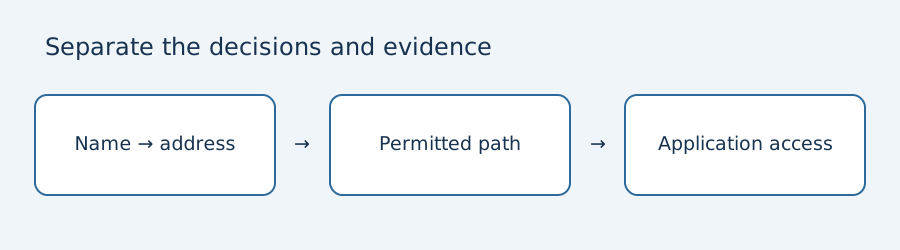
A decision record should connect the observed symptom to the governing constraint and the evidence for the proposed action. For a private-only requirement, explain why a public endpoint changes the exposure design. For a name mismatch, explain why a route change does not update the name answer. For an application denial, explain why successful network communication is insufficient to grant business access. Use the original network-path diagram as a checklist rather than a promise that every deployment has identical components. Then complete the linked questions and summarize one condition under which your proposed diagnosis would be wrong. A good explanation acknowledges that condition and identifies the next observation needed to resolve it.
Apply the guide
A direct network probe succeeds, but the name resolves to an old address. Which layer should you investigate first, and what remains untested?Reveal explanation
Investigate the relevant DNS record and resolver cache/visibility first. The probe does not establish complete browser, identity or application behavior.
A private name resolves correctly from a new office, but the database cannot be reached. Does creating a database user verify the missing prerequisite?Reveal explanation
No. Verify the authorized private connection, routes and access rules from that office. Application credentials are a separate check after network reachability.
Turn the idea into practice.
Apply the rule to a new case, then explain your choice.
Practice this skillSources & authorship
Official references support the concepts. Original fictional examples and diagrams are authored for this guide; qualified educator review remains pending.
Original OpenExam teaching and fictional cases; no official examination questions reproduced.
Independent educator review is pending. This guide is not an official exam paper or a video transcript.
Cloud DNS overviewGeneral DNS overviewIP addresses