
The source demonstrates rewriting quadratic equations in zero form, finding factor pairs, and applying the zero-product property.
Read what the equation actually says
Factoring is a way to expose structure, not an instruction to set every expression equal to zero. Start by reading whether the prompt gives a function value, asks for a root or requests a combination of solutions. These tasks can share an algebraic expression while asking for different quantities. A useful habit is to write the requested object in a small box before beginning the manipulation.
The source lesson demonstrates moving a quadratic equation into zero form and checking factor pairs. This companion uses independently written examples and adds restrictions and quantitative-comparison reasoning for GRE foundations. The source captions contain imperfect mathematical notation, so the displayed computations here are checked separately rather than treated as a literal transcript.
Make zero the reference point
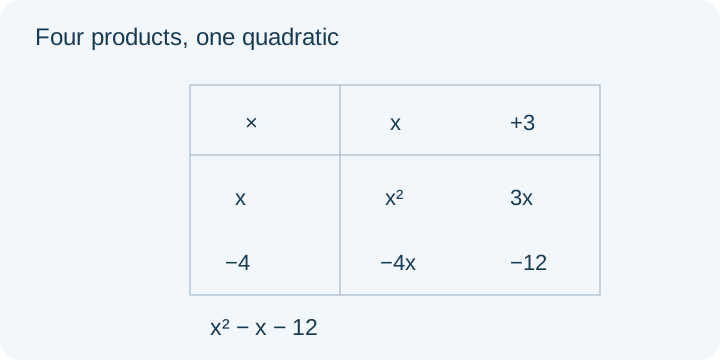
Consider the equation x² − x = 12. Move twelve to the left to obtain x² − x − 12 = 0. We want two numbers whose product is negative twelve and whose sum is negative one. The pair negative four and positive three works. Therefore the left side is (x − 4)(x + 3). Expanding the product is a quick check: the middle terms combine to negative x.
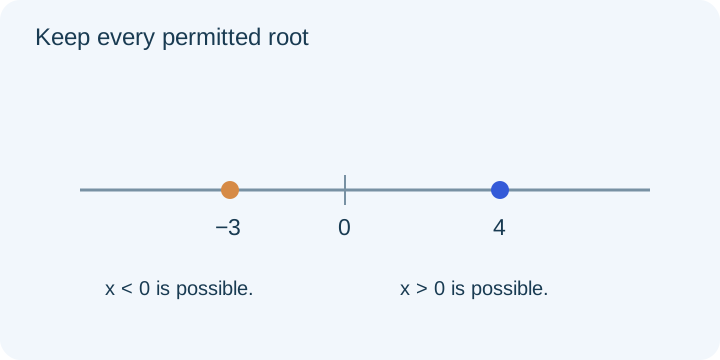
The zero-product property now applies because the product equals zero. Either x − 4 equals zero or x + 3 equals zero, producing x = 4 or x = −3. Substitute each value into the original equation: sixteen minus four is twelve, and nine plus three is also twelve. Keeping both roots is essential unless a stated domain removes one.
Use restrictions to decide what survives
If x represents a positive number of complete units, the negative root is not admissible, and four is the only candidate satisfying that additional condition. If x is simply a real number, discarding the negative root is an error. The story supplies the domain; the algebra does not invent it. A square length, a signed coordinate and a transaction count can impose different restrictions.
Another common restriction appears in a denominator. An equation derived by multiplying both sides by an expression may suggest a value that makes an original denominator zero. Check the original expression, not only the transformed polynomial. The transformation can be convenient while still requiring a final admissibility check.
Answer a comparison without overclaiming
Given only x² − x = 12, compare x with zero. One permitted root is positive and the other negative, so the relationship cannot be determined. The correct reasoning is not that the question lacks enough equations in some vague sense. It is that two explicit allowed values produce different orderings. That pair of counterexamples is a complete explanation of why no fixed comparison follows.
If the additional condition is x greater than zero, the same comparison changes: only four survives, so x is greater than zero. This illustrates why rereading the condition can be more valuable than doing more algebra. A tiny phrase changes the solution set, and therefore changes the comparison answer.
Sometimes the requested combination is easier
For a monic quadratic x² − sx + p = 0 with roots r and t, expansion of (x − r)(x − t) shows that r + t equals s and rt equals p. For the current example the roots sum to one and multiply to negative twelve. If the question asks only for the sum, solving for both roots is optional; the coefficient already encodes the answer.
This shortcut has a condition: the polynomial must first be written in standard zero form, and a nonunit leading coefficient changes the formulas. In ax² + bx + c = 0, the root sum is −b/a and the product is c/a. Checking with a simple factored expression helps you remember the signs rather than relying on a fragile mnemonic.
Build a verification habit
A compact solution has three checks. First, multiply the proposed factors to recover the polynomial. Second, substitute candidate roots into the original equation. Third, apply the stated domain and return the exact quantity asked for. These checks serve different purposes; passing one does not guarantee the others. They are especially useful when an attractive answer choice matches an intermediate calculation.
For an independent practice example, x² + 2x = 15 becomes (x + 5)(x − 3) = 0. The roots are negative five and three, their sum is negative two, and their product is negative fifteen. If x is positive, only three remains. If no sign condition is given, comparing x with zero is indeterminate. Explain all four conclusions from the same equation before moving on.
PAUSE & TRYFor x² − x = 12 with x > 0, what is x?Reveal explanation
4
Turn the idea into practice.
A fresh set will help you use the relationship with different numbers.
Practice this skillEvidence & editorial note
Shared foundational video source already acquired for the SAT pilot. The indicated caption segments were read for this companion; full audiovisual review was not performed. New examples and instructional text are original and specific to this exam scope. The video’s SAT label is not evidence of current GRE or GMAT exam rules.
Original teaching text and diagrams; brief source synopsis only.
Caption track SHA-256: e8cd3ef004b42dc23f0cfa85bd3314b2b7a16612426c002ce58f3d5ebed9efc2
Source segment references are retained in the catalog. Full captions remain in the local research archive.