
The video introduces coordinates, gradient and slope-intercept form. This original companion applies the prerequisite to Cambridge IGCSE Extended foundation work. It is not a Cambridge lesson recording or an official paper walkthrough.
Write what each coordinate means
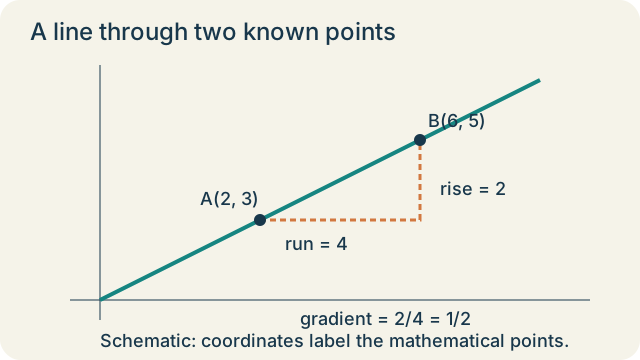
Take two points A(2,3) and B(6,5). Before calculating anything, read each ordered pair correctly: the first number is horizontal position, the second is vertical position. Moving from A to B changes the horizontal coordinate by four and the vertical coordinate by two. The gradient is therefore two divided by four, or one half. The source video supplies the prerequisite language of slope; in this companion we use the equivalent term gradient common in IGCSE materials.
A sketch gives the result a useful direction check. The line rises as you move to the right, so its gradient should be positive. The drawing is a schematic, not a measuring instrument. The coordinates determine the calculation even when the picture is stretched to fit a page. Never measure a slope from an unscaled illustration when exact coordinates are supplied.
Recover the complete line equation
A gradient alone describes a family of parallel lines. To identify the line through A, substitute its coordinates into y=mx+c. The statement 3=(1/2)×2+c becomes 3=1+c, giving c=2. The full equation is y=x/2+2. Substituting B gives 6/2+2=5, so the second point provides an independent check.
The intercept tells us that the line passes through (0,2). It does not tell us that every real-world context permits a horizontal input of zero. In a purely geometric question the line extends indefinitely. In a model of distance, cost or time, the meaningful domain may be restricted. State the equation first, then explain any contextual restriction separately instead of silently changing the algebra.
PAUSE & TRYWhat is y on this line when x=10?Reveal explanation
7. Substitute x=10 into y=x/2+2.
Connect perpendicular lines and midpoints
A perpendicular line with finite gradient must have gradient negative two, because (1/2)×(−2)=−1. If that perpendicular passes through A, its equation is y=−2x+7: substituting x=2 must still give y=3. Check the shared point as well as the gradient. Having the correct slope but the wrong intercept gives a different perpendicular line.
The midpoint of AB is ((2+6)/2,(3+5)/2)=(4,4). Substitution into y=x/2+2 confirms that it lies on the original line. The perpendicular bisector must pass through this midpoint, so its equation is y=−2x+12. These three related lines illustrate why a question’s final phrase matters: perpendicular through A and perpendicular bisector of AB are distinct requests.
PAUSE & TRYDoes (4,4) lie on the perpendicular bisector?Reveal explanation
Yes: −2×4+12=4.
Keep exact arithmetic visible
On a non-calculator task, leave the gradient as one half while substituting. There is no need to round a terminating decimal, and exact fractions become even more useful when the differences produce thirds or sevenths. Write the numerator and denominator before simplifying, because that line records which endpoints you used.
Reverse both subtractions and you obtain (3−5)/(2−6)=−2/−4=1/2, the same result. Reverse only one and you create an incorrect negative gradient. This small consistency check is often faster than restarting the entire problem. If the horizontal difference is zero, stop: the line is vertical and its equation has the form x=constant. It does not have a finite gradient.
Translate a numerical answer into written reasoning
The foundation drills on this site accept a short numeric answer or an option. The official 0580 papers use structured and unstructured written questions, so practice showing your intermediate equations on paper. A sensible response names the formula, substitutes the data, simplifies and then gives the requested quantity with an appropriate label. This habit remains useful when an answer is wrong, because it makes the error easier to locate.
For a final self-check, use a different representation. Draw a line through the two given points and verify its intercept, or substitute a computed midpoint. Do not treat a correct-looking sketch as proof of every coordinate. The lesson is to make the equation, points and geometric conditions agree with one another. The official guide separately distinguishes the Extended non-calculator and calculator papers; this short companion is foundational preparation for both.
Try an independent transfer
Now consider C(1,4) and D(5,12). Their gradient is eight divided by four, giving two. Substitution gives y=2x+2, and the midpoint is (3,8). A perpendicular through that midpoint has gradient negative one half and equation y=−x/2+19/2. Check the midpoint in both equations. Explaining this second case without copying the first line by line is a stronger learning check than merely remembering the first answer.
Turn the idea into practice.
A fresh set will help you use the relationship with different numbers.
Practice this skillEvidence & editorial note
Relevant foundational automatic-caption evidence is shared with the SAT collection. The teaching text, IGCSE examples and diagrams are newly authored. Only selected caption chapters support the short synopsis; no full audiovisual review is claimed.
Original companion teaching with brief source synopsis; no transcript reproduction.
Caption track SHA-256: 950946b8f5c3b339f834de1c5cb2510c365a313ba18bcb0e1aae568aae2f77b2
Source segment references are retained in the catalog. Full captions remain in the local research archive.