
The video demonstrates rearranging quadratic equations and solving them by factoring. This original companion applies the prerequisite to Cambridge IGCSE Extended foundation work. It is not a Cambridge lesson recording or an official paper walkthrough.
Build the equation from the quantity
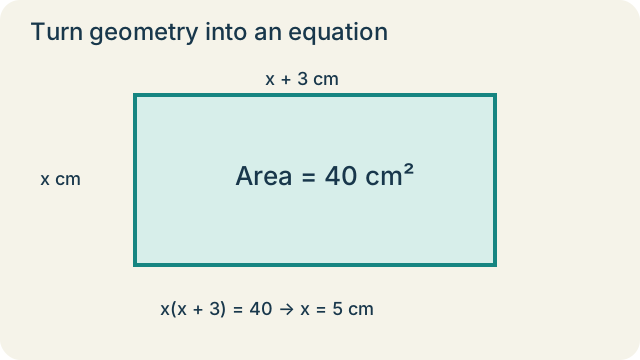
A rectangle has width x centimetres, length x+3 centimetres and area forty square centimetres. The area relationship is x(x+3)=40. Expanding and bringing every term to one side gives x²+3x−40=0. This setup is part of the mathematical work: a correct factorisation of the wrong equation would not solve the rectangle problem.
The source video develops the prerequisite habit of rearranging an equation before using factors. Our original IGCSE example adds a second responsibility: interpreting the roots in a geometric context. Label the width and length on a sketch and identify the units of each quantity. An area uses square centimetres, while the value of x will be a length in centimetres.
Find factors and verify the middle term
To factor x²+3x−40, seek two integers with product negative forty and sum positive three. Eight and negative five work, giving (x+8)(x−5)=0. The product check alone is insufficient: five and negative eight also multiply to negative forty, but their sum is negative three, which would produce a different polynomial.
Expand your proposed factors to verify them: x²−5x+8x−40=x²+3x−40. Only after that check apply the zero-product property. One factor must be zero, so the algebraic solutions are x=−8 and x=5. Dividing both sides by a factor would risk discarding a root; setting each factor equal to zero keeps both possibilities visible.
PAUSE & TRYWhich pair has product −40 and sum 3?Reveal explanation
8 and −5; check both conditions.
Use the context after solving
The rectangle requires a positive width. The solution x=−8 would also give length negative five, so it cannot represent the stated physical rectangle. The admissible width is five centimetres and its length is eight centimetres. Their product is forty square centimetres, which checks the original context directly rather than only the rearranged equation.
Notice that a negative root is not automatically an algebra mistake. It is a legitimate root of the polynomial and must be rejected for a stated contextual reason. In a pure equation-solving task both roots would be reported. Reading whether the prompt asks for all real solutions or a physical dimension prevents a correct calculation from becoming an incomplete or misleading final answer.
Connect a target output with a graph
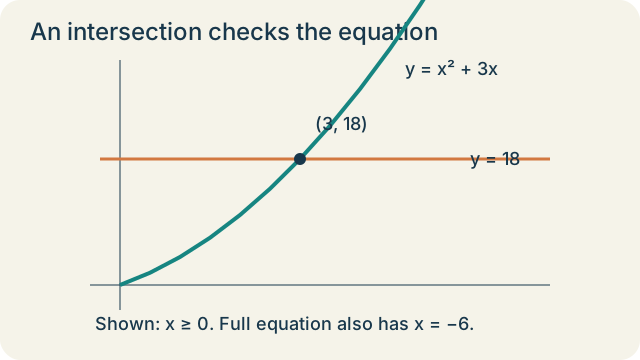
Consider the function y=x²+3x and ask where its output equals eighteen. The equation is x²+3x−18=0, which factors as (x+6)(x−3)=0. The inputs are negative six and three. The horizontal line y=18 meets the parabola at those two inputs. On the displayed nonnegative part of the graph, only the intersection at (3,18) appears.
A graph window can hide another valid root. The sketch below intentionally shows nonnegative inputs because a dimension problem uses them, but the unrestricted polynomial equation still has the negative solution. Always distinguish a restricted contextual diagram from an unrestricted algebraic equation. Substituting both roots into x²+3x gives eighteen, providing a check independent of the factorisation.
Choose a method that fits the structure
Not every quadratic factors conveniently over integers. When a factor search stalls, check the discriminant or use the quadratic formula rather than forcing a pattern. For x²+3x−20=0, the discriminant is nine plus eighty, or eighty-nine; it is not a perfect square. The exact roots are (−3 plus or minus the square root of eighty-nine) divided by two.
For the original rectangle equation the discriminant is nine plus one hundred sixty, or one hundred sixty-nine, whose square root is thirteen. The formula gives (−3±13)/2, confirming five and negative eight. Comparing the two methods helps distinguish a difficult factorisation from an arithmetic error. Keep exact radical form until an approximation is requested and use the correct calculator settings when needed.
Make your final answer reviewable
A good written solution shows the model equation, the rearrangement, the solving step and the contextual choice. The short-answer drills here cannot automatically award all method marks from a formal written paper. Use them to find weaknesses, then practise writing a complete explanation beside the screen.
For a final independent exercise, use a rectangle with width t, length t+2 and area twenty-four. The equation t²+2t−24=0 factors as (t+6)(t−4)=0. The physical dimensions are four and six. Check the area, explain why negative six is rejected and compare the factor pair with the earlier example. These checks build transferable reasoning rather than memorisation of a single pair of numbers.
Turn the idea into practice.
A fresh set will help you use the relationship with different numbers.
Practice this skillEvidence & editorial note
Relevant foundational automatic-caption evidence is shared with the SAT collection. The teaching text, IGCSE examples and diagrams are newly authored. Only selected caption chapters support the short synopsis; no full audiovisual review is claimed.
Original companion teaching with brief source synopsis; no transcript reproduction.
Caption track SHA-256: e8cd3ef004b42dc23f0cfa85bd3314b2b7a16612426c002ce58f3d5ebed9efc2
Source segment references are retained in the catalog. Full captions remain in the local research archive.