
A reliable method
Identify the shape, label perpendicular heights and write the formula before substituting. Keep pi exact until the requested rounding stage.
The common trap
A sloping edge is not always the perpendicular height. A diameter must be halved before using a radius formula.
Make the connection
Estimate scale and dimensions after calculating. Doubling every length multiplies area by four and volume by eight.
Separate area, arc length and volume
A trapezium with parallel sides three and seven and perpendicular height four has area (3+7)×4/2=20. Multiplying by a sloping side instead of the perpendicular height would use the wrong geometry. For a cylinder of radius two and height three, volume is π×2²×3=12π. Its curved surface area is a different quantity. A quarter-circle arc of radius four has length one quarter of 2π×4, giving 2π; a sector area would involve radius squared and square units. Unit labels can reveal a formula substitution that otherwise looks plausible.
Transfer, explain and check
A triangular prism has cross-section base six, perpendicular height four and length five. Its volume is (6×4/2)×5=60 cubic units. Explain why 120 would indicate that the triangular half was omitted.
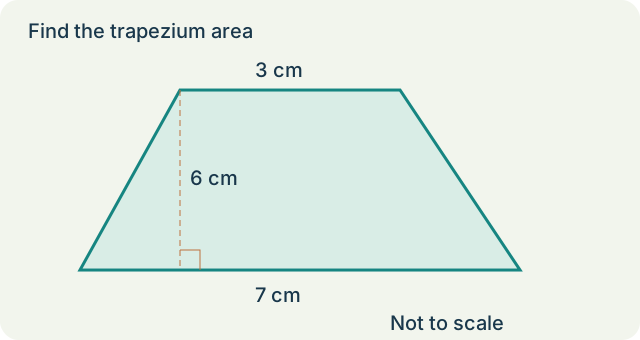
Use the labeled trapezium. What is its area in square centimetres?
 Open full-size diagram ↗
- Area is half the sum of parallel sides times height.
- Use the perpendicular height 6.
- The area is (3+7)×6/2.
Compare the other answer choices
Add parallel sides but ignore height and halving.
Use only the shorter parallel side as a rectangular base.
Use only the longer parallel side as a rectangular base.
Explain your thinking.
Optional written extension. Self-assessed only; it does not change your automatic practice result. These are teaching criteria, not official awarded marks.
For the displayed trapezium: (a) calculate its area; (b) explain why the height must be perpendicular; (c) a similar trapezium has every length doubled—find its area and justify the scale factor.
This draft stays on this page only. Use paper if you want to keep your working.
Try it, then explain it.
Complete a short set without looking at the example. After each answer, explain which operation preserved the relationship and why the result makes sense.
Sources & authorship
Original Slope explanations and examples. References support the concepts; they are not the source of copied questions. Independent educator review is pending.
Cambridge IGCSE Mathematics 0580