
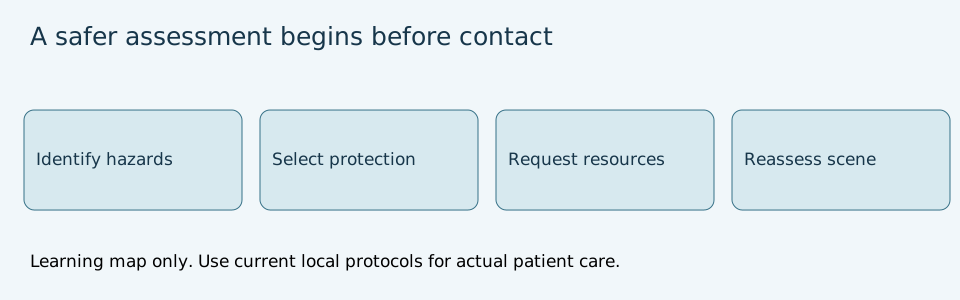
Original worked contrasts connect a stated finding to the assessment category or decision it supports. This is independent teaching, not a video summary or an official examination item.
The decision to practise
A useful EMT assessment starts by identifying which decision is actually being asked. A true statement can still be the wrong choice when it belongs to a different stage or describes a different observation. This guide uses original contrasts to separate those nearby ideas. Read the case, name the decisive finding, and explain why an attractive alternative answers another question. The purpose is not to memorize a numbered field algorithm. Actual care follows current local protocols, authorized training, and medical direction.
For each example, distinguish three layers: the observations or reported history, the provisional interpretation, and the action or information need that follows. Keep an uncertain layer uncertain. This makes it easier to update the plan when new information arrives instead of defending an early label. A change in the patient or environment can invalidate an earlier safe or stable impression.
Recognize scene hazards
The key distinctions are these. Active violence requires a secured scene before patient contact. A downed electrical wire requires isolation and qualified utility control. An unidentified chemical atmosphere requires appropriate hazardous-materials resources. Moving traffic requires a protected response area and scene traffic management.
Dispatch reports an assault. You arrive while a person is still threatening others with a knife. Which scene action takes priority? Work the case in order. An ongoing weapon threat makes immediate entry unsafe. Therefore the matching choice is Stage until law enforcement secures the scene. Compare that with Keep clear and request the utility company: A downed electrical wire requires isolation and qualified utility control. That alternative may be important in another situation, but it is not the concept selected by the stated details here. The useful check is whether the choice answers this case rather than whether it is generally related to EMS.
A patient is beside a fallen power line that has not been declared de-energized. Which scene action takes priority? Work the case in order. The line may energize the ground or vehicle; ordinary gloves do not establish electrical safety. Therefore the matching choice is Keep clear and request the utility company. Compare that with Stay outside and request hazardous-materials resources: An unidentified chemical atmosphere requires appropriate hazardous-materials resources. That alternative may be important in another situation, but it is not the concept selected by the stated details here. The useful check is whether the choice answers this case rather than whether it is generally related to EMS.
Several workers collapse inside a room containing an unidentified gas. You lack atmospheric protection. Which scene action takes priority? Work the case in order. Multiple collapsed workers in one atmosphere suggest a hazard that can also incapacitate rescuers. Therefore the matching choice is Stay outside and request hazardous-materials resources. Compare that with Use traffic control and a protected work area: Moving traffic requires a protected response area and scene traffic management. That alternative may be important in another situation, but it is not the concept selected by the stated details here. The useful check is whether the choice answers this case rather than whether it is generally related to EMS.
An awake patient is on the shoulder of a busy highway. Vehicles are passing close to the crew. Which scene action must be established? Work the case in order. An otherwise approachable patient does not remove the moving-traffic hazard. Therefore the matching choice is Use traffic control and a protected work area. Compare that with Stage until law enforcement secures the scene: Active violence requires a secured scene before patient contact. That alternative may be important in another situation, but it is not the concept selected by the stated details here. The useful check is whether the choice answers this case rather than whether it is generally related to EMS.
PAUSE & TRYDispatch reports an assault. You arrive while a person is still threatening others with a knife. Which scene action takes priority?Reveal explanation
Stage until law enforcement secures the scene. An ongoing weapon threat makes immediate entry unsafe.
Match protection to the task
The key distinctions are these. Expected contact with body fluids requires gloves; gloves do not replace hand hygiene. Splash-generating work adds a risk to mucous membranes of the eyes and face. A suspected airborne exposure requires the agency respiratory-protection process. Standard medical PPE does not make an unknown toxic or oxygen-deficient atmosphere safe.
You are about to contact a small bleeding hand wound with no expected splash. Which protection principle best fits? Work the case in order. The described exposure is hand contact with blood. Therefore the matching choice is Gloves and hand hygiene. Compare that with Gloves plus eye and face protection: Splash-generating work adds a risk to mucous membranes of the eyes and face. That alternative may be important in another situation, but it is not the concept selected by the stated details here. The useful check is whether the choice answers this case rather than whether it is generally related to EMS.
Blood may splash toward your eyes while you assist with a contaminated airway. Which protection principle best fits? Work the case in order. The task adds a splash route to the eyes and face. Therefore the matching choice is Gloves plus eye and face protection. Compare that with Appropriate respiratory protection under the exposure plan: A suspected airborne exposure requires the agency respiratory-protection process. That alternative may be important in another situation, but it is not the concept selected by the stated details here. The useful check is whether the choice answers this case rather than whether it is generally related to EMS.
Dispatch identifies a respiratory infection requiring airborne precautions under your agency plan. Which protection principle best fits? Work the case in order. Follow the indicated respiratory-protection plan rather than relying only on examination gloves. Therefore the matching choice is Appropriate respiratory protection under the exposure plan. Compare that with Do not enter an atmosphere beyond the available protection: Standard medical PPE does not make an unknown toxic or oxygen-deficient atmosphere safe. That alternative may be important in another situation, but it is not the concept selected by the stated details here. The useful check is whether the choice answers this case rather than whether it is generally related to EMS.
A person lies inside an untested sewer space. Your crew has only routine medical PPE. Which protection principle best fits? Work the case in order. Routine medical equipment does not control an untested confined-space atmosphere. Therefore the matching choice is Do not enter an atmosphere beyond the available protection. Compare that with Gloves and hand hygiene: Expected contact with body fluids requires gloves; gloves do not replace hand hygiene. That alternative may be important in another situation, but it is not the concept selected by the stated details here. The useful check is whether the choice answers this case rather than whether it is generally related to EMS.
PAUSE & TRYYou are about to contact a small bleeding hand wound with no expected splash. Which protection principle best fits?Reveal explanation
Gloves and hand hygiene. The described exposure is hand contact with blood.
Request the appropriate additional resource
The key distinctions are these. Multiple patients can exceed one crew and ambulance capacity. Entrapment or specialized access requires appropriately trained rescue resources. Communication barriers require accurate interpretation, without inventing consent or history. Uncertainty about an intervention or scope should be resolved through the applicable medical-direction system.
After a minor bus crash you find six people requesting assessment, but only your ambulance is present. Which additional resource directly addresses this problem? Work the case in order. The known deficit is the capacity to assess and transport several patients. Therefore the matching choice is Additional EMS transport units. Compare that with Technical rescue personnel: Entrapment or specialized access requires appropriately trained rescue resources. That alternative may be important in another situation, but it is not the concept selected by the stated details here. The useful check is whether the choice answers this case rather than whether it is generally related to EMS.
A conscious patient is trapped beneath industrial machinery. Your crew cannot safely free the patient. Which additional resource directly addresses this problem? Work the case in order. The access problem is specialized rescue, not simply transport capacity. Therefore the matching choice is Technical rescue personnel. Compare that with Language interpretation support: Communication barriers require accurate interpretation, without inventing consent or history. That alternative may be important in another situation, but it is not the concept selected by the stated details here. The useful check is whether the choice answers this case rather than whether it is generally related to EMS.
A stable adult cannot understand the language used by the crew, and no qualified interpreter is present. Which support directly addresses this problem? Work the case in order. An accurate history and consent discussion require a reliable communication channel. Therefore the matching choice is Language interpretation support. Compare that with Medical direction for a scope question: Uncertainty about an intervention or scope should be resolved through the applicable medical-direction system. That alternative may be important in another situation, but it is not the concept selected by the stated details here. The useful check is whether the choice answers this case rather than whether it is generally related to EMS.
An unusual request would require an intervention outside the written protocol you can confirm. Which support directly addresses the uncertainty? Work the case in order. A scope or protocol question requires authorized direction rather than improvisation. Therefore the matching choice is Medical direction for a scope question. Compare that with Additional EMS transport units: Multiple patients can exceed one crew and ambulance capacity. That alternative may be important in another situation, but it is not the concept selected by the stated details here. The useful check is whether the choice answers this case rather than whether it is generally related to EMS.
PAUSE & TRYAfter a minor bus crash you find six people requesting assessment, but only your ambulance is present. Which additional resource directly addresses this problem?Reveal explanation
Additional EMS transport units. The known deficit is the capacity to assess and transport several patients.
Transfer without overclaiming
Now change one important condition in an example: replace the environmental hazard, change the observed responsiveness, or remove the source of a reported history. Explain which conclusion must change and which remains supported. This is a stronger self-check than recalling the answer position. It tests whether the rule was connected to the evidence. If an answer depends on a fact not supplied or a local protocol not available, state the missing information instead of inventing it.
Before moving to a practice set, say what this guide does not establish. It does not confirm a final diagnosis, authorize a new procedure, replace an EMT education program, or predict a certification result. Its examples teach assessment vocabulary and boundaries. Use qualified instruction and current local clinical resources for treatment decisions, and use the official National Registry materials for current examination administration.
Turn the idea into practice.
Apply the rule to a new case, then explain your choice.
Practice this skillSources & authorship
Original examples informed by the current official task plan and foundational instructional references. No source question text or video transcript is reproduced.
Original Slope teaching and case contrasts.
Independent educator review is pending. This guide is not an official exam paper or a video transcript.
National Registry EMT Examination Specifications, Spring 2025 onwardNational EMS Education Standards EMT Instructional Guidelines