
Original worked contrasts connect a stated finding to the assessment category or decision it supports. This is independent teaching, not a video summary or an official examination item.
The decision to practise
A useful EMT assessment starts by identifying which decision is actually being asked. A true statement can still be the wrong choice when it belongs to a different stage or describes a different observation. This guide uses original contrasts to separate those nearby ideas. Read the case, name the decisive finding, and explain why an attractive alternative answers another question. The purpose is not to memorize a numbered field algorithm. Actual care follows current local protocols, authorized training, and medical direction.
For each example, distinguish three layers: the observations or reported history, the provisional interpretation, and the action or information need that follows. Keep an uncertain layer uncertain. This makes it easier to update the plan when new information arrives instead of defending an early label. A change in the patient or environment can invalidate an earlier safe or stable impression.
Connect findings with transport planning
The key distinctions are these. Time-critical findings should influence departure urgency while essential care continues. Destination decisions follow the local system and patient needs. Care or access needs can exceed the first crew resources. Transport is a period of ongoing assessment, not a pause in clinical observation.
The primary assessment identifies a time-critical problem that cannot be definitively resolved on scene. Which planning principle applies? Work the case in order. Unnecessary on-scene delay can postpone needed definitive care. Therefore the matching choice is Prompt transport with continuing authorized care. Compare that with Appropriate destination planning under the local system: Destination decisions follow the local system and patient needs. That alternative may be important in another situation, but it is not the concept selected by the stated details here. The useful check is whether the choice answers this case rather than whether it is generally related to EMS.
The patient condition suggests a specialty service may be needed. Which decision process governs the destination? Work the case in order. Use the applicable system and patient criteria rather than selecting a facility by habit alone. Therefore the matching choice is Appropriate destination planning under the local system. Compare that with Additional resources for care needs beyond crew capacity: Care or access needs can exceed the first crew resources. That alternative may be important in another situation, but it is not the concept selected by the stated details here. The useful check is whether the choice answers this case rather than whether it is generally related to EMS.
The crew cannot safely manage the patient needs with available personnel and equipment. Which planning principle applies? Work the case in order. The resource deficit must be addressed through the response system. Therefore the matching choice is Additional resources for care needs beyond crew capacity. Compare that with Continued assessment without assuming stability from one finding: Transport is a period of ongoing assessment, not a pause in clinical observation. That alternative may be important in another situation, but it is not the concept selected by the stated details here. The useful check is whether the choice answers this case rather than whether it is generally related to EMS.
The initial vital signs were reassuring, and the ambulance has now departed. Which monitoring principle applies? Work the case in order. The patient can change during transport despite reassuring initial measurements. Therefore the matching choice is Continued assessment without assuming stability from one finding. Compare that with Prompt transport with continuing authorized care: Time-critical findings should influence departure urgency while essential care continues. That alternative may be important in another situation, but it is not the concept selected by the stated details here. The useful check is whether the choice answers this case rather than whether it is generally related to EMS.
PAUSE & TRYThe primary assessment identifies a time-critical problem that cannot be definitively resolved on scene. Which planning principle applies?Reveal explanation
Prompt transport with continuing authorized care. Unnecessary on-scene delay can postpone needed definitive care.
Document findings accurately
The key distinctions are these. A record should preserve the assessed finding rather than a convenient invented value. Witness information must not be represented as the clinician direct observation. The record should describe actual interventions and what followed. Corrections should preserve record integrity under the documentation policy.
The crew did not obtain a blood pressure. Which record principle applies instead of entering a typical normal value? Work the case in order. An unmeasured value must not be invented. Therefore the matching choice is Record what was observed or measured. Compare that with Attribute a reported event to its source: Witness information must not be represented as the clinician direct observation. That alternative may be important in another situation, but it is not the concept selected by the stated details here. The useful check is whether the choice answers this case rather than whether it is generally related to EMS.
A coworker reports a seizure that the crew did not see. How should that event be documented? Work the case in order. The account should identify the reporting source. Therefore the matching choice is Attribute a reported event to its source. Compare that with Record actual care and response: The record should describe actual interventions and what followed. That alternative may be important in another situation, but it is not the concept selected by the stated details here. The useful check is whether the choice answers this case rather than whether it is generally related to EMS.
An authorized intervention is given and symptoms change. Which entry supports continuity? Work the case in order. The actual care and observed response belong in the record. Therefore the matching choice is Record actual care and response. Compare that with Correct an error through the approved record process: Corrections should preserve record integrity under the documentation policy. That alternative may be important in another situation, but it is not the concept selected by the stated details here. The useful check is whether the choice answers this case rather than whether it is generally related to EMS.
A responder notices a wrong time in a completed record. Which correction principle applies? Work the case in order. Use the approved correction mechanism rather than silently altering the history. Therefore the matching choice is Correct an error through the approved record process. Compare that with Record what was observed or measured: A record should preserve the assessed finding rather than a convenient invented value. That alternative may be important in another situation, but it is not the concept selected by the stated details here. The useful check is whether the choice answers this case rather than whether it is generally related to EMS.
PAUSE & TRYThe crew did not obtain a blood pressure. Which record principle applies instead of entering a typical normal value?Reveal explanation
Record what was observed or measured. An unmeasured value must not be invented.
Identify essential handoff categories
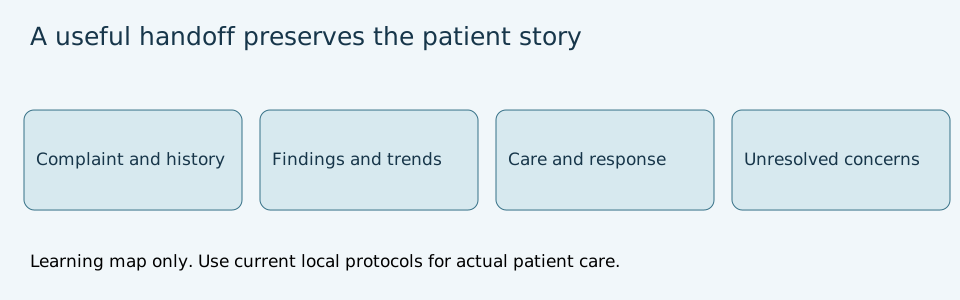
The key distinctions are these. The receiving team needs the reason for care and relevant background. Current and serial findings describe the patient course. The receiving team needs to know what was done and what followed. Handoff should identify continuing risks and an explicit transfer process.
The EMT tells the receiving team why the patient called and what happened before symptoms. Which handoff category is this? Work the case in order. The statement describes the presenting problem and relevant history. Therefore the matching choice is Presenting problem and relevant history. Compare that with Assessment findings and trends: Current and serial findings describe the patient course. That alternative may be important in another situation, but it is not the concept selected by the stated details here. The useful check is whether the choice answers this case rather than whether it is generally related to EMS.
The EMT reports that the patient became less responsive during transport. Which handoff category is this? Work the case in order. The statement communicates an assessment trend. Therefore the matching choice is Assessment findings and trends. Compare that with Interventions and observed responses: The receiving team needs to know what was done and what followed. That alternative may be important in another situation, but it is not the concept selected by the stated details here. The useful check is whether the choice answers this case rather than whether it is generally related to EMS.
The EMT names an authorized intervention and the change observed afterward. Which handoff category is this? Work the case in order. The statement connects care with the observed response. Therefore the matching choice is Interventions and observed responses. Compare that with Unresolved concerns and transfer of responsibility: Handoff should identify continuing risks and an explicit transfer process. That alternative may be important in another situation, but it is not the concept selected by the stated details here. The useful check is whether the choice answers this case rather than whether it is generally related to EMS.
The EMT states that an important history item is still unknown and confirms who is accepting care. Which handoff category is this? Work the case in order. The statement preserves unresolved information and clarifies transfer responsibility. Therefore the matching choice is Unresolved concerns and transfer of responsibility. Compare that with Presenting problem and relevant history: The receiving team needs the reason for care and relevant background. That alternative may be important in another situation, but it is not the concept selected by the stated details here. The useful check is whether the choice answers this case rather than whether it is generally related to EMS.
PAUSE & TRYThe EMT tells the receiving team why the patient called and what happened before symptoms. Which handoff category is this?Reveal explanation
Presenting problem and relevant history. The statement describes the presenting problem and relevant history.
Transfer without overclaiming
Now change one important condition in an example: replace the environmental hazard, change the observed responsiveness, or remove the source of a reported history. Explain which conclusion must change and which remains supported. This is a stronger self-check than recalling the answer position. It tests whether the rule was connected to the evidence. If an answer depends on a fact not supplied or a local protocol not available, state the missing information instead of inventing it.
Before moving to a practice set, say what this guide does not establish. It does not confirm a final diagnosis, authorize a new procedure, replace an EMT education program, or predict a certification result. Its examples teach assessment vocabulary and boundaries. Use qualified instruction and current local clinical resources for treatment decisions, and use the official National Registry materials for current examination administration.
Turn the idea into practice.
Apply the rule to a new case, then explain your choice.
Practice this skillSources & authorship
Original examples informed by the current official task plan and foundational instructional references. No source question text or video transcript is reproduced.
Original Slope teaching and case contrasts.
Independent educator review is pending. This guide is not an official exam paper or a video transcript.
National Registry EMT Examination Specifications, Spring 2025 onwardNational EMS Education Standards EMT Instructional Guidelines