
The selected source segments illustrate factoring a rearranged quadratic and using its zero factors.
Read a quadratic as a relationship
A quadratic expression can be written in several equivalent forms, and each form makes a different feature easy to see. For PSAT foundations, it is useful to distinguish a value of the expression, an input that makes the expression zero, and the location of its minimum or maximum. These are three different requests even when they involve the same expression.
The selected caption ranges in the linked lesson demonstrate rearranging an equation into a zero-product form and using its factors to find solutions. A later selected example asks about a sum of solutions. Our companion uses those general algebra ideas with entirely new examples. It is not a written transcript of the video, and the source is a SAT lesson rather than an authority on PSAT administration.
Check both parts of a factorization
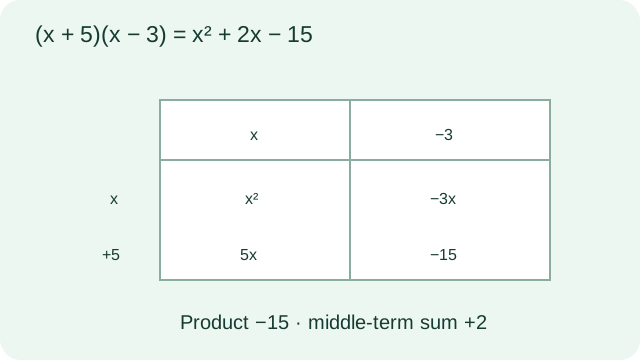
Consider x² + 2x − 15. To factor a monic quadratic, look for two numbers whose product is the constant and whose sum is the coefficient of x. Here 5 and negative 3 multiply to negative 15 and add to 2. Therefore x² + 2x − 15 equals (x + 5)(x − 3). Checking only the product would leave other pairs that do not produce the correct middle term.
The product grid shows all four contributions: x squared, negative 3x, positive 5x and negative 15. Combining the two middle contributions gives positive 2x. The grid is a way to inspect equivalence, not a requirement to draw a box for every question. Expanding your proposed factors once is a reliable check when signs feel uncertain.
Use the zero-product condition exactly
If (x + 5)(x − 3) equals zero, at least one factor must equal zero. The solutions are negative 5 and positive 3. The distance between them on the number line is 8, while their sum is negative 2. A question requesting distance would therefore have a different answer from a question requesting the sum, even though the algebraic work identifies the same two solutions.
The right-hand side matters. If x² + 2x − 15 equals 9, first subtract 9 to obtain x² + 2x − 24 = 0. This factors as (x + 6)(x − 4), giving solutions negative 6 and positive 4. Setting the original two factors equal to 9 separately would not be a valid method. Always arrange the equation before applying the zero-product property.
Apply the physical domain after solving
A rectangular display is 5 centimeters longer than it is wide and has area 84 square centimeters. Calling the width w gives w(w + 5) = 84. Rearrange to w² + 5w − 84 = 0 and factor as (w + 12)(w − 7) = 0. The algebraic candidates are negative 12 and positive 7.
A width must be positive, so the display is 7 centimeters wide and 12 centimeters long. Its perimeter is 38 centimeters. If the prompt asks for perimeter, stopping at the correct width is still incomplete. Check the area, 7 times 12 equals 84, then return to the requested quantity. This habit prevents a common mistake in word problems: solving a useful intermediate question and reporting it as the final answer.
PAUSE & TRYA 7 by 12 rectangle has area 84. What is its perimeter?Reveal explanation
38 centimeters, from 2×(7+12).
Keep the vertex separate from the zeros
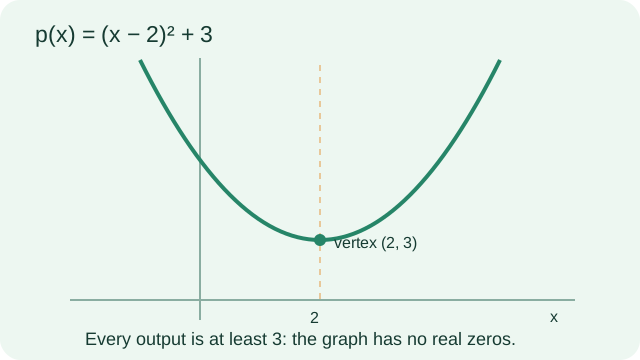
The function p(x) = (x − 2)² + 3 has its minimum value at x = 2. The minimum output is 3 because the squared part cannot be negative. Its vertex is therefore (2, 3). Unlike the earlier examples, it has no real zeros: a nonnegative square plus 3 cannot equal zero. Knowing where a function is smallest does not mean it crosses the horizontal axis there.
The original curve drawing labels the vertex and shows the entire curve above the horizontal axis. Try a nearby pair of inputs as a check: p(1) and p(3) both equal 4. Equal distances from the axis of symmetry give equal outputs. In a question asking for the input at the minimum, report 2; in a question asking for the minimum value, report 3.
Select a form that answers the question
Factored form is especially useful for zeros and their relationships. A completed square is useful for a turning point. Expanded form is useful when you need to compare coefficients or substitute an input directly. Translating between forms is a means to a question, so do not expand everything automatically and hide the feature you were trying to find.
Use a final three-part check: verify the algebra, enforce the stated domain, and identify the requested quantity. During practice, explain the distinction in words before selecting an answer or typing a number. These examples build fluency for a foundation pilot; they do not cover every nonlinear equation in the official syllabus and do not predict a PSAT score. Full audiovisual review of the linked video remains pending; only the documented caption ranges support the brief source summary.
Turn the idea into practice.
A fresh set will help you use the relationship with different numbers.
Practice this skillEvidence & editorial note
Shared foundational caption evidence from the SAT collection, explicitly reused for overlapping algebra concepts. All PSAT examples, prose and diagrams are newly authored. Source video is not PSAT format guidance. Only listed caption ranges reviewed; full audiovisual review pending.
Brief source synopsis and original PSAT teaching extension; no transcript republication.
Caption track SHA-256: e8cd3ef004b42dc23f0cfa85bd3314b2b7a16612426c002ce58f3d5ebed9efc2
Source segment references are retained in the catalog. Full captions remain in the local research archive.