
Independent original teaching uses fictional records and worked contrasts to separate related product, order and safety concepts. No video or official examination item is represented.
Define the question before choosing an answer
Pharmacy processing places related information side by side: a product name, a strength, a patient identifier, a daily frequency, and a warning can all appear on one screen. Their proximity does not make them interchangeable. A useful first step is to say what the current question asks you to establish. Is it product identity, an amount, a batch, a clinical decision, or a workflow status? The answer should fit that requested field rather than merely sound familiar.
This guide uses original fictional records to practise distinctions. Its examples are not prescriptions, clinical recommendations, or a complete statement of federal and state law. Keep the actual order and product instructions available. When a critical field is missing or two sources disagree, preserve the discrepancy for an authorized resolution. Guessing a usual value can create a convincing-looking entry while leaving the real question unanswered.
Read distinct medication-label fields
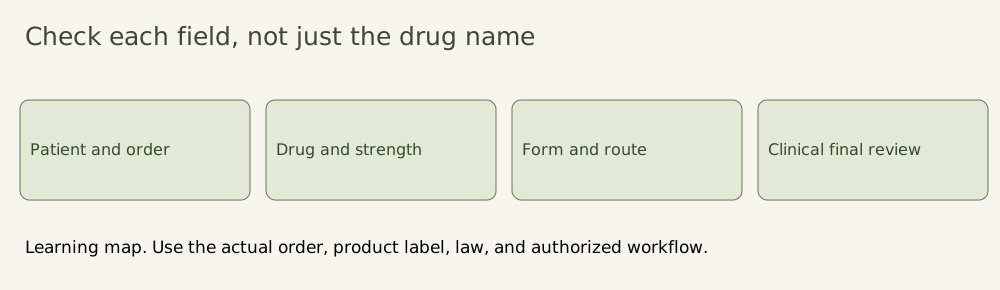
The distinction to preserve is this. The active ingredient identifies the drug substance. Strength gives the amount of drug per stated unit. Dosage form describes the physical pharmaceutical preparation. Route describes the intended pathway of administration.
An example label names acetaminophen as the substance in the product. Which field is this? Start with the supplied evidence. The named substance is the active ingredient. The matching choice is Active ingredient. Compare it with Strength: Strength gives the amount of drug per stated unit. The second statement can describe a valid concern in another case, but it does not identify the field or stage selected by this question. The difference matters because the wrong classification can send an otherwise accurate fact into the wrong part of the workflow.
An example label states500mg per tablet. Which field does this amount describe? Start with the supplied evidence. The amount is linked to one dosage unit. The matching choice is Strength. Compare it with Dosage form: Dosage form describes the physical pharmaceutical preparation. The second statement can describe a valid concern in another case, but it does not identify the field or stage selected by this question. The difference matters because the wrong classification can send an otherwise accurate fact into the wrong part of the workflow.
An example label describes the product as an oral suspension. Which field does the word suspension identify? Start with the supplied evidence. Suspension describes the preparation rather than the amount. The matching choice is Dosage form. Compare it with Route: Route describes the intended pathway of administration. The second statement can describe a valid concern in another case, but it does not identify the field or stage selected by this question. The difference matters because the wrong classification can send an otherwise accurate fact into the wrong part of the workflow.
An example label states that a solution is for ophthalmic use. Which field describes this instruction? Start with the supplied evidence. Ophthalmic identifies administration to the eye. The matching choice is Route. Compare it with Active ingredient: The active ingredient identifies the drug substance. The second statement can describe a valid concern in another case, but it does not identify the field or stage selected by this question. The difference matters because the wrong classification can send an otherwise accurate fact into the wrong part of the workflow.
PAUSE & TRYAn example label names acetaminophen as the substance in the product. Which field is this?Reveal explanation
Active ingredient. The named substance is the active ingredient.
Preserve release-form information
The distinction to preserve is this. Release characteristics are part of product identity. An immediate-release product is not automatically equivalent to an extended-release order. Altering a dosage form can change safety or release and needs a product-specific professional decision. Instructions depend on the actual formulation, not only the generic drug name.
A prescription specifies ER but the selected product listing omits any release designation. Which check is needed? Start with the supplied evidence. The release designation has not been confirmed. The matching choice is Verify the extended-release designation. Compare it with Do not substitute an immediate-release form without authorization: An immediate-release product is not automatically equivalent to an extended-release order. The second statement can describe a valid concern in another case, but it does not identify the field or stage selected by this question. The difference matters because the wrong classification can send an otherwise accurate fact into the wrong part of the workflow.
A technician proposes changing an ER order to an immediate-release product because the generic name is the same. What is the issue? Start with the supplied evidence. A matching generic name does not establish interchangeable release behavior. The matching choice is Do not substitute an immediate-release form without authorization. Compare it with Refer a crushing or splitting question to the pharmacist: Altering a dosage form can change safety or release and needs a product-specific professional decision. The second statement can describe a valid concern in another case, but it does not identify the field or stage selected by this question. The difference matters because the wrong classification can send an otherwise accurate fact into the wrong part of the workflow.
A patient asks whether a particular modified-release tablet can be crushed. What is the appropriate workflow? Start with the supplied evidence. The product-specific administration question requires pharmacist review. The matching choice is Refer a crushing or splitting question to the pharmacist. Compare it with Retain formulation-specific instructions in the check: Instructions depend on the actual formulation, not only the generic drug name. The second statement can describe a valid concern in another case, but it does not identify the field or stage selected by this question. The difference matters because the wrong classification can send an otherwise accurate fact into the wrong part of the workflow.
Two products share a drug name but have different release and administration instructions. What should guide processing? Start with the supplied evidence. The actual formulation-specific directions must be preserved. The matching choice is Retain formulation-specific instructions in the check. Compare it with Verify the extended-release designation: Release characteristics are part of product identity. The second statement can describe a valid concern in another case, but it does not identify the field or stage selected by this question. The difference matters because the wrong classification can send an otherwise accurate fact into the wrong part of the workflow.
PAUSE & TRYA prescription specifies ER but the selected product listing omits any release designation. Which check is needed?Reveal explanation
Verify the extended-release designation. The release designation has not been confirmed.
Recognize questions requiring pharmacist intervention
The distinction to preserve is this. A patient-specific OTC recommendation requires clinical assessment by the pharmacist. Changing therapy is not an independent technician decision. Potential interactions should be referred for pharmacist evaluation. A product-specific use question should reach the pharmacist for appropriate counselling.
A patient asks which OTC medicine is safest with several chronic conditions. Which clinical referral category fits? Start with the supplied evidence. The request requires a patient-specific product recommendation. The matching choice is Clinical choice of an OTC product. Compare it with Therapeutic substitution decision: Changing therapy is not an independent technician decision. The second statement can describe a valid concern in another case, but it does not identify the field or stage selected by this question. The difference matters because the wrong classification can send an otherwise accurate fact into the wrong part of the workflow.
A medicine is unavailable and the patient asks the technician to choose a different therapeutic agent. Which referral category fits? Start with the supplied evidence. Choosing a different therapy requires authorized clinical judgment. The matching choice is Therapeutic substitution decision. Compare it with Possible drug interaction: Potential interactions should be referred for pharmacist evaluation. The second statement can describe a valid concern in another case, but it does not identify the field or stage selected by this question. The difference matters because the wrong classification can send an otherwise accurate fact into the wrong part of the workflow.
A system flags that two drugs may interact. Which referral category fits? Start with the supplied evidence. The flag requires clinical review of the possible interaction. The matching choice is Possible drug interaction. Compare it with Product-use counselling question: A product-specific use question should reach the pharmacist for appropriate counselling. The second statement can describe a valid concern in another case, but it does not identify the field or stage selected by this question. The difference matters because the wrong classification can send an otherwise accurate fact into the wrong part of the workflow.
A patient asks how to change the way a prescribed inhaler is being used. Which referral category fits? Start with the supplied evidence. The question concerns individualized administration counselling. The matching choice is Product-use counselling question. Compare it with Clinical choice of an OTC product: A patient-specific OTC recommendation requires clinical assessment by the pharmacist. The second statement can describe a valid concern in another case, but it does not identify the field or stage selected by this question. The difference matters because the wrong classification can send an otherwise accurate fact into the wrong part of the workflow.
PAUSE & TRYA patient asks which OTC medicine is safest with several chronic conditions. Which clinical referral category fits?Reveal explanation
Clinical choice of an OTC product. The request requires a patient-specific product recommendation.
Transfer to a new record
Try a new case by changing one important field while holding the others fixed. Change strength but keep the name, change the lot but keep the carton design, or change frequency but keep the total quantity. Explain which conclusion changes and why. This tests a relationship rather than an answer position. It also helps identify when a seemingly plausible shortcut relies on a field that the question never established.
Before finishing, identify who has authority over the unresolved part of the problem. A technician can collect accurate information, preserve records, calculate from explicit directions, and flag discrepancies. Patient-specific clinical judgement and therapeutic change require the appropriate professional process. An answer in a learning guide does not replace current references, the actual notice, applicable law, or the authorized final review.
Turn the idea into practice.
Apply the rule to a new case, then explain your choice.
Practice this skillSources & authorship
Original examples and explanations. References establish topic alignment and the cited safety concept; fictional orders are not therapeutic recommendations.
Original Slope pharmacy foundation teaching.
Independent educator review is pending. This guide is not an official exam paper or a video transcript.
PTCE Content Outline effective January6,2026