
Independent original teaching uses fictional records and worked contrasts to separate related product, order and safety concepts. No video or official examination item is represented.
Define the question before choosing an answer
Pharmacy processing places related information side by side: a product name, a strength, a patient identifier, a daily frequency, and a warning can all appear on one screen. Their proximity does not make them interchangeable. A useful first step is to say what the current question asks you to establish. Is it product identity, an amount, a batch, a clinical decision, or a workflow status? The answer should fit that requested field rather than merely sound familiar.
This guide uses original fictional records to practise distinctions. Its examples are not prescriptions, clinical recommendations, or a complete statement of federal and state law. Keep the actual order and product instructions available. When a critical field is missing or two sources disagree, preserve the discrepancy for an authorized resolution. Guessing a usual value can create a convincing-looking entry while leaving the real question unanswered.
Distinguish prescription-processing quantities
The distinction to preserve is this. Dose states the amount used at one administration. Frequency states how often an administration occurs. Quantity states the number or amount supplied. Days supply estimates how long the supplied amount lasts under explicit directions.
A training direction says take2tablets at each administration. Which quantity is2tablets? Start with the supplied evidence. The value is the amount used at one administration. The matching choice is Dose per administration. Compare it with Frequency: Frequency states how often an administration occurs. The second statement can describe a valid concern in another case, but it does not identify the field or stage selected by this question. The difference matters because the wrong classification can send an otherwise accurate fact into the wrong part of the workflow.
A training direction says take a dose three times daily. Which field describes three times daily? Start with the supplied evidence. The phrase describes how often doses occur. The matching choice is Frequency. Compare it with Total quantity supplied: Quantity states the number or amount supplied. The second statement can describe a valid concern in another case, but it does not identify the field or stage selected by this question. The difference matters because the wrong classification can send an otherwise accurate fact into the wrong part of the workflow.
A training order requests a package of90tablets. Which quantity is90tablets? Start with the supplied evidence. The number describes the total supplied count. The matching choice is Total quantity supplied. Compare it with Days supply: Days supply estimates how long the supplied amount lasts under explicit directions. The second statement can describe a valid concern in another case, but it does not identify the field or stage selected by this question. The difference matters because the wrong classification can send an otherwise accurate fact into the wrong part of the workflow.
A training calculation determines that the supplied tablets last30days at the stated use. Which quantity is30days? Start with the supplied evidence. The value is the duration covered by the supply. The matching choice is Days supply. Compare it with Dose per administration: Dose states the amount used at one administration. The second statement can describe a valid concern in another case, but it does not identify the field or stage selected by this question. The difference matters because the wrong classification can send an otherwise accurate fact into the wrong part of the workflow.
PAUSE & TRYA training direction says take2tablets at each administration. Which quantity is2tablets?Reveal explanation
Dose per administration. The value is the amount used at one administration.
Distinguish product tracking fields
The distinction to preserve is this. An NDC identifies a labeled drug product/package entry; it is not a patient identifier. A lot identifies a manufacturing batch. An expiration date states the labeled time boundary under stated storage. A prescription number identifies a local prescription record.
A stock system asks for the drug product/package identifier rather than a batch or patient record. Which field fits? Start with the supplied evidence. The NDC is the product identification field. The matching choice is NDC identifier. Compare it with Lot number: A lot identifies a manufacturing batch. The second statement can describe a valid concern in another case, but it does not identify the field or stage selected by this question. The difference matters because the wrong classification can send an otherwise accurate fact into the wrong part of the workflow.
A recall requires identifying a manufacturing batch. Which field is central? Start with the supplied evidence. The batch is represented by the lot number. The matching choice is Lot number. Compare it with Expiration date: An expiration date states the labeled time boundary under stated storage. The second statement can describe a valid concern in another case, but it does not identify the field or stage selected by this question. The difference matters because the wrong classification can send an otherwise accurate fact into the wrong part of the workflow.
The stock check asks whether the labeled time limit has passed. Which field is being checked? Start with the supplied evidence. The expiration date supplies that time boundary. The matching choice is Expiration date. Compare it with Patient prescription number: A prescription number identifies a local prescription record. The second statement can describe a valid concern in another case, but it does not identify the field or stage selected by this question. The difference matters because the wrong classification can send an otherwise accurate fact into the wrong part of the workflow.
A local pharmacy needs to retrieve one patient prescription record. Which identifier serves that local purpose? Start with the supplied evidence. The prescription number links to the local order record. The matching choice is Patient prescription number. Compare it with NDC identifier: An NDC identifies a labeled drug product/package entry; it is not a patient identifier. The second statement can describe a valid concern in another case, but it does not identify the field or stage selected by this question. The difference matters because the wrong classification can send an otherwise accurate fact into the wrong part of the workflow.
PAUSE & TRYA stock system asks for the drug product/package identifier rather than a batch or patient record. Which field fits?Reveal explanation
NDC identifier. The NDC is the product identification field.
Recognize decimal-writing risks
The distinction to preserve is this. A leading zero makes a decimal point easier to notice. A trailing zero can be misread as a larger number if the decimal is missed. A number without its unit can be interpreted incorrectly. An unclear order must be resolved rather than interpreted by guesswork.
An example dose is written .5mg. Which notation improvement directly reduces the missed-decimal risk? Start with the supplied evidence. Writing0.5mg preserves a visible zero before the decimal. The matching choice is Use a leading zero for a value below one. Compare it with Avoid an unnecessary trailing zero: A trailing zero can be misread as a larger number if the decimal is missed. The second statement can describe a valid concern in another case, but it does not identify the field or stage selected by this question. The difference matters because the wrong classification can send an otherwise accurate fact into the wrong part of the workflow.
An example dose is written5.0mg when5mg is intended. Which risk-reducing change is appropriate? Start with the supplied evidence. An unnecessary trailing zero can obscure the intended magnitude. The matching choice is Avoid an unnecessary trailing zero. Compare it with Preserve the unit with the value: A number without its unit can be interpreted incorrectly. The second statement can describe a valid concern in another case, but it does not identify the field or stage selected by this question. The difference matters because the wrong classification can send an otherwise accurate fact into the wrong part of the workflow.
A data field contains only the number5 with no dose unit. Which information is missing? Start with the supplied evidence. The value cannot be interpreted safely without its unit. The matching choice is Preserve the unit with the value. Compare it with Clarify an ambiguous entry before processing: An unclear order must be resolved rather than interpreted by guesswork. The second statement can describe a valid concern in another case, but it does not identify the field or stage selected by this question. The difference matters because the wrong classification can send an otherwise accurate fact into the wrong part of the workflow.
A prescription value can plausibly be read as0.5mg or5mg. Which processing principle applies? Start with the supplied evidence. The magnitude is unclear and must be clarified. The matching choice is Clarify an ambiguous entry before processing. Compare it with Use a leading zero for a value below one: A leading zero makes a decimal point easier to notice. The second statement can describe a valid concern in another case, but it does not identify the field or stage selected by this question. The difference matters because the wrong classification can send an otherwise accurate fact into the wrong part of the workflow.
PAUSE & TRYAn example dose is written .5mg. Which notation improvement directly reduces the missed-decimal risk?Reveal explanation
Use a leading zero for a value below one. Writing0.5mg preserves a visible zero before the decimal.
Work an explicit supply calculation
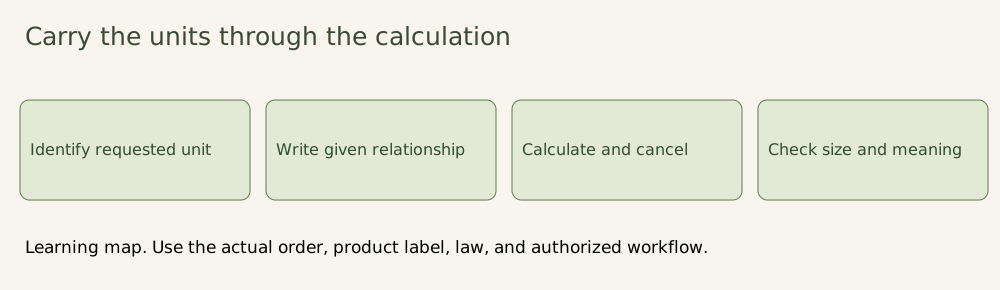
Consider a fictional fixed-use training order: supply60tablets,with an explicit total daily use of2tablets. Divide60tablets by2tablets/day to obtain30days. The tablet unit cancels and the remaining unit is days. Reporting60days would confuse package quantity with duration; reporting2days would confuse daily use with duration. Reverse the operation:30days times2tablets/day returns the supplied60tablets.
Now change only the daily use to3tablets/day while keeping the supply60tablets. The duration becomes20days. This is not a recommendation to change a patient dose. It is a demonstration that a calculation depends on the stated directions. If directions are unclear, the arithmetic cannot repair the missing authorization. Resolve the actual order first.
Transfer to a new record
Try a new case by changing one important field while holding the others fixed. Change strength but keep the name, change the lot but keep the carton design, or change frequency but keep the total quantity. Explain which conclusion changes and why. This tests a relationship rather than an answer position. It also helps identify when a seemingly plausible shortcut relies on a field that the question never established.
Before finishing, identify who has authority over the unresolved part of the problem. A technician can collect accurate information, preserve records, calculate from explicit directions, and flag discrepancies. Patient-specific clinical judgement and therapeutic change require the appropriate professional process. An answer in a learning guide does not replace current references, the actual notice, applicable law, or the authorized final review.
Turn the idea into practice.
Apply the rule to a new case, then explain your choice.
Practice this skillSources & authorship
Original examples and explanations. References establish topic alignment and the cited safety concept; fictional orders are not therapeutic recommendations.
Original Slope pharmacy foundation teaching.
Independent educator review is pending. This guide is not an official exam paper or a video transcript.
PTCE Content Outline effective January6,2026FDA medication-error review discussing leading and trailing zeroes