
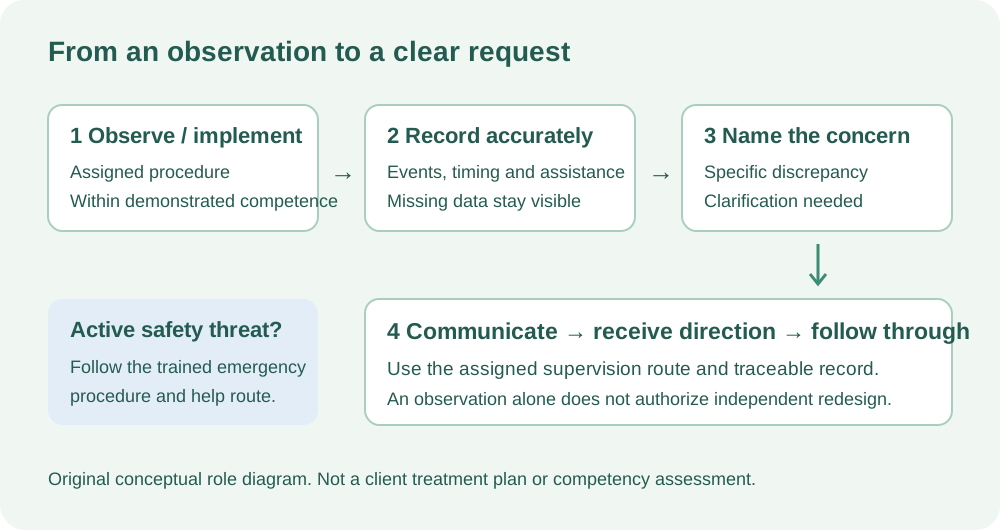
The BACB describes RBT services as supervised and includes documentation, reporting, competence and ethics in the examination outline. The fictional cases below are original teaching examples about those boundaries. They do not supply a treatment plan, clinical authorization, or an official competency assessment.
Keep implementation and decision authority distinct
A technician can be responsible for carrying out a carefully specified procedure while another qualified professional is responsible for its clinical design and revision. Those responsibilities work together. The technician’s observations matter precisely because they reveal what happened when the assigned procedure met the actual setting. An unexpected result does not justify hiding the observation, and it does not automatically authorize a new intervention.
Begin by naming the concrete task and the boundary in the scenario. Was the technician asked to implement a trained step, interpret an unclear assessment, change a target, or use an unfamiliar procedure? A question about role is easier to answer when the requested action is specific instead of reduced to a vague choice between “help” and “do nothing.”
Build an observation that can travel
In a fictional session, a transition instruction is delivered, a learner places the materials on the floor, and the transition is delayed. That sequence can be recorded in observable terms. Writing that the learner “wanted control” adds an inferred motive. A supervisor may investigate the relation among these events, but one descriptive sequence does not establish the maintaining function.
Preserve the relevant time, instruction, response, assistance and subsequent event required by the record. If a caregiver contributes information, attribute it rather than presenting it as your own observation. A useful report allows another professional to see the difference between a directly observed event, information supplied by someone else, and an interpretation that still needs evidence.
Turn a discrepancy into a precise question
Suppose the written program says to allow a response interval before prompting, but a new verbal instruction appears to require an immediate prompt. The discrepancy is the issue to communicate. Identify the two directions, ask which instruction applies, and follow the organization’s clarification and safety process. Choosing whichever direction produces a faster correct response would leave the implementation question unresolved.
An actionable request can be brief: state what occurred, name the conflict, explain what was done within the existing procedure, and ask for the missing direction. Timeliness depends on the actual issue. Active safety threats call for trained immediate responses, while a nonurgent documentation question follows the appropriate reporting route. A generic end-of-day message is not a substitute for required urgent communication.
Treat competence as performance rather than confidence
Reading a procedure, watching a demonstration and explaining it verbally can be useful learning steps. They are not all the same as demonstrating accurate implementation under the relevant conditions. Training may include instructions, modeling, rehearsal, observation and feedback. If a technician cannot perform a step or is uncertain about the conditions under which it should be used, the training need should become visible before an unsupported independent attempt.
Consider a prompt delivered too early. Even if the learner eventually answers, the assigned opportunity for independence may not have occurred. The appropriate response to feedback is to identify and practice the timing step, not to argue that a correct answer erased the procedure deviation. Outcome and procedural fidelity are different parts of the record.
Protect a record and a person at the same time
Documentation should accurately reflect the session while protecting information through approved systems and access rules. RBT Ethics Code 2.0, clause 2.09, prohibits identifying client information on social media or websites; caregiver consent does not create an exception in that clause. Removing a name does not necessarily remove identifying details. Necessary confidential job-related communication follows the separate direction and disclosure limits in clause 2.10. Do not merge these rules into a general statement that any disclosure becomes acceptable with permission.
Errors also require honest handling. If a value was recorded in the wrong unit, use the traceable correction process. If an observation was missed, document the gap rather than recreating a precise count as though it had been measured. Accurate information and appropriate privacy are compatible responsibilities; neither is served by copying a polished but untrue note.
Close the loop without claiming more than was checked
After direction is received, implement and document it through the assigned process. State the actual clarification and subsequent performance; do not rewrite history to imply the new direction had always been followed. When a later observation differs, preserve that difference and report it. A responsible service record can contain uncertainty, incomplete data and a request for more training without becoming a record of failure.
For a transfer exercise, imagine an unfamiliar data code during a session. Draft a message naming the observed response, assistance used and coding question. Then ask what would make the situation urgent and which trained route would apply. The learning goal is an accurate handoff with a clear request. Completing this exercise does not establish professional competence or replace the BACB’s requirements and qualified supervision.
Turn the idea into practice.
Apply the rule to a new case, then explain your choice.
Practice this skillSources & authorship
Original learning guide based on the BACB topic outline and supervised role description. Fictional examples and calculations are independently written; no video transcript, actual client record or official examination question is reproduced.
Original Slope explanations, examples and diagrams. References identify the outline and role boundaries; they do not constitute BACB endorsement or educator approval.
Independent educator review is pending. This guide is not an official exam paper or a video transcript.
RBT Test Content Outline3rd editionRegistered Behavior Technician official overviewRBT Ethics Code2.0