
Khan Academy connects a circle’s equation to equal distance from its center, using perpendicular coordinate differences and the Pythagorean theorem. The final portion distinguishes the signs of center coordinates from the squared radius. This companion supplies independent examples, a new diagram and extensions to expanded equations and point checks; those extensions are not a claim about material shown in the short source video.
Begin with the distance, not a sign trick
A circle collects points at one fixed distance from a fixed center. If the center is (h,k), the horizontal coordinate difference to a point (x,y) is x−h and the vertical difference is y−k. The squares of these differences add to the squared distance. This gives a reason for the equation, instead of a rule to reverse every sign you happen to see.
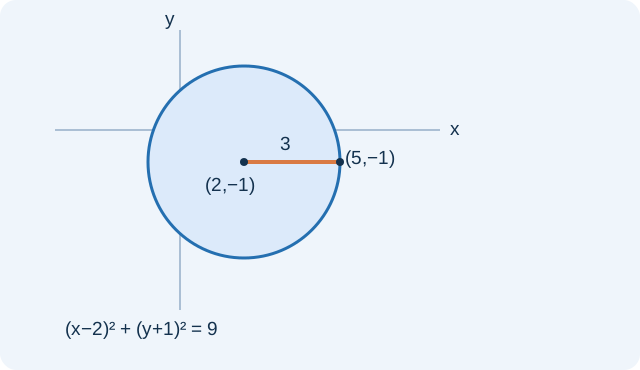
For the independently chosen center (2,−1) and radius three, the equation is (x−2)²+(y+1)²=9. The plus sign in the second bracket comes from subtracting a negative coordinate. The nine is a squared length. Center coordinates describe where the circle is located; they are not two different radii.
Check the original coordinate diagram
The diagram uses equal horizontal and vertical scales. Its center is (2,−1), and the marked point (5,−1) is three units to the right. Their vertical coordinates agree, so the distance can be read directly as a horizontal difference. Substituting the marked point gives (5−2)²+(−1+1)²=9+0=9, exactly the right-hand side.
A different point on the same circle is (2,2), three units above the center. It gives zero plus nine instead. These checks are simple because one coordinate difference is zero. They still use the same distance rule that applies when both differences are nonzero. A point need not lie on an axis to be on a circle.
PAUSE & TRYIs (−1,−1) on this circle?Reveal explanation
Yes. Its horizontal difference from the center is −3 and its vertical difference is 0, so the squared distance is 9.
Convert expanded form without changing the circle
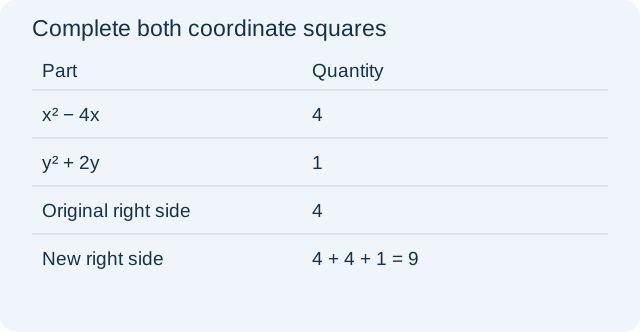
Now take x²+y²−4x+2y−4=0. Move the constant and group by coordinate: x²−4x+y²+2y=4. The first group becomes a square by adding four, while the second needs one. Add those quantities to both sides, producing (x−2)²+(y+1)²=9. The center and radius are exactly those of the first example.
The table separates the two additions so neither can disappear. Completing only the x square leaves the y term unfinished. Adding four and one only to the left changes the equation and therefore changes its set of points. Expand the completed expression to confirm that the original constant returns; this is a check on equivalence rather than a new method.
Classify a point by squared distance
For our circle, consider (2,0). Its squared distance from the center is one, which is smaller than nine, so it lies inside the circle. The point (2,4) has squared distance twenty-five, larger than nine, so it lies outside. Only equality identifies the circumference. There is no need to take a square root when comparing nonnegative squared distances.
This distinction prevents a common interpretation error: a point inside the disk does not satisfy the circle equation. The equation describes the boundary. An inequality with the same left side less than or equal to nine describes the filled disk. Read whether a task asks about the circle, its interior, or the entire region including its boundary.
PAUSE & TRYClassify (4,1) relative to the circle.Reveal explanation
Inside: the squared distance is 2²+2²=8, less than 9.
Keep radius, arc and sector separate
Once the radius is known, another question may ask for circumference, area or part of either. Radius three gives circumference 6π and area 9π. A 60-degree central angle selects one sixth of the circle: the associated arc length isπ, while the sector area is 3π/2. The fraction is the same, but the full-circle measure and the units differ.
If the central angle is supplied in radians instead, arc length equals radius times that angle. This is an extension of the distance viewpoint, not a claim that the source video covers arc formulas. State the angle unit before choosing a formula; applying a degree fraction to a radian value silently changes the geometry.
A transfer problem with a built-in check
Complete squares in x²+y²−6x−8y=0. Adding nine and sixteen yields (x−3)²+(y−4)²=25. The center is (3,4) and the radius is five. The origin satisfies the original equation; in the new form its squared distance is nine plus sixteen, also twenty-five. This check connects the expanded and geometric descriptions.
Before moving to practice, identify what each number represents: coordinates locate the center, a nonnegative distance measures the radius, and its square appears on the right. Choose the linked circle families to practice radius extraction, two-square completion, radian arcs and sector area as distinct tasks. The goal is to select the relevant relationship, not to memorize the example’s numbers.
PAUSE & TRYFor this transfer circle, what is its diameter?Reveal explanation
10. Completing squares gives radius 5; diameter is twice that length.
Turn the idea into practice.
A fresh set will help you use the relationship with different numbers.
Practice this skillEvidence & editorial note
All 82 normalized caption segments were read. Automatic captions flatten powers and punctuation, so the short source synopsis stays conceptual. Original examples were independently computed. Completing squares, point classification and arc/sector comparisons below are Slope extensions. Caption-only source review; original video graphics and full audiovisual fidelity remain pending. No source screenshots or full transcript are republished.
Brief source synopsis; original teaching text, examples, and SVG diagrams.
Caption track SHA-256: dd7036ca6a4144482b19e50425c2ed4f6990a929c7b266c1e0e41cd525669d02
Source segment references are retained in the catalog. Full captions remain in the local research archive.