
A reliable method
Write the target unit first. Multiply by a conversion factor with the unwanted unit in the denominator.
The common trap
A ratio of red to blue equal to 2:3 makes red 2/5 of the total, not 2/3.
Make the connection
Area and volume conversions square and cube a length conversion. Do not apply a linear factor to a squared unit.
Name each ratio part
A red-to-blue ratio of 3:5 divides a collection into eight equal parts. For 40 objects, each part contains five, so there are 15 red and 25 blue. The ratio 3/5 compares red with blue; the fraction 3/8 compares red with all objects. Always name the denominator before setting a proportion.
Let units choose the direction
A speed of 18 kilometers in 3 hours is 6 kilometers per hour. Multiplying by 4 hours gives 24 kilometers; dividing by 4 hours would give a unit of kilometers per hour squared. For area, 1 meter=100 centimeters implies 1 square meter=10,000 square centimeters because both dimensions change.
Try, then check
A map uses 2 centimeters for 7 kilometers. Towns 6 centimeters apart are 21 kilometers apart: three copies of the stated scale. A 6-centimeter square on the map does not have actual area 21 square kilometers; determine each side’s length first, then multiply lengths to find area.
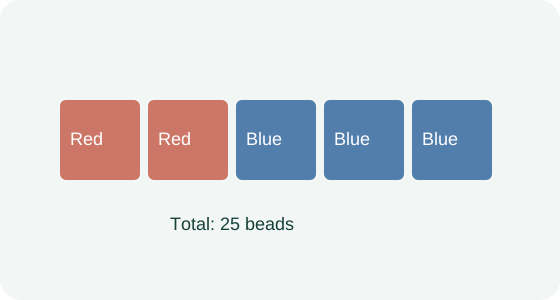
The bar shows the ratio of red to blue beads in a collection of 25 beads. Each box represents an equal share. How many beads are red?
 Open full-size diagram ↗
- There are 2 + 3 = 5 equal ratio parts.
- Each part contains 25/5 = 5 beads.
- Red beads occupy two parts: 10.
Compare the other answer choices
Reported one ratio part instead of two.
Reported the blue part instead of the red part.
Reported the whole instead of the red part.
Try it, then explain it.
Complete a short set without looking at the example. After each answer, explain which operation preserved the relationship and why the result makes sense.
Sources & authorship
Original Slope explanations and examples. References support the concepts; they are not the source of copied questions. Independent educator review is pending.
Official mathematics skillsSiyavula Grade 10 mathematics