
A concrete table
Suppose eight swimmers cycle and four swimmers do not; among non-swimmers, six cycle and ten do not. There are 28 people overall. Given that a selected person swims, the cycling probability is 8/12=2/3. The probability of both swimming and cycling when selecting from everyone is 8/28=2/7.
Count a union once
The swimming-or-cycling union contains three disjoint cells: eight, four and six, giving 18/28=9/14. The neither cell contains ten, so the complement calculation 1−10/28 agrees. Adding row and column totals without subtracting the overlap counts the eight people in both groups twice.
Compare conditions and estimates
Overall, 14/28 cycle, while 8/12 of swimmers cycle. Their difference is 1/6, so the proportions are not equal in this table. This arithmetic comparison is not proof that swimming causes cycling. Separately, a machine producing blue tokens in six of twenty trials has observed frequency 0.3; the model-based expected count in 100 new trials is thirty.
Recover a missing conditional count
In a separate table, n swimmers cycle, three swimmers do not, five non-swimmers cycle and four do not. If P(cycles | swims)=5/8, then n/(n+3)=5/8. Cross-multiplication gives 8n=5n+15, so n=5. The full cycling column therefore contains ten people. Treating the known three non-cyclists as the total number of swimmers would give the wrong equation.
Count both independent orders
Use an observed blue-token frequency 5/20 as the probability p=1/4 for each of two future independent trials. Exactly one blue can occur as blue then non-blue or the reverse. These are disjoint cases, each with probability(1/4)(3/4). Adding gives 3/8. The at-least-one probability 7/16 also includes two blues and answers a different question. Independence is an assumption of this model; observed frequency alone does not establish it.
Transfer and check
Using the original table with cell counts 8,4,6,10, find P(swims | cycles)=8/14=4/7. Explain why it differs from P(cycles | swims). Then identify which denominator changes if you select only non-swimmers. Expected counts and conditional proportions are statements about a specified selection process, not arbitrary ratios of nearby cells.
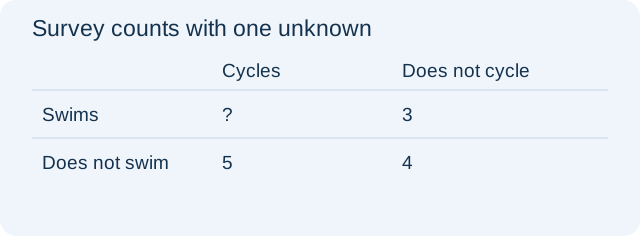
For a person selected uniformly from the swimmers, the probability of cycling is 5/8. Use this condition to recover the missing cell in the table. How many people in the entire table cycle?
 Open full-size diagram ↗
- Let n be the missing cell. The swimming condition gives n/(n+3)=5/8.
- Solving gives n=5; the conditional denominator includes both swimmer cells.
- Add the 5 non-swimming cyclists: total cyclists=5+5=10.
Compare the other answer choices
Return the total non-cyclists rather than cyclists.
After recovering the missing cell, total the swimmer row instead of the cycling column.
Return the grand total rather than the cycling column total.
Explain your thinking.
Optional written extension. Self-assessed only; it does not change your automatic practice result. These are teaching criteria, not official awarded marks.
Compute P(swims | cycles) from this table, then explain why reversing the condition changes the denominator.
This draft stays on this page only. Use paper if you want to keep your working.
Try it, then explain it.
Complete a short set without looking at the example. After each answer, explain which operation preserved the relationship and why the result makes sense.
Sources & authorship
Original Slope explanations and examples. References support the concepts; they are not the source of copied questions. Independent educator review is pending.
SAT official Problem-Solving and Data Analysis scopeOpenExamPrep SAT Math archived topic research