
Original worked cases distinguish the food process from its temperature measurement. All numeric rules use the expressly stated 2022 FDA model basis.
A decision process for this topic
A thermometer reports a condition; it does not choose the rule for you. Begin every time-temperature case by naming the food, the stage of the process, and the time history that matters. Receiving a delivery, cooking raw food, cooling a cooked batch and reheating for holding are different decisions. A number remembered from one stage can become a wrong answer at another stage.
The worked cases below use the explicitly stated 2022 FDA model. They teach a method for applying a sourced limit, not a claim that every jurisdiction has adopted identical requirements. Read each case before the response. Write down the controlling stage, the required observation, and a tempting shortcut that would leave the hazard uncontrolled.
Receiving temperatures
A delivery of refrigerated TCS food that has no special receiving exception measures 50 F. Begin with the condition that makes this case different from a routine situation. The product temperature must meet the applicable receiving limit; ambient impressions are insufficient. The appropriate response is: Reject this 50 F refrigerated TCS delivery.
Compare the proposed shortcut "Accept it because the truck feels cool.". A cool-feeling truck does not establish the food's internal temperature. Another proposal is "Accept it and leave it in the receiving area for later checking.". Delayed checking does not resolve the receiving violation. Finally, consider "Approve it based only on an uncalibrated truck display.". A display that has not been verified cannot replace an appropriate product check. State the rule in your own words, identify the observation that triggers it, and explain what evidence would be needed before accepting a different response.
PAUSE & TRYWhat is the first justified response to this case, and which condition makes it necessary?Reveal explanation
Reject this 50 F refrigerated TCS delivery. The product temperature must meet the applicable receiving limit; ambient impressions are insufficient.
Refrigerator thawing
A manager must thaw frozen meat safely for preparation tomorrow. Begin with the condition that makes this case different from a routine situation. Controlled refrigeration limits warming of outer surfaces while the center thaws. The appropriate response is: Thaw under refrigeration at 41 F or below.
Compare the proposed shortcut "Thaw it overnight on a room-temperature counter.". Counter thawing can warm the exterior while the center remains frozen. Another proposal is "Leave it in a bucket of standing warm water overnight.". Warm stagnant water is not the model controlled running-water method. Finally, consider "Put it near a hot stove until the outside softens.". External warming near a stove creates uncontrolled temperature exposure. State the rule in your own words, identify the observation that triggers it, and explain what evidence would be needed before accepting a different response.
PAUSE & TRYWhat is the first justified response to this case, and which condition makes it necessary?Reveal explanation
Thaw under refrigeration at 41 F or below. Controlled refrigeration limits warming of outer surfaces while the center thaws.
Poultry cooking
Under the stated 2022 Food Code model, raw poultry is ready to leave the cooking stage only after the required treatment. Begin with the condition that makes this case different from a routine situation. A measured product-specific time-temperature treatment is required; appearance is not a validated endpoint. The appropriate response is: Verify at least 165 F throughout the poultry.
Compare the proposed shortcut "Stop when the surface browns.". Surface color does not establish internal pathogen reduction. Another proposal is "Use the same endpoint as an intact fish fillet without checking the poultry requirement.". Different food categories can have different required cooking treatments. Finally, consider "Judge doneness only by clear juices.". Juice appearance is not a substitute for internal temperature measurement. State the rule in your own words, identify the observation that triggers it, and explain what evidence would be needed before accepting a different response.
PAUSE & TRYWhat is the first justified response to this case, and which condition makes it necessary?Reveal explanation
Verify at least 165 F throughout the poultry. A measured product-specific time-temperature treatment is required; appearance is not a validated endpoint.
Hot holding
A batch of TCS soup is held HOT for service under the ordinary 2022 model rule with no special exception. Begin with the condition that makes this case different from a routine situation. Hot holding controls growth after cooking and requires an appropriate food-temperature limit. The appropriate response is: Monitor the soup at 135 F or above.
Compare the proposed shortcut "Hold it at 120 F because steam is visible.". Steam appearance does not establish that the minimum holding temperature is met. Another proposal is "Use the room thermostat as the holding measurement.". Room temperature does not show the soup's holding condition. Finally, consider "Assume a heated cabinet guarantees the soup temperature without checking.". Equipment operation alone does not prove the food meets its critical limit. State the rule in your own words, identify the observation that triggers it, and explain what evidence would be needed before accepting a different response.
PAUSE & TRYWhat is the first justified response to this case, and which condition makes it necessary?Reveal explanation
Monitor the soup at 135 F or above. Hot holding controls growth after cooking and requires an appropriate food-temperature limit.
Cooling first stage
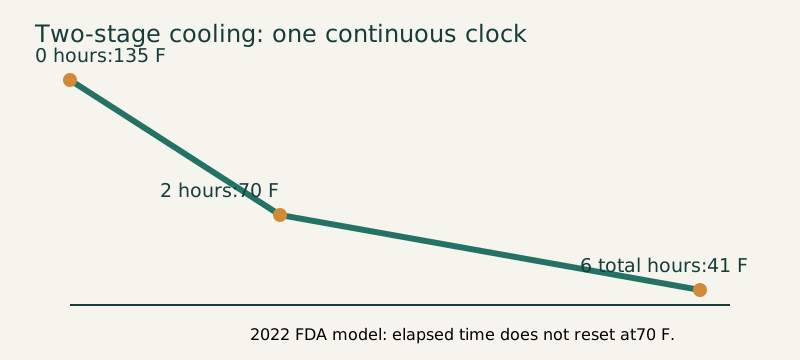
Under the 2022 model, cooked soup cools from 135 F to 80 F in the first two hours. Begin with the condition that makes this case different from a routine situation. The model requires cooling from 135 F to 70 F within two hours, then to 41 F within six total hours. The appropriate response is: Apply the approved first-stage cooling corrective procedure.
Compare the proposed shortcut "Count it as compliant because it is below 100 F.". Being below an arbitrary round temperature does not meet the first-stage limit. Another proposal is "Add another four hours to reach 70 F without corrective action.". The additional cooling period is not an extension of the first-stage deadline. Finally, consider "Reset the cooling clock when the soup enters a refrigerator.". Moving containers does not reset elapsed cooling time. State the rule in your own words, identify the observation that triggers it, and explain what evidence would be needed before accepting a different response.
PAUSE & TRYWhat is the first justified response to this case, and which condition makes it necessary?Reveal explanation
Apply the approved first-stage cooling corrective procedure. The model requires cooling from 135 F to 70 F within two hours, then to 41 F within six total hours.
Reheating for hot holding
TCS stew originally cooked on site, then cooled, is reheated for hot holding under the ordinary 2022 model rule. Begin with the condition that makes this case different from a routine situation. Reheating for hot holding has its own treatment and time limit, distinct from the later holding minimum. The appropriate response is: Reheat to 165 F for fifteen seconds within two hours.
Compare the proposed shortcut "Use a steam table to warm it slowly all afternoon.". Slow warming does not meet the required rapid reheating process. Another proposal is "Stop reheating when it reaches the 135 F hot-holding minimum.". The hot-holding minimum does not replace the reheating endpoint. Finally, consider "Mix it with fresh hot stew without checking the combined food.". Mixing does not demonstrate that every portion received the required treatment. State the rule in your own words, identify the observation that triggers it, and explain what evidence would be needed before accepting a different response.
PAUSE & TRYWhat is the first justified response to this case, and which condition makes it necessary?Reveal explanation
Reheat to 165 F for fifteen seconds within two hours. Reheating for hot holding has its own treatment and time limit, distinct from the later holding minimum.
Transfer the method to a new case
To transfer this method, redraw a process with a different food or container. Ask what changed: the product category, the thermometer location, the elapsed time, or the permitted method. Keep unchanged conditions in place and find the exact reference for the changed condition before applying an exception. A cooler setting, a new container, or a fresh date label cannot erase what already happened to the food.
Finish by explaining one distinction without quoting a number: why cooking is not holding, why a cold pot exterior is not a cooled center, or why the second cooling stage does not restart the overall clock. Then attempt the linked learning items and use the explanations to diagnose the incorrect proposal, not merely to memorize a letter.
Turn the idea into practice.
Apply the rule to a new case, then explain your choice.
Practice this skillSources & authorship
Original learning guide. Source: identified 2022 FDA Food Code model provisions, independently scoped from current exam and jurisdiction adoption. No video is represented.
Original educational guide with original cases, contrasts, and diagrams; not a transcript or official question reproduction.
Independent educator review is pending. This guide is not an official exam paper or a video transcript.
FDA Food Code 2022, January 18,2023 version