
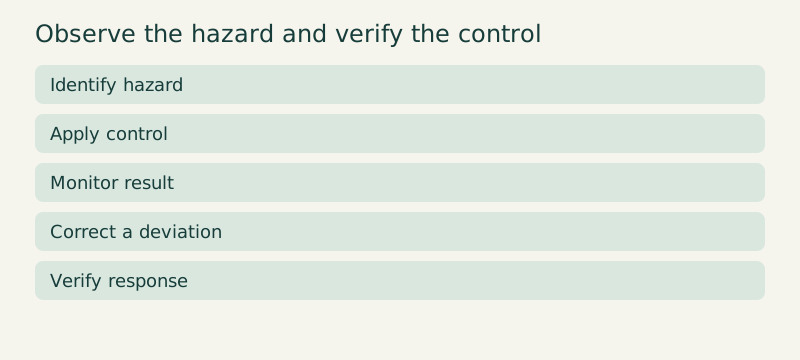
Original decision cases connect hand hygiene, ready-to-eat protection, allergens, cleaning and supervision.
A decision process for this topic
A food-safety problem can remain even when the kitchen looks organized. Find the route by which a biological agent, chemical, physical object or allergenic ingredient can reach a guest. The best response interrupts that route and checks the result. It does not merely make the operation look reassuring.
Start by identifying the affected food and whether it will receive any further effective treatment. A ready-to-eat item, a used tasting utensil, and a grill carrying allergenic residue pose different questions. Use the cases below to practice choosing the relevant control rather than applying the same familiar remedy to every situation.
Biological contamination
A cook uses the same unwashed cutting board for raw chicken and ready-to-eat melon. Begin with the condition that makes this case different from a routine situation. A raw-animal-food surface can transfer pathogens to food that will receive no further cooking. The appropriate response is: Clean and sanitize the board before cutting the melon.
Compare the proposed shortcut "Wipe the board with a dry towel and continue.". A dry wipe does not perform the required cleaning and sanitizing steps. Another proposal is "Rinse the melon after it touches the board and serve it.". Rinsing afterward is not a reliable corrective control for the contaminated ready-to-eat food. Finally, consider "Keep using the board because the chicken was refrigerated.". Refrigeration does not make raw poultry free of pathogens. State the rule in your own words, identify the observation that triggers it, and explain what evidence would be needed before accepting a different response.
PAUSE & TRYWhat is the first justified response to this case, and which condition makes it necessary?Reveal explanation
Clean and sanitize the board before cutting the melon. A raw-animal-food surface can transfer pathogens to food that will receive no further cooking.
Handwashing
A food employee returns from the restroom and is about to put on gloves for sandwich preparation. Begin with the condition that makes this case different from a routine situation. Gloves do not replace handwashing at required handwashing events. The appropriate response is: Wash and dry hands, then put on new gloves.
Compare the proposed shortcut "Put on gloves without washing hands.". Hands can contaminate gloves while the employee puts them on. Another proposal is "Rinse the gloves while they are worn.". Washing disposable gloves is not a substitute for clean hands and new gloves. Finally, consider "Use hand antiseptic alone instead of handwashing.". Hand antiseptic does not replace required washing with soap and water. State the rule in your own words, identify the observation that triggers it, and explain what evidence would be needed before accepting a different response.
PAUSE & TRYWhat is the first justified response to this case, and which condition makes it necessary?Reveal explanation
Wash and dry hands, then put on new gloves. Gloves do not replace handwashing at required handwashing events.
Ready-to-eat food handling
A server is arranging ready-to-eat bread with bare hands, with no approved alternative procedure. Begin with the condition that makes this case different from a routine situation. Ready-to-eat food normally requires a barrier against bare-hand contact under the model rule. The appropriate response is: Use suitable utensils or gloves after handwashing.
Compare the proposed shortcut "Continue because the bread is dry.". A dry texture does not create a general exemption from the handling rule. Another proposal is "Touch only the outside edge of each slice.". The outside edge is still part of the ready-to-eat food. Finally, consider "Wash hands once at opening and use bare hands all day.". Earlier washing does not authorize prohibited bare-hand contact. State the rule in your own words, identify the observation that triggers it, and explain what evidence would be needed before accepting a different response.
PAUSE & TRYWhat is the first justified response to this case, and which condition makes it necessary?Reveal explanation
Use suitable utensils or gloves after handwashing. Ready-to-eat food normally requires a barrier against bare-hand contact under the model rule.
Allergen cross-contact
An allergen-sensitive order is placed on a grill used for an allergen-containing food without cleaning. Begin with the condition that makes this case different from a routine situation. Allergenic proteins can remain on equipment; heat or distance alone does not establish safe separation. The appropriate response is: Use verified ingredients and properly cleaned equipment.
Compare the proposed shortcut "Scrape visible residue only and assume the grill is allergen-free.". Visible-residue removal alone does not establish effective removal of the allergen. Another proposal is "Cook the new order longer to destroy the allergen.". Ordinary cooking is not a reliable method of eliminating food allergens. Finally, consider "Move the food to the far side of the same dirty grill.". Changing position does not demonstrate that the contacted surface is clean. State the rule in your own words, identify the observation that triggers it, and explain what evidence would be needed before accepting a different response.
PAUSE & TRYWhat is the first justified response to this case, and which condition makes it necessary?Reveal explanation
Use verified ingredients and properly cleaned equipment. Allergenic proteins can remain on equipment; heat or distance alone does not establish safe separation.
Tasting technique
A cook repeatedly tastes a sauce using the same spoon without washing it. Begin with the condition that makes this case different from a routine situation. A used tasting utensil can transfer saliva to the food. The appropriate response is: Use a clean utensil for each tasting.
Compare the proposed shortcut "Rinse the spoon briefly in the sauce between tastes.". Dipping the utensil back into food is not utensil cleaning. Another proposal is "Keep using the spoon because the sauce is hot.". Food heat cannot be assumed to sanitize the utensil or prevent the contact event. Finally, consider "Wipe the spoon on the cook's sleeve.". A sleeve is not a cleaned and sanitized food-contact surface. State the rule in your own words, identify the observation that triggers it, and explain what evidence would be needed before accepting a different response.
PAUSE & TRYWhat is the first justified response to this case, and which condition makes it necessary?Reveal explanation
Use a clean utensil for each tasting. A used tasting utensil can transfer saliva to the food.
Training verification
New employees can recite a handwashing rule but repeatedly skip it during observed preparation. Begin with the condition that makes this case different from a routine situation. Managerial control requires actual food-safety behavior, not only completed training paperwork. The appropriate response is: Observe, coach, and verify the actual work procedure.
Compare the proposed shortcut "Treat a memorized answer as proof of correct on-shift behavior.". Verbal recall does not establish correct performance in the workplace. Another proposal is "Post another slogan without observing practice.". A slogan alone does not verify that employees perform the required behavior. Finally, consider "Stop monitoring because orientation was completed.". Orientation completion does not remove the need for ongoing supervision. State the rule in your own words, identify the observation that triggers it, and explain what evidence would be needed before accepting a different response.
PAUSE & TRYWhat is the first justified response to this case, and which condition makes it necessary?Reveal explanation
Observe, coach, and verify the actual work procedure. Managerial control requires actual food-safety behavior, not only completed training paperwork.
Transfer the method to a new case
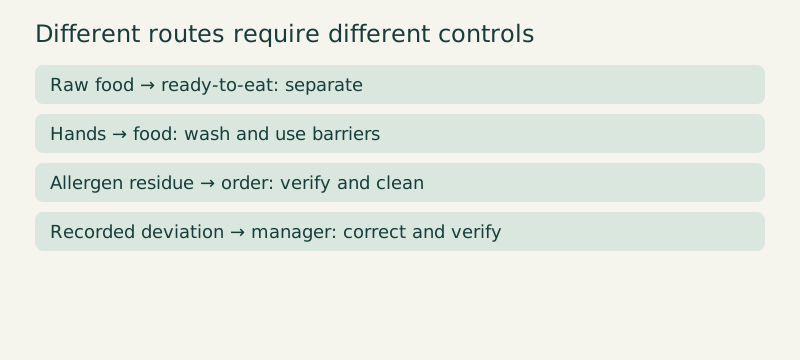
Build your own control chain from the original source of contamination to the service point. At every transition, name the barrier: clean hands, a suitable utensil, protected storage, verified ingredients, an effective cleaning procedure, or a manager's corrective action. Avoid combining them into a vague claim that the kitchen is clean. Each barrier has a specific job, and a failure at one point may remain even if another barrier is present.
When a guest or employee reports uncertainty, record what is actually known. Do not replace missing evidence with an appearance test or an assurance. Ask which document, observation or authorized response would resolve the question, then follow the applicable operation and regulatory procedure. Review these cases by explaining the error in each rejected proposal in your own words.
Turn the idea into practice.
Apply the rule to a new case, then explain your choice.
Practice this skillSources & authorship
Original learning guide. Source: identified 2022 FDA Food Code model provisions, independently scoped from current exam and jurisdiction adoption. No video is represented.
Original educational guide with original cases, contrasts, and diagrams; not a transcript or official question reproduction.
Independent educator review is pending. This guide is not an official exam paper or a video transcript.
FDA Food Code 2022, January 18,2023 versionFood Standards Scotland: Cooking for people with allergies