
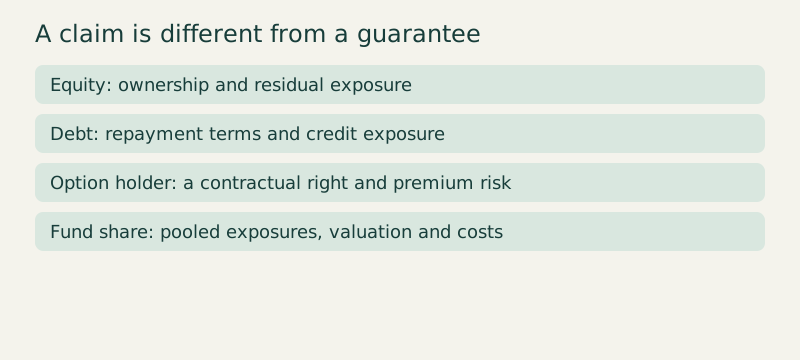
Original educational cases distinguish product claims, risks, valuation and protection. These are general exam concepts rather than personal investment recommendations.
A decision process for this topic
An investment description can contain several true statements while still supporting a wrong conclusion. A bond can promise repayment without guaranteeing that its issuer will pay. A fund can diversify exposures without guaranteeing principal. A protection organization can serve an important role without insuring the investment's market return. Begin with the exact legal or economic claim before choosing a risk label.
The cases below separate product identity, payment order, valuation, market risk and institutional protection. Read each fact pattern, name the claim the investor actually holds, and state what the claim does not promise. Use the cited official education or rule reference to check the distinction rather than relying on a product's familiar name.
FDIC boundaries
A customer buys a mutual fund through a bank and assumes the fund is FDIC-insured because of the location. Begin with the condition that makes this case different from a routine situation. Deposit insurance depends on the product and applicable deposit coverage, not simply the building where it is sold. The appropriate response is: Explain that the mutual fund is not an FDIC-insured deposit.
Compare the proposed shortcut "Promise deposit insurance for every product sold inside a bank.". Sale at a bank does not convert a nondeposit investment into an insured deposit. Another proposal is "Describe the fund's market loss as a guaranteed FDIC reimbursement.". FDIC deposit insurance does not reimburse ordinary mutual-fund market losses. Finally, consider "Treat a fund share as identical to a bank savings deposit.". A fund ownership interest and a savings deposit have different legal characteristics. State the rule in your own words, identify the observation that triggers it, and explain what evidence would be needed before accepting a different response.
PAUSE & TRYWhat is the first justified response to this case, and which condition makes it necessary?Reveal explanation
Explain that the mutual fund is not an FDIC-insured deposit. Deposit insurance depends on the product and applicable deposit coverage, not simply the building where it is sold.
SIPC boundaries
A customer asks whether SIPC reimburses a stock's ordinary price decline while the brokerage remains solvent. Begin with the condition that makes this case different from a routine situation. SIPC protection addresses specified customer-asset issues in a failed member brokerage, not the investment's market performance. The appropriate response is: Explain that SIPC does not insure ordinary market losses.
Compare the proposed shortcut "Promise reimbursement of any decline in a brokerage account.". A market-price decline alone is not the customer-asset shortfall that SIPC protection addresses. Another proposal is "Treat SIPC as a guarantee of the issuer's financial performance.". Protection of customer property is different from guaranteeing the issuer's business results. Finally, consider "Assume every security's purchase price is protected against volatility.". Market volatility remains an investment risk despite the existence of SIPC. State the rule in your own words, identify the observation that triggers it, and explain what evidence would be needed before accepting a different response.
PAUSE & TRYWhat is the first justified response to this case, and which condition makes it necessary?Reveal explanation
Explain that SIPC does not insure ordinary market losses. SIPC protection addresses specified customer-asset issues in a failed member brokerage, not the investment's market performance.
Common stock ownership
An investor purchases common shares and asks what basic interest was acquired. Begin with the condition that makes this case different from a routine situation. Common stock represents equity ownership rather than a contractual debt repayment claim. The appropriate response is: Identify an ownership interest in the corporation.
Compare the proposed shortcut "Describe the shares as the company's fixed repayment obligation.". A shareholder is not a bondholder merely because both invest money in the company. Another proposal is "Promise a fixed dividend on every common share.". Common dividends are not automatically fixed or guaranteed. Finally, consider "Classify the purchase as an insured bank deposit.". An ownership security is not a deposit product. State the rule in your own words, identify the observation that triggers it, and explain what evidence would be needed before accepting a different response.
PAUSE & TRYWhat is the first justified response to this case, and which condition makes it necessary?Reveal explanation
Identify an ownership interest in the corporation. Common stock represents equity ownership rather than a contractual debt repayment claim.
Interest-rate risk
Market interest rates rise after an investor buys a fixed-rate bond, with other factors unchanged. Begin with the condition that makes this case different from a routine situation. Existing fixed-rate bonds generally become less attractive when comparable new debt offers higher rates. The appropriate response is: Expect downward pressure on the existing bond's market price.
Compare the proposed shortcut "Assume the existing fixed coupon automatically rises with market rates.". A fixed coupon does not automatically reset when market rates change. Another proposal is "Expect every existing fixed-rate bond price to rise for this reason.". Higher market yields generally exert the opposite pressure on existing fixed-rate prices. Finally, consider "Treat interest-rate risk as relevant only to stocks.". Fixed-income securities can have material interest-rate risk. State the rule in your own words, identify the observation that triggers it, and explain what evidence would be needed before accepting a different response.
PAUSE & TRYWhat is the first justified response to this case, and which condition makes it necessary?Reveal explanation
Expect downward pressure on the existing bond's market price. Existing fixed-rate bonds generally become less attractive when comparable new debt offers higher rates.
Call option holder
A customer purchases a standard call option and asks what exercise right it provides. Begin with the condition that makes this case different from a routine situation. A purchased call conveys a contractual buying right, while a put conveys a selling right. The appropriate response is: Identify the right to buy the underlying at the strike price.
Compare the proposed shortcut "Describe a call holder's right as the right to sell the underlying.". The selling right describes a put rather than a call. Another proposal is "Treat purchase of the call as an obligation to exercise it.". The holder has a right, not an unconditional obligation to exercise. Finally, consider "Promise that the call's value cannot fall below its premium.". An option buyer can lose the premium; the premium is not a guaranteed future value. State the rule in your own words, identify the observation that triggers it, and explain what evidence would be needed before accepting a different response.
PAUSE & TRYWhat is the first justified response to this case, and which condition makes it necessary?Reveal explanation
Identify the right to buy the underlying at the strike price. A purchased call conveys a contractual buying right, while a put conveys a selling right.
Fund expenses
Two otherwise comparable funds differ in ongoing expense ratios. Begin with the condition that makes this case different from a routine situation. Fund operating costs are borne by investors and affect net results over time. The appropriate response is: Recognize that ongoing expenses reduce the investor's net return.
Compare the proposed shortcut "Assume expenses matter only when the investor sells.". Ongoing fund expenses are not limited to a final sale transaction. Another proposal is "Treat the higher expense ratio as a guaranteed higher return.". A higher fee is not a promise of superior performance. Finally, consider "Assume an index label makes every fund free of costs.". An index strategy can still have operating expenses and other costs. State the rule in your own words, identify the observation that triggers it, and explain what evidence would be needed before accepting a different response.
PAUSE & TRYWhat is the first justified response to this case, and which condition makes it necessary?Reveal explanation
Recognize that ongoing expenses reduce the investor's net return. Fund operating costs are borne by investors and affect net results over time.
Transfer the method to a new case
Transfer the process to a new description by making four short notes: who owes or owns what, which condition could change the outcome, which market or pricing process applies, and which claim would need stronger evidence. Do not convert the words preferred, covered, diversified or regulated into a universal guarantee. Each term answers a narrower question.
An exam-learning response should identify the controlling distinction and reject the specific mistaken inference. It should not turn a general concept into an instruction for a particular person to buy or sell. After reading these cases, explain a rejected proposal in your own words and identify which additional facts would be needed to evaluate an actual investment decision.
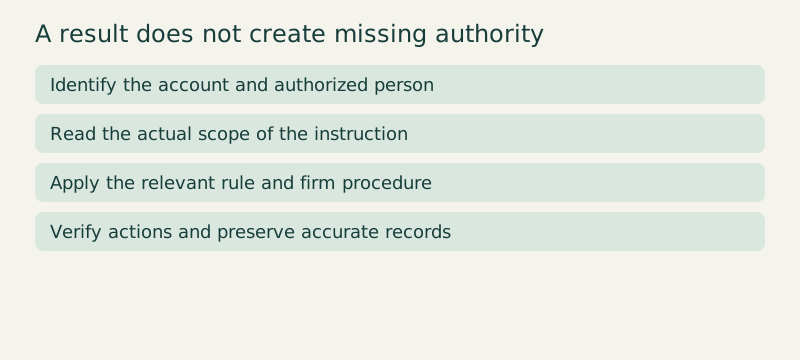
Turn the idea into practice.
Apply the rule to a new case, then explain your choice.
Practice this skillSources & authorship
Original educational guide based on captured official FINRA, SEC, FDIC, SIPC and FinCEN materials. This is neither a video transcript nor personalized investment advice.
Original educational guide with original cases, contrasts, and diagrams; not a transcript or official question reproduction.
Independent educator review is pending. This guide is not an official exam paper or a video transcript.
SEC Investor.gov: StocksSEC Investor.gov: BondsFINRA investor education: OptionsFINRA investor education: Mutual FundsSIPC: What SIPC ProtectsFDIC: Understanding Deposit Insurance