
A reliable method
Identify the integrand and both endpoints. Substitute the upper endpoint and multiply by its derivative; subtract the analogous lower-endpoint contribution.
Worked foundation example
F(x) is the integral of 2t²+4 from 0 to x. Find F′(3). The integrand is continuous, so the Fundamental Theorem applies. F′(x)=2x²+4. At x=3, the value is 22.
The common trap
An arbitrary constant lower endpoint changes the accumulated amount but not its derivative. A variable lower endpoint is different and contributes a minus sign.
Connect the representations
The theorem connects local rate to global accumulation. It often avoids finding an explicit antiderivative altogether.
Explain before checking
Write the defining equation, state its assumptions, and attach units before calculating. After checking the numerical answer, compare every step with the worked reasoning. These short tasks build selected foundations; a complete AP free-response solution also needs written justification, correct notation and attention to the rubric.
Compare constant and moving endpoints
For F(x)=∫₀ˣ(t+2)dt, F′(x)=x+2. For G(x)=∫₀^(x²)(t+2)dt, the endpoint itself changes at rate 2x, so G′(x)=(x²+2)2x. For H(x)=∫ₓ⁵(t+2)dt, increasing the lower endpoint removes area and H′(x)=−(x+2). These three similar-looking integrals require three distinct endpoint decisions.
Transfer and explain
Transfer: J(x)=∫ₓ^(2x)(t+2)dt has derivative 2(2x+2)−(x+2)=3x+2. State continuity and identify each endpoint contribution before combining them.
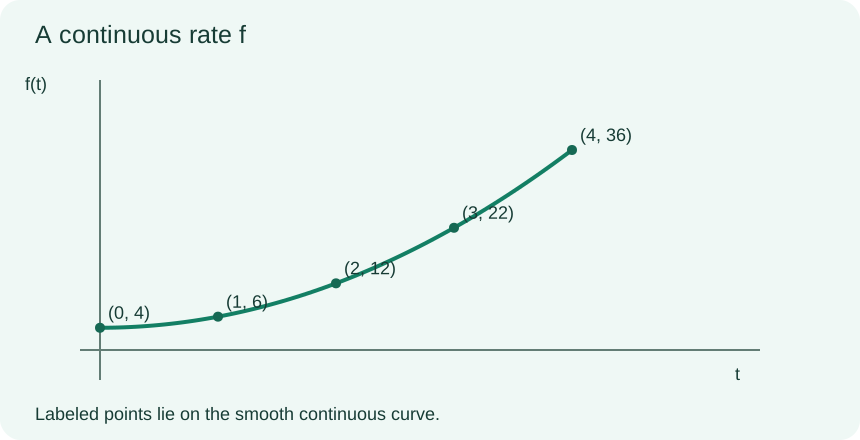
Let F(x) be the integral from 0 to x of the continuous function f shown in the graph. Find F′(3).
 Open full-size diagram ↗
- Continuity of f allows the fundamental theorem at the interior input 3.
- Read the labeled height f(3)=22.
- Therefore F′(3)=22.
Compare the other answer choices
Read f(0), the fixed starting input, instead of f(3).
Read the height at x=1 rather than the requested endpoint 3.
Read the height at x=2 rather than the requested endpoint 3.
Explain your thinking.
Optional written extension. Self-assessed only; it does not change your automatic practice result. These are teaching criteria, not official awarded marks.
(a) Find F′(3). (b) Explain why the theorem applies. (c) Is F increasing on (0,3)? (d) Does F(3) equal the graph height 22?
This draft stays on this page only. Use paper if you want to keep your working.
Try it, then explain it.
Complete a short set without looking at the example. After each answer, explain which operation preserved the relationship and why the result makes sense.
Sources & authorship
Original Slope explanations and examples. References support the concepts; they are not the source of copied questions. Independent educator review is pending.
AP Calculus AB courseCalculus Volume 1: Fundamental Theorem of Calculus