
An independent fictional comparison shows how unequal estimate scopes can reverse a tempting price conclusion. Then distinguish Calculator, Cost Management, Advisor and budget notifications without treating an estimate as an invoice or an alert as a hard cap.
Direct answer: compare like scopes before choosing a cheaper number
A lower displayed subtotal is not yet a lower complete scenario cost. Before comparing two estimates, identify the interval, resource quantities, rate assumptions and included components. The Azure pricing calculator models possible resource costs from scenario inputs; adding a configuration there does not deploy it or produce a final invoice. Microsoft Cost Management instead helps examine recorded cost/usage and related management information. Advisor recommendations and budget notifications answer additional questions. Keeping these evidence tasks distinct prevents a planning number from being used as proof of an operational or billing outcome.
This original guide follows a fictional exhibition collective comparing two demonstration-site plans. Every amount below is an invented teaching value, not an Azure rate, discount, offer or purchase recommendation. The collective wants a fair comparison, then later wants to investigate recorded spending. Its case is different from the lesson’s single toy subtotal and the formal practice calculations: the first challenge is mismatched component coverage, not multiplication alone.
Work an incomplete comparison
Plan A shows a fictional subtotal of $8 for the selected interval. Its worksheet includes processing and storage, but its data-transfer line has not been completed. Plan B shows $6 and includes processing and transfer, but its storage line has not been completed. The immediate claim “B is cheaper because six is less than eight” compares two differently bounded quantities. Neither subtotal is the same complete model. First list the missing component in each plan; do not invent a rate or silently treat a blank as zero.
Now the exercise supplies the missing hypothetical amounts for the same interval and workload: A needs an additional $2 transfer charge, and B needs an additional $5 storage charge. Normalized totals are A = $8 + $2 = $10 and B = $6 + $5 = $11. Under these deliberately complete teaching assumptions, the original comparison reverses. The result does not establish a real Azure bill or a universal winner; it demonstrates why scope normalization comes before interpreting the order of displayed subtotals. If the workload or terms change, the comparison must be revisited.
An estimate and an invoice have different jobs
An estimate should preserve its assumptions so that a reviewer can explain why it changes. Relevant inputs can include compute, storage, network and service configuration, as applicable. Real billing can involve additional timing, agreement and data-processing conditions that this toy comparison does not model. Do not describe the calculator as already-recorded consumption data, and do not turn its informational estimate into a promise that exactly that amount will be charged. The current official calculator unit explicitly treats it as an estimate and states that modeling resources does not provision them.
Later, the collective observes a rise in recorded spending and asks which usage contributed. That is a recorded-cost investigation. Inspect the appropriate Cost Management scope, period, filters and available usage/cost records; compare like intervals and components. Re-running an old planning estimate can help examine an assumption, but it is not a substitute for the recorded evidence needed to explain what was captured. A current total alone also does not show every causal mechanism. State which underlying records support the explanation and what remains unknown.
Allocation, recommendations and notifications remain separate
Tags can supply name-value metadata for grouping and attributing supported cost data across organizational boundaries. A tag named for a project does not itself grant that project’s staff resource permissions. Also, tagging at one scope does not justify assuming every resource automatically inherits the value or that all historical records now contain it. Check what metadata is actually available in the cost records being used. This is why the collective keeps its project-allocation explanation separate from its identity/access decisions.
Advisor can provide supported resource-based improvement recommendations. A recommendation is evidence of a suggestion to review, not proof that a change was made or that a particular saving has been achieved. A budget threshold can notify the team about actual or forecast cost conditions. The official budget guidance distinguishes those notifications from stopping resources or consumption. Separately configured actions may exist, but their supported behavior and actual outcome must be verified. An ordinary notification is therefore not a universal hard spending cap or a completed optimization.
Record the evidence at each stage
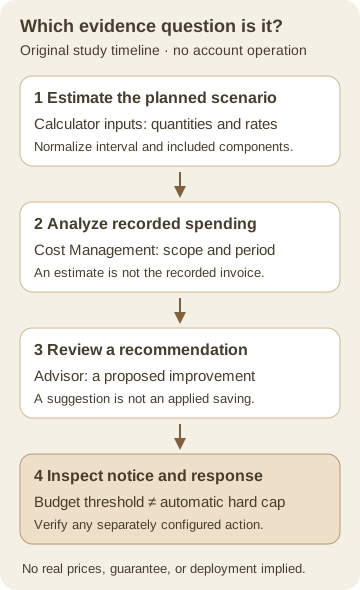
The original timeline asks four questions in sequence: what scenario was modeled, what cost/usage was recorded, what improvement was recommended, and what condition produced a notice or a separately configured response? It is an original teaching figure, not a copied Azure workflow or an account automation. Keeping the four records distinct lets a later reviewer trace a claim without treating every cost-related screen as the same source. It also identifies when a missing component or unavailable record should remain unknown.
Use the two application checks below to apply the distinction to new questions. Explain the required evidence rather than repeating the word cost. Then follow the related lesson for unit-aware toy arithmetic or the independent practice for different estimation and allocation cases. This guide does not operate a cloud account, quote current prices, recommend a personal spending commitment, predict a certification score or establish complete AZ-900 coverage. Qualified educator review and learner testing remain pending; formal publication remains on HOLD.
Apply the guide
A fictional team wants to explain why last month’s recorded data-transfer cost rose. It has an old pre-launch estimate. What evidence should it inspect before accepting a cause?Reveal explanation
Inspect applicable recorded cost/usage for the matched scope, period and transfer components, including relevant changes in quantities/conditions. The old estimate preserves assumptions but is not the actual recorded-spending evidence or a causal explanation by itself.
A fictional project receives an ordinary budget threshold email and declares that no more consumption can be charged. What distinction is missing?Reveal explanation
A threshold notification is not by itself a resource shutdown or universal spending cap. Consumption can continue; any separately configured response and its actual supported outcome must be checked rather than inferred from the email.
Turn the idea into practice.
Apply the rule to a new case, then explain your choice.
Practice this skillSources & authorship
Current Microsoft reference bodies ground tool and notification boundaries. All scope-comparison amounts, fictional cases, checks, prose and timeline are original; rates are not Azure quotes.
Original independent estimate-scope and evidence-timing guide, not copied lesson text or video companion.
Independent educator review is pending. This guide is not an official exam paper or a video transcript.
Tutorial: Create and manage budgetsExplore the pricing calculatorWhat is Microsoft Cost ManagementDescribe the purpose of tagsIntroduction to Azure Advisor