
An independently authored guide to applying selected EPA reference rules to original cases. It is not a transcript, official examination or field service instruction.
Start with the object, not the refrigerant brand
A useful service decision begins by naming the object and the activity. A factory-sealed household appliance, a stationary supermarket rack, a low-pressure chiller and a vehicle air conditioner do not become the same regulatory object merely because all contain refrigerant. Write a short description before choosing a certification label. For example, a household freezer charged with four pounds points toward small-appliance scope; a low-pressure centrifugal chiller points toward Type III. An automotive passenger-compartment air conditioner sends you to the separate Section 609 program. The category is doing the work in the argument.
Now change the activity while keeping the appliance. Recovering refrigerant solely to prepare a small appliance for disposal is not the same case as opening that appliance for repair and returning it to service. A disposal-specific certification exception cannot simply be moved to the repair case. Likewise, cleaning an outside cabinet does not become refrigerant-circuit service just because the worker stands near a refrigerator. The exact action determines which qualification question needs to be answered.
Separate a person credential from an equipment label
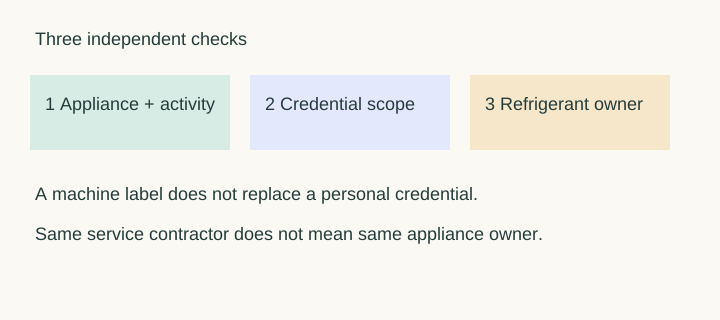
A certification card identifies a person and the equipment scope that person has earned. A recovery-machine label concerns the machine and the category for which its performance was certified. Neither is a substitute for the other. Imagine a contractor buys a properly certified recovery machine, then assigns a worker without the appropriate qualification to open a charged appliance. The equipment purchase does not fill the personal-qualification gap. In the reverse situation, a Universal technician still needs suitable equipment and must follow its directions.
A course attendance certificate is another distinct record. It may show that instruction occurred, but it does not alone establish a qualifying result from an EPA-approved certifying organization. For Universal, the Core condition includes proctoring: an open-book Core does not count toward that combined credential. When comparing training offers, ask what examination is actually administered and what credential follows, rather than comparing only course duration or advertising promises.
Follow ownership through the refrigerant journey
Consider two customers with similar chillers. Refrigerant recovered from one appliance is stored, cleaned and then proposed for use in the other customer's appliance. Similar equipment and a shared service contractor do not make the customers a single owner. The ownership-transfer rule therefore matters. Field recycling does not by itself establish the reclaimed purity and certified-reclaimer pathway required before transferring used refrigerant for reuse to another owner.
Change only one material fact: both receiving and donating appliances now belong to the same customer. The mandatory reclamation question tied to an ownership transfer changes, even though the equipment looks the same. That does not prove that any contaminated batch is suitable for every machine. Equipment suitability and other requirements remain separate. The learning purpose is to isolate the exact reason a rule applies, then avoid expanding that reason into an unlimited permission.
Keep recovery, recycling and reclamation distinct
Recovery describes removal and external storage. It tells you that refrigerant left the appliance, not that a purity standard was achieved. Recycling reduces contaminants for reuse; reclamation involves processing to the required purity standard under the certified-reclaimer framework. A cylinder marked recovered therefore answers only one stage of the story. It cannot, by its label alone, prove that a batch is eligible for transfer to another owner for reuse.
Use an evidence chain when studying a scenario. First ask where the material came from, then what processing actually occurred, then where it is going and who owns each appliance. A question that asks about a transfer should not be answered using only a pressure reading or a visual impression that the fluid looks clean. These observations are different types of evidence, and none replaces the ownership and processing facts.
Use records to preserve the decision
Good records make a decision explainable later. Certification evidence is kept at the business under the stated retention rule. A customer may request proof during a visit even though EPA does not generally require carrying the physical card at every service call. Those two statements can both be true. In a disposal chain, the final processor needs evidence that refrigerant was recovered before disposal; a sticker alone is not the specified verification.
When practicing, make a three-column note: the fact that controls, the rule that uses that fact and the record that could substantiate it. For a prior-recovery statement, identify the recovery person's name and address and the recovery date. For a regular commercial supplier, examine whether the qualifying contract pathway fits. For an occasional individual drop-off, do not assume the regular-supplier shortcut. This approach teaches a transferable habit: match evidence to the exact claim being made, then state the limits of that evidence.
Turn the idea into practice.
Apply the rule to a new case, then explain your choice.
Practice this skillSources & authorship
Original explanations and cases informed by the linked EPA references. No third-party examination questions, video metadata or transcript are represented as authored source evidence.
Independently written teaching guide and original diagrams.
Independent educator review is pending. This guide is not an official exam paper or a video transcript.
Epa CertificationEpa QaEpa DisposalEpa Reclaim