
The source distinguishes boundary, coverage and capacity, omits a cylinder base from painted area, and adds component volumes.
Choose the measured object first
A tank can raise several different questions. How far is it around its rim? How much material covers its surface? How much liquid fits inside? These questions concern length, area and volume respectively, even when the same dimensions appear in all three. The linked video was discovered in the OpenExamPrep archive and is labeled Navy OAR. Its foundational geometry is useful for this GED companion, but it is not evidence about GED rules or test policies. The complete retained caption track was read. All quantities and drawings below are our own teaching examples, rather than copied examination questions.
List which surfaces are exposed
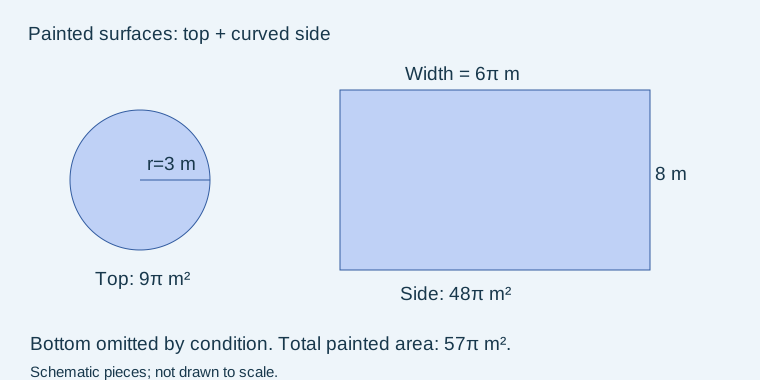
Imagine a cylindrical container of radius three meters and height eight meters. Its bottom rests on a platform and is not painted; its side and circular top are painted. The exposed top has area π × 3² = 9π square meters. Unrolling the curved side makes a rectangle whose width is the circumference, 2π × 3 = 6π, and whose height is eight. Its area is therefore 48π. Together the painted area is 57π square meters. The diagram separates those pieces and marks the omitted bottom so that the condition is visible.
Explain the tempting alternative
The closed-cylinder formula would give 2πr² + 2πrh = 18π + 48π = 66π square meters for these dimensions. That arithmetic is correct for a different surface inventory, but it includes the unpainted bottom. The difference, 9π, is exactly one circular base. Do not replace the geometry decision with a vague instruction to subtract something whenever a container touches the floor. Identify the particular omitted face and compute its area. A container with neither top nor painted bottom would require only the curved side, while painting every surface would require both circular ends.
Capacity uses the same dimensions differently
The volume of the same ideal cylinder is base area multiplied by height: 9π × 8 = 72π cubic meters. A cubic meter measures occupied space, whereas a square meter measures coverage. The numerical answers 57π and 72π cannot be compared as if they were two estimates of one quantity, because their dimensions differ. If the stated radius describes the outside of a thick-walled container, its internal capacity would require internal measurements or a wall-thickness model. Our practice example explicitly treats the given dimensions as the dimensions of the region whose volume is being measured.
Decompose a solid with a roof
Now consider a rectangular body measuring twelve meters long, six meters wide and four meters high. Above it is a triangular-prism roof with triangular cross-section base six meters and perpendicular height two meters, extending the full twelve-meter length. The body volume is 12 × 6 × 4 = 288 cubic meters. The triangular cross-section area is one half of 6 × 2, or six square meters. Multiplying that by twelve gives a roof volume of seventy-two cubic meters. The combined enclosed volume is therefore 360 cubic meters, provided the parts occupy nonoverlapping regions.
Do not add surfaces as if they were volumes
Volumes of the two nonoverlapping pieces add because every small unit of space belongs to one piece. Their full surface areas would not add to the exposed surface of the joined building: the rectangular interface is internal after assembly. If you began with the complete separate surface areas, you would remove the interface twice, once from each piece. This extension goes beyond the linked video’s volume example and is included to clarify the boundary of the add-the-parts strategy. A shared face has area but no three-dimensional thickness, so it contributes no overlapping volume in the ideal model.
Reverse a formula with a purpose
Suppose a cylinder holds 45π cubic meters and has radius three meters. The missing height satisfies 45π = π × 3² × h. Divide by 9π to obtain h = five meters. Dividing volume by circumference would leave an area-like unit and would not isolate height in the volume formula. Dimensional checks can therefore reveal an incorrect denominator before detailed calculation. They do not by themselves prove that a formula matches every shape: both πr²h and a wrong constant times that expression have volume units, so the geometric model still matters.
A final comparison to practice
A cone with the same base and height as that last cylinder occupies one third of its volume, or 15π cubic meters. That statement requires the shared base and height; comparing unrelated cones and cylinders gives no fixed ratio. For a written solution, begin by naming the quantity, list the dimensions and exposed parts, substitute into the appropriate formula, then state the unit. Finally refute one plausible alternative by describing the object it actually measures. This sequence turns a formula exercise into a modeling decision and makes a solution easier to inspect without relying only on an answer key.
PAUSE & TRYA cylinder has radius 2 m and height 5 m. Only its curved side is painted. What area is painted?Reveal explanation
20π m², using 2πrh. Neither circular base is included.
Turn the idea into practice.
A fresh set will help you use the relationship with different numbers.
Practice this skillEvidence & editorial note
New public English caption acquisition; complete retained track read. Original examples and figures; no source questions or media republished. Archive-discovered Navy OAR source used only for transferable geometry, not GED policy.
Original instructional companion with explicit source boundaries.
Caption track SHA-256: b9a0442bee3a9164cc5e1df6f4ac7d86333daa3759215169fec399ae6d236d6f
Source segment references are retained in the catalog. Full captions remain in the local research archive.