
A reliable method
Split a composite region into familiar pieces, write a formula for each piece, and combine their areas. Track squared and cubed units throughout the calculation.
The common trap
A sketch that looks like a right triangle is not sufficient evidence for the Pythagorean theorem. Use it only when a right angle is specified.
Check and transfer
Estimate using an enclosing rectangle or box. A cut-out region cannot have a larger area than the original region, and a length should not carry square units.
Worked comparison: why the alternative fails
A 10 by 8 sheet with a 3 by 2 corner removed has area 80−6=74. Computing (10−3)(8−2)=42 would remove whole strips, not one corner. A sketch makes the difference in the regions visible.
Transfer and explain
A right triangle with legs 6 and 8 has hypotenuse sqrt(36+64)=10. Adding the lengths gives 14, which measures a bent route along the sides instead.
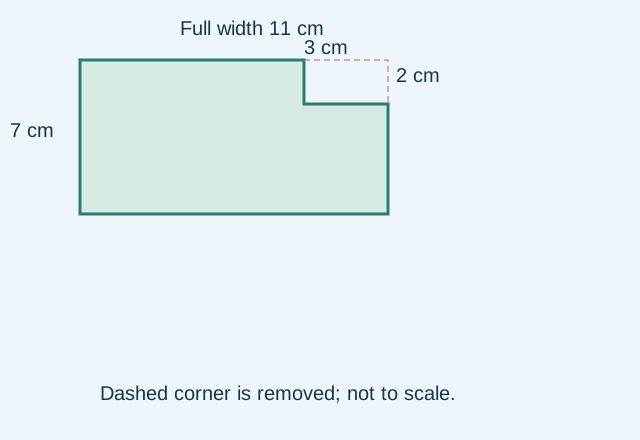
The full sheet is 11 cm wide. Using the other dimensions in the diagram, what area remains after the dashed corner is removed, in square centimeters?
 Open full-size diagram ↗
- Calculate the area of the full rectangular sheet.
- Subtract the cut-out rectangle rather than subtracting one side length.
- The requested value is 71. Check its units and meaning against the original question.
Compare the other answer choices
Report the removed area instead of the remaining area.
Subtract cut-out side lengths from both full-sheet dimensions as if a full strip were removed.
Add the cut-out area instead of subtracting it.
Explain your thinking.
Optional written extension. Self-assessed only; it does not change your automatic practice result. These are teaching criteria, not official awarded marks.
Explain your model, identify a tempting alternative and show why it fails. This extension is self-assessed and does not affect automatic scoring.
This draft stays on this page only. Use paper if you want to keep your working.
Try it, then explain it.
Complete a short set without looking at the example. After each answer, explain which operation preserved the relationship and why the result makes sense.
Sources & authorship
Original Slope explanations and examples. References support the concepts; they are not the source of copied questions. Independent educator review is pending.
GED Mathematical Reasoning overviewSiyavula Grade 10 mathematics foundation reference