Free access · No sign-up · No personal progress recorded on this page · Coverage & review notes
TRY A QUESTION. FOLLOW THE REASONING.
Sample questions with answers
Work out your answer first, then compare the explanation. This stable selection uses distinct task families across the available learning domains.
QUESTION 01Life Science
Plan a fair experiment
A lab wants to know whether a starch coating reduces browning of fresh pear slices after 20 minutes. All slices came from the same batch.
The lab brushes one set with a water-and-starch mixture and scores browning after 20 minutes. Which comparison best isolates the starch?
Leave slices dry and score them after 10 minutes.
Brush slices with the same volume of water alone and score them after 20 minutes.
Brush slices with more of the starch mixture and score them after 20 minutes.
Brush a different fruit with water and score it after 20 minutes.
Answer: Brush slices with the same volume of water alone and score them after 20 minutes.
The treatment ingredient is starch.
The comparison needs the same handling, water exposure and scoring time while omitting starch.
Compare the other answer choices
Leave slices dry and score them after 10 minutes.
Both the exposure time and the liquid treatment would differ.
Brush slices with more of the starch mixture and score them after 20 minutes.
This tests two amounts of starch without a starch-free comparison.
Brush a different fruit with water and score it after 20 minutes.
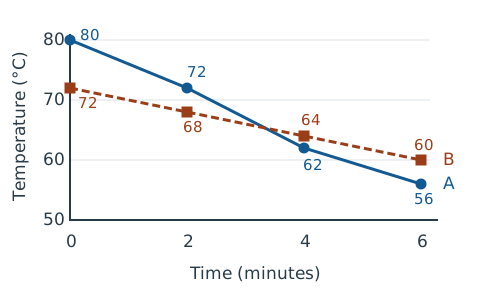
The graph shows two liquids cooling on the same bench.
From minute 2 to minute 6, how much greater was the temperature drop for liquid A than for liquid B?
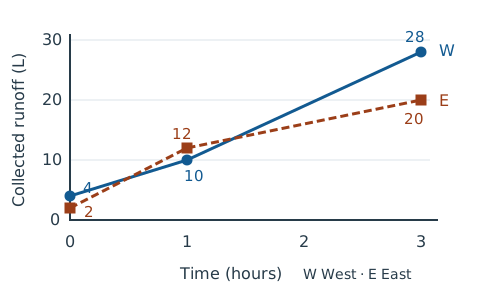
The graph tracks cumulative runoff collected from two parking lots. Compare hours 1 through 3.
How much larger was the average collection rate at the west lot than at the east lot in this interval?
A mushroom grower tries a new substrate. New-substrate trays sit by an air vent, while standard-substrate trays sit on a sheltered shelf. The new-substrate trays dry out faster. What change best tests whether substrate itself affects drying?
Put twice as many new-substrate trays by the vent.
Measure humidity only on the sheltered shelf.
Place matched trays of both substrates at each location and compare within each location.
Put the standard substrate by the vent and the new substrate on the shelf for a single comparison.
Answer: Place matched trays of both substrates at each location and compare within each location.
Airflow can affect drying and differs with substrate in the original setup.
Within each location, matched trays let the grower change substrate while holding the location fixed.
Compare the other answer choices
Put twice as many new-substrate trays by the vent.
More trays repeat the same coupling of substrate and location.
Measure humidity only on the sheltered shelf.
That measurement does not separate the two differences.
Put the standard substrate by the vent and the new substrate on the shelf for a single comparison.
Switching one unequal comparison preserves the location difference.
Two small model slopes receive the same rainfall, have equal area and incline, and begin dry. One is covered by a nonporous sheet and the other by loose soil. No edge losses occur. Which first observation supports more infiltration on the soil slope?
More water reaches the outlet from the loose soil slope.
Both slopes receive the same volume of rain.
Sensors below the soil surface become wetter while less water reaches its outlet.
Both outlets collect equal amounts and no subsurface reading is taken.
Answer: Sensors below the soil surface become wetter while less water reaches its outlet.
Infiltration means water enters the ground.
A subsurface moisture increase supplies evidence of that path, and the smaller outlet volume supports the comparison under the stated controls.
Compare the other answer choices
More water reaches the outlet from the loose soil slope.
More outlet flow alone would not show more water entering the soil.
Both slopes receive the same volume of rain.
Matched input supports the comparison but cannot show where water went.
Both outlets collect equal amounts and no subsurface reading is taken.
The results leave the proposed difference in infiltration unresolved.
A survey records 14 pollinator visits per hour at flower beds beside one community garden, compared with 8 at nearby paved sites with pots. Counts were taken on four sunny mornings. Which summary stays within the evidence?
All pollinators visit planted beds more often in every season.
Replacing pavement caused exactly six additional visits each hour.
During the sampled mornings, observers counted more visits per hour at the garden beds.
The paved sites contain exactly eight individual pollinators.
Answer: During the sampled mornings, observers counted more visits per hour at the garden beds.
Identify the outcome as observed visits per hour and limit the claim to the sampled locations and mornings.
The observed difference supports a local comparison but leaves possible site and weather effects.
Compare the other answer choices
All pollinators visit planted beds more often in every season.
One site and four sunny mornings do not represent every species or season.
Replacing pavement caused exactly six additional visits each hour.
The observational comparison did not assign surfaces or hold other site differences fixed.
The paved sites contain exactly eight individual pollinators.
A visit count does not distinguish individuals, and eight is a rate.
A cart starts at position 2 m on a straight track, travels to 8 m, then returns to position 5 m. What are the cart’s total distance and displacement, respectively?
3 m and +9 m
6 m and +3 m
9 m and +3 m
9 m and −3 m
Answer: 9 m and +3 m
Distance adds the magnitudes of the two legs: 6 + 3 = 9 m.
Displacement is final minus initial position: 5 − 2 = +3 m.
Compare the other answer choices
3 m and +9 m
This assigns net change to distance and path length to displacement.
6 m and +3 m
Six meters accounts only for the outward part of the path.
9 m and −3 m
The final leg is toward smaller positions, but the finish is 3 m above the start.
Observers at similar latitudes north and south of the equator record opposite changes in daylight over the same months. One region gains daylight while the other loses it. Which model best accounts for this pattern?
Both regions become closer to the Sun by the same amount, making both days longer.
The Sun emits more energy on one side of Earth during each year.
Earth stops rotating at different times in each hemisphere.
Earth’s tilted axis makes one hemisphere lean more toward the Sun as the other leans away.
Answer: Earth’s tilted axis makes one hemisphere lean more toward the Sun as the other leans away.
Both hemispheres share the same orbital change in Earth–Sun distance.
Axial tilt changes how long each hemisphere faces the Sun during a rotation, with opposite effects north and south.
Compare the other answer choices
Both regions become closer to the Sun by the same amount, making both days longer.
The two regions show changes in opposite directions.
The Sun emits more energy on one side of Earth during each year.
The observation concerns daylight duration and does not require an output difference.
Earth stops rotating at different times in each hemisphere.
Earth rotates as a planet. The pattern does not require a change in rotation.
In one simplified marsh web, algae feed snails, and ducks eat those snails. Ducks decrease. Assuming all other influences on this pathway initially stay similar, what is one plausible indirect effect on algae?
More snails may survive and graze more algae.
Algae immediately lose energy because ducks no longer supply it.
Fewer ducks make surviving snails stop eating algae.
Fewer snails survive because they have fewer ducks to eat.
Answer: More snails may survive and graze more algae.
Follow the links backward from the reduced predator to reduced snail predation.
If snail survival rises, added grazing can lower algae. The prediction depends on the stated simplified conditions.
Compare the other answer choices
Algae immediately lose energy because ducks no longer supply it.
Ducks are consumers. They do not supply the algae with food in this pathway.
Fewer ducks make surviving snails stop eating algae.
Nothing in the pathway changes the food of an individual snail in that way.
Fewer snails survive because they have fewer ducks to eat.
Original foundation practice for selected skills across three science domains.
Read evidence, compare experiments, and work with graphs across life, physical, and Earth and space science.
Each question uses four choices and gives feedback on the reasoning behind them.
10 public examples48 question variants in the studio48 task families
Review status: Independent educator review and learner calibration are pending. Use these selected foundation examples alongside the coverage map and current official references.
Start with the lesson linked to an unfamiliar topic, try a focused set in the practice studio, then return to the review cards. Your practice progress stays in this browser.
Catalog scope record: . This records the saved content mapping, not a guarantee that every external rule is current.
Original foundation practice for selected skills across three science domains.
Four-option questions with feedback. Use official materials for the full range of item formats and pacing.
Practice percentages describe this question set. The material is pending educator review.
Check the exam provider's current information for registration, test rules and official preparation materials. The exam guide collects the relevant official references.