
Room for pencil and paper.
Print a worksheet, or choose “Save as PDF” in your browser’s print dialog.
Mixed skills
10 original practice questions · Untimed · Follow each question’s response instructions
1. Two bar charts display the same air-temperature measurements, 21°C and 23°C. Chart A starts the vertical axis at 0°C; chart B starts it at 20°C. Which statement correctly compares the displays?
gs-092. A dry steel wool sample sits on a scale pan in air. It changes color and gains mass. Nothing falls onto or leaves the pan, and the sample stays dry. Assume the air is the only possible source of new material. Which model explains the gain?
gs-393. Two small model slopes receive the same rainfall, have equal area and incline, and begin dry. One is covered by a nonporous sheet and the other by loose soil. No edge losses occur. Which first observation supports more infiltration on the soil slope?
gs-434. A reaction in an open beaker yields gas. The beaker and contents have a mass of 148 g before mixing and 143 g afterward. Assume nothing spills, no matter enters, and the only matter leaving is gas. How much gas left the weighed system?
gs-385. At a pond, workers record more tadpoles on days with warmer water. They also collect samples later in the afternoon on those days. Which conclusion is supported?
gs-056. A survey records 14 pollinator visits per hour at flower beds beside one community garden, compared with 8 at nearby paved sites with pots. Counts were taken on four sunny mornings. Which summary stays within the evidence?
gs-137. A stream gauge rises 6 centimeters in 30 minutes during one storm and 10 centimeters in 1 hour during another. Which comparison uses average rise per hour?
gs-118. In a simplified temperature-control model, a detector sends a signal when temperature falls. The signal normally activates heat production. The detector and signal work, but the heat-producing tissue cannot respond. Which result is consistent with the failure?
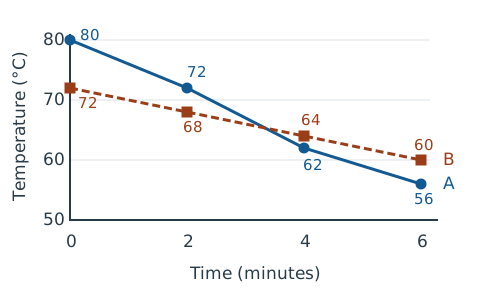
gs-239. The graph shows two liquids cooling on the same bench. From minute 2 to minute 6, how much greater was the temperature drop for liquid A than for liquid B?
 Open full-size diagram ↗
10. Two model lifts each deliver 120 J of useful work. Lift A takes 4 seconds; lift B takes 6 seconds. Average useful power is work divided by time. Which comparison is correct?
gs-35Answers & reasoning
1. Both show a 2°C difference. Relative to the baseline, the warmer bar is three times as tall in chart B and only slightly taller in chart A. · Choice A
Subtract the two data values regardless of the drawing baseline. In A the bar lengths in scale units are 21 and 23. In B they are 1 and 3 above the 20°C baseline. The relative heights differ, while the labeled temperatures are unchanged.
gs-092. Oxygen from outside the initial sample becomes part of the solid product. · Choice C
The initial weighed system excludes surrounding air. Oxygen atoms enter the measured solid. The larger system including air can conserve mass while the wool gains mass.
gs-393. Sensors below the soil surface become wetter while less water reaches its outlet. · Choice C
Infiltration means water enters the ground. A subsurface moisture increase supplies evidence of that path, and the smaller outlet volume supports the comparison under the stated controls.
gs-434. 5 g · Choice D
Subtract the mass remaining from the initial mass: 148 − 143 = 5 g. Because only gas left, this difference is the mass of escaped gas.
gs-385. In these samples, higher tadpole counts occurred with warmer water; collection time could also matter. · Choice A
The researchers observed an association and changed neither factor by a controlled assignment. Time and water temperature vary together, so the result alone cannot separate them.
gs-056. During the sampled mornings, observers counted more visits per hour at the garden beds. · Choice C
Identify the outcome as observed visits per hour and limit the claim to the sampled locations and mornings. The observed difference supports a local comparison but leaves possible site and weather effects.
gs-137. The first storm averages 12 cm per hour, which is 2 cm per hour faster. · Choice D
Thirty minutes is half an hour, so 6 ÷ 0.5 = 12 cm per hour. The second storm averages 10 cm per hour.
gs-118. The signal can remain active while temperature stays below the usual range. · Choice A
Separate detection from the tissue response. If the signal works but heat production does not increase, the normal corrective pathway can fail.
gs-239. 8°C · Choice D
A fell from 72°C to 56°C, a drop of 16°C. B fell from 68°C to 60°C, a drop of 8°C. The difference between drops is 8°C.
gs-0710. Lift A produces 10 W more average useful power. · Choice C
A gives 120 ÷ 4 = 30 W. B gives 120 ÷ 6 = 20 W. A delivers 10 W more useful power on average. This calculation alone says nothing about energy efficiency.
gs-35Original selected foundation practice. Educator review is pending. Not an official exam paper.